Department of Infection Control and Infectious Diseases, RWTH Aachen University Hospital, Aachen, Germany.
BMC Infect Dis. 2013 Aug 7;13:367. doi: 10.1186/1471-2334-13-367.
The emergency department (ED) represents an environment with a high density of invasive, and thus, infection-prone procedures. The two primary goals of this study were (1) to define the number of hand-rubs needed for an individual patient care at the ED and (2) to optimize hand hygiene (HH) compliance without increasing workload.
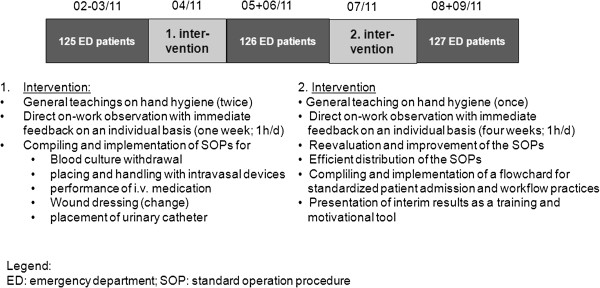
Prospective tri-phase (6-week observation phases interrupted by two 6-week interventions) before after study to determine opportunities for and compliance with HH (WHO definition). Standard operating procedures (SOPs) were optimized for invasive procedures during two predefined intervention periods (phases I and II) to improve workflow practices and thus compliance with HH.
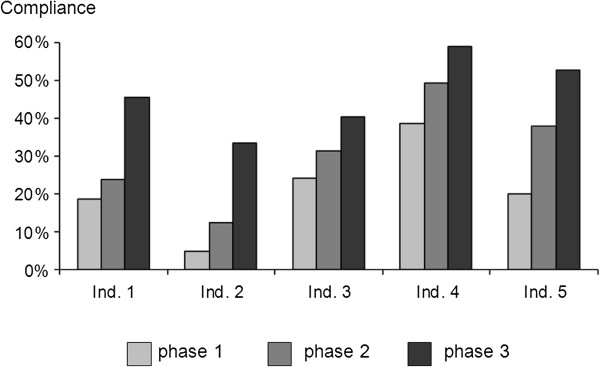
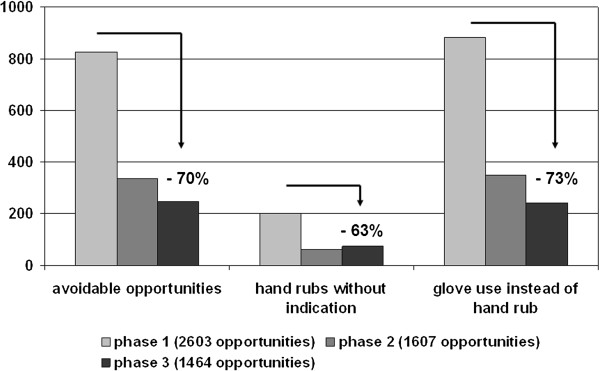
378 patient cases were evaluated with 5674 opportunities for hand rubs (HR) and 1664 HR performed. Compliance significantly increased from 21% (545/2603) to 29% (467/1607), and finally 45% (652/1464; all p<0.001) in phases 1, 2, and 3, respectively. The number of HR needed for one patient care significantly decreased from 22 to 13 for the non-surgical and from 13 to 7 for the surgical patients (both p<0.001) due to improved workflow practices after implementing SOPs. In parallel, the number of HR performed increased from 3 to 5 for non-surgical (p<0.001) and from 2 to 3 for surgical patients (p=0.317). Avoidable opportunities as well as glove usage instead of HR significantly decreased by 70% and 73%, respectively.
Our study provides the first detailed data on HH in an ED setting. Importantly, HH compliance improved significantly without increasing workload.
急诊科(ED)是一个具有高侵入性和易感染性的环境。本研究的两个主要目标是:(1)确定每位患者在 ED 接受护理时所需的手卫生(HH)次数;(2)在不增加工作量的情况下优化 HH 依从性。
采用前瞻性三阶段(为期 6 周的观察阶段,其间穿插两个为期 6 周的干预阶段)研究方案,以确定 HH 的机会和依从性(根据世界卫生组织的定义)。在两个预先定义的干预阶段(阶段 I 和 II)优化了侵入性操作的标准操作流程(SOPs),以改善工作流程实践,从而提高 HH 的依从性。
共评估了 378 例患者,共有 5674 次手卫生机会,实施了 1664 次手卫生。在第 1、2 和 3 阶段,手卫生依从性分别从 21%(545/2603)显著增加至 29%(467/1607)和 45%(652/1464)(均 p<0.001)。由于实施 SOP 后工作流程得到改善,每位患者接受护理所需的手卫生次数从非手术患者的 22 次显著减少至 13 次,从手术患者的 13 次减少至 7 次(均 p<0.001)。同时,非手术患者的手卫生次数从 3 次增加至 5 次(p<0.001),手术患者从 2 次增加至 3 次(p=0.317)。避免性机会和改用手套代替手卫生的情况分别显著减少了 70%和 73%。
本研究首次提供了急诊科环境下 HH 的详细数据。重要的是,在不增加工作量的情况下,HH 依从性显著提高。