Department of Emergency Medicine, University of North Carolina.
J Am Heart Assoc. 2013 Aug 6;2(4):e000289. doi: 10.1161/JAHA.113.000289.
Prehospital 12-lead electrocardiography (ECG) is critical to timely STEMI care although its use remains inconsistent. Previous studies to identify reasons for failure to obtain a prehospital ECG have generally only focused on individual emergency medical service (EMS) systems in urban areas. Our study objective was to identify patient, geographic, and EMS agency-related factors associated with failure to perform a prehospital ECG across a statewide geography.
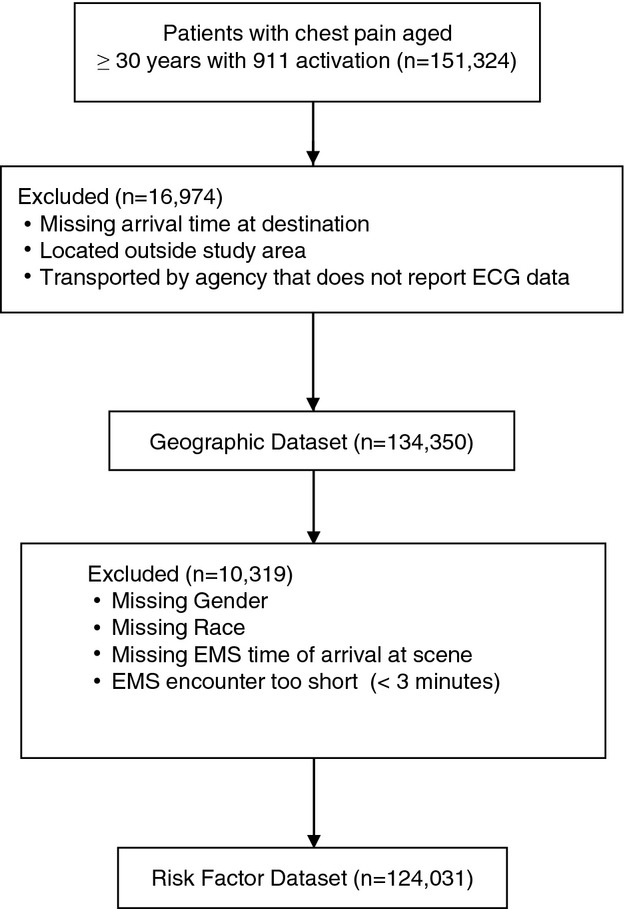
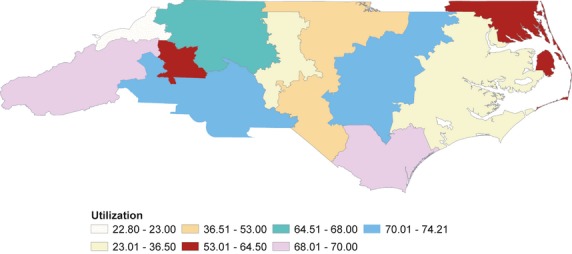
We analyzed data from the Prehospital Medical Information System (PreMIS) in North Carolina from January 2008 to November 2010 for patients >30 years of age who used EMS and had a prehospital chief complaint of chest pain. Among 3.1 million EMS encounters, 134 350 patients met study criteria. From 2008-2010, 82 311 (61%) persons with chest pain received a prehospital ECG; utilization increased from 55% in 2008 to 65% in 2010 (trend P<0.001). Utilization by health referral region ranged from 22.9% to 74.2% and was lowest in rural areas. Men were more likely than women to have an ECG performed (63.0% vs 61.3%, adjusted RR 1.02, 95% CI 1.01 to 1.04). The certification-level of the EMS provider (paramedic vsbasic/intermediate) and system-level ECG equipment availability were the strongest predictors of ECG utilization. Persons in an ambulance with a certified paramedic were significantly more likely to receive a prehospital ECG than nonparamedics (RR 2.15, 95% CI 1.55, 2.99).
Across a large geographic area prehospital ECG use increased significantly, although important quality improvement opportunities remain. Increasing ECG availability and improving EMS certification and training levels are needed to improve overall care and reduce rural-urban treatment differences.
虽然院前 12 导联心电图(ECG)对及时进行 STEMI 治疗至关重要,但实际上其使用仍不一致。以前的研究旨在确定未能获取院前 ECG 的原因,这些研究通常仅集中在城市地区的个别紧急医疗服务(EMS)系统上。我们的研究目的是确定与未能进行院前 ECG 相关的患者、地理位置和 EMS 机构相关因素,这些因素跨越全州地理范围。
我们分析了北卡罗来纳州院前医疗信息系统(PreMIS)的数据,时间范围为 2008 年 1 月至 2010 年 11 月,研究对象为使用 EMS 并在院前有胸痛主诉的年龄大于 30 岁的患者。在 310 万次 EMS 就诊中,有 134350 名患者符合研究标准。2008 年至 2010 年,82311 名胸痛患者(61%)接受了院前 ECG;利用率从 2008 年的 55%增加到 2010 年的 65%(趋势 P<0.001)。按卫生转诊区域划分,使用率从 22.9%到 74.2%不等,农村地区最低。男性比女性更有可能进行心电图检查(63.0%比 61.3%,调整后的 RR 1.02,95%CI 1.01 至 1.04)。EMS 提供者的认证级别(护理人员与基础/中级)和系统级 ECG 设备的可用性是 ECG 利用率的最强预测因素。与非护理人员相比,在配备认证护理人员的救护车中的患者接受院前 ECG 的可能性显著更高(RR 2.15,95%CI 1.55,2.99)。
在一个较大的地理区域内,院前 ECG 的使用率显著增加,但仍存在重要的质量改进机会。需要增加 ECG 的可用性,并提高 EMS 的认证和培训水平,以改善整体护理水平,并缩小城乡之间的治疗差异。