University of Groningen, Department of Pulmonary Diseases, University Medical Center Groningen, Groningen, The Netherlands.
PLoS One. 2013 Jul 29;8(7):e70346. doi: 10.1371/journal.pone.0070346. Print 2013.
In randomly assigned studies with EGFR TKI only a minor proportion of patients with NSCLC have genetically profiled biopsies. Guidelines provide evidence to perform EGFR and KRAS mutation analysis in non-squamous NSCLC. We explored tumor biopsy quality offered for mutation testing, different mutations distribution, and outcome with EGFR TKI.
Clinical data from 8 regional hospitals were studied for patient and tumor characteristics, treatment and overall survival. Biopsies sent to the central laboratory were evaluated for DNA quality and subsequently analyzed for mutations in exons 18-21 of EGFR and exon 2 of KRAS by bidirectional sequence analysis.
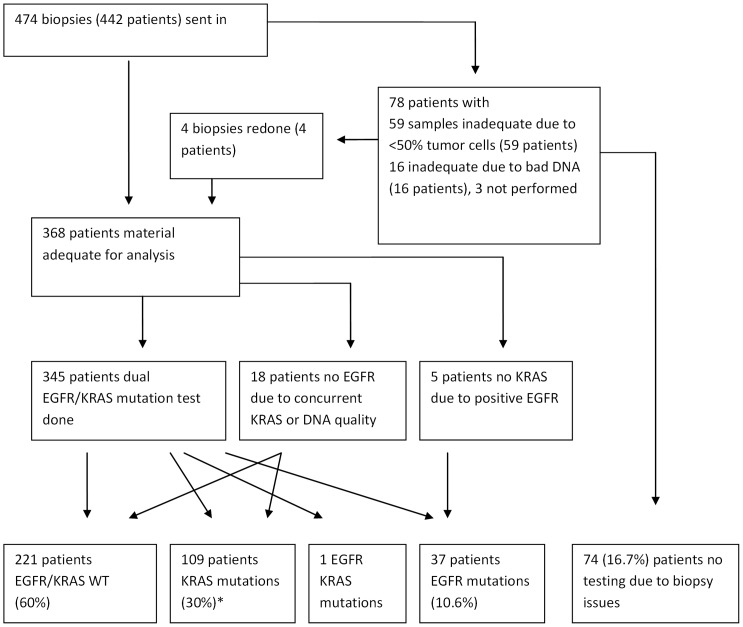
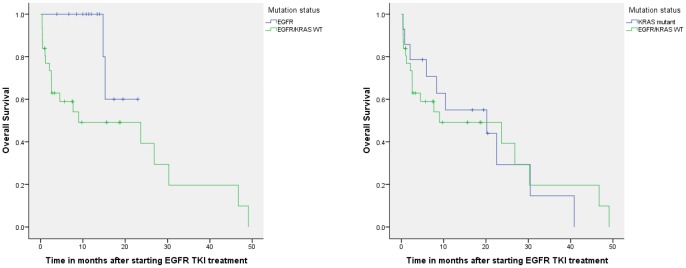
Tumors from 442 subsequent patients were analyzed. For 74 patients (17%) tumors were unsuitable for mutation analysis. Thirty-eight patients (10.9%) had EGFR mutations with 79% known activating mutations. One hundred eight patients (30%) had functional KRAS mutations. The mutation spectrum was comparable to the Cosmic database. Following treatment in the first or second line with EGFR TKI median overall survival for patients with EGFR (n = 14), KRAS (n = 14) mutations and wild type EGFR/KRAS (n = 31) was not reached, 20 and 9 months, respectively.
One out of every 6 tumor samples was inadequate for mutation analysis. Patients with EGFR activating mutations treated with EGFR-TKI have the longest survival.
在仅接受 EGFR TKI 治疗的随机研究中,只有少数 NSCLC 患者进行了基因分析活检。指南建议对非鳞状 NSCLC 进行 EGFR 和 KRAS 突变分析。我们探讨了用于突变检测的肿瘤活检质量、不同突变分布以及 EGFR TKI 的治疗效果。
研究了 8 家地区医院的临床数据,包括患者和肿瘤特征、治疗和总生存情况。将送往中心实验室的活检标本进行 DNA 质量评估,然后通过双向序列分析检测 EGFR 外显子 18-21 和 KRAS 外显子 2 的突变。
分析了 442 例后续患者的肿瘤。74 例(17%)肿瘤不适合进行突变分析。38 例(10.9%)患者存在 EGFR 突变,其中 79%为已知的激活突变。108 例(30%)患者存在功能性 KRAS 突变。突变谱与 Cosmic 数据库相似。在一线或二线接受 EGFR TKI 治疗后,EGFR 突变(n=14)、KRAS 突变(n=14)和野生型 EGFR/KRAS(n=31)患者的中位总生存期分别为未达到、20 个月和 9 个月。
每 6 个肿瘤样本中就有 1 个不适合进行突变分析。接受 EGFR-TKI 治疗的 EGFR 激活突变患者的生存时间最长。