Department of Nutrition and Dietetics, Internal Medicine, VU University Medical Center, PO Box 7057, 1007 MB Amsterdam, The Netherlands.
Br J Cancer. 2013 Sep 3;109(5):1093-9. doi: 10.1038/bjc.2013.458. Epub 2013 Aug 8.
Pre-treatment weight loss (WL) is a prognostic indicator for overall survival (OS) in head and neck cancer (HNC) patients. This study investigates the association between WL before or during radiotherapy and disease-specific survival (DSS) in HNC patients.
In 1340 newly diagnosed HNC patients, weight change was collected before and during (adjuvant) radiotherapy with curative intent. Critical WL during radiotherapy was defined as >5% WL during radiotherapy or >7.5% WL until week 12. Differences in 5-year OS and DSS between WL groups were analysed by Cox's regression with adjustments for important socio-demographic and tumour-related confounders.
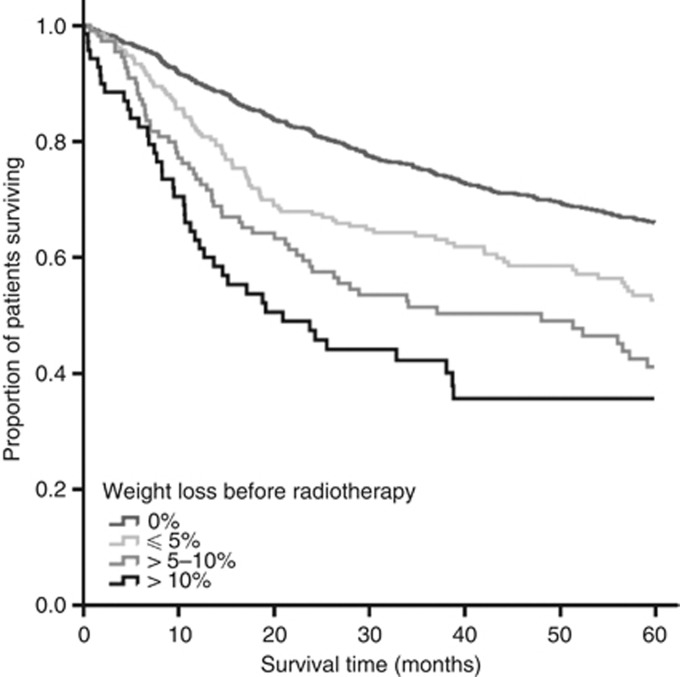
Before radiotherapy, 70% of patients had no WL, 16% had ≤5% WL, 9% had >5-10% WL, and 5% had >10% WL. Five-year OS and DSS rates for these groups were 71%, 59%, 47%, and 42% (P<0.001), and 86%, 86%, 81%, and 71%, respectively (P<0.001). After adjustment for potential confounders, >10% WL before radiotherapy remained significantly associated with a worse OS (HR 1.7; 95% CI 1.2-2.5; P=0.002) and DSS (HR 2.1; 95% CI 1.2-3.5; P=0.007).The 5-year OS and DSS rates for patients with critical WL during radiotherapy were 62% and 82%, compared with 70% and 89% for patients without critical WL (P=0.01; P=0.001). After adjustment, critical WL during radiotherapy remained significantly associated with a worse DSS (HR 1.7; 95% CI 1.2-2.4; P=0.004).
Weight loss both before and during radiotherapy are important prognostic indicators for 5-year DSS in HNC patients. Randomised studies into the prognostic effect of nutritional intervention are needed.
治疗前的体重减轻(WL)是头颈部癌症(HNC)患者总体生存(OS)的预后指标。本研究调查了 HNC 患者放疗前或放疗期间 WL 与疾病特异性生存(DSS)之间的关系。
在 1340 例新诊断的 HNC 患者中,收集了具有治愈意图的放疗前和放疗期间的体重变化。放疗期间的临界 WL 定义为放疗期间 WL 超过 5%或直至第 12 周 WL 超过 7.5%。通过 Cox 回归分析,对重要的社会人口统计学和肿瘤相关混杂因素进行调整,分析 WL 组之间 5 年 OS 和 DSS 的差异。
放疗前,70%的患者无 WL,16%的患者 WL 小于等于 5%,9%的患者 WL 大于 5-10%,5%的患者 WL 大于 10%。这些组的 5 年 OS 和 DSS 率分别为 71%、59%、47%和 42%(P<0.001)和 86%、86%、81%和 71%(P<0.001)。在调整潜在混杂因素后,放疗前 WL 大于 10%与 OS 更差显著相关(HR 1.7;95%CI 1.2-2.5;P=0.002)和 DSS(HR 2.1;95%CI 1.2-3.5;P=0.007)。放疗期间临界 WL 的患者 5 年 OS 和 DSS 率分别为 62%和 82%,而无临界 WL 的患者分别为 70%和 89%(P=0.01;P=0.001)。调整后,放疗期间的临界 WL 与 DSS 更差显著相关(HR 1.7;95%CI 1.2-2.4;P=0.004)。
放疗前和放疗期间的体重减轻都是 HNC 患者 5 年 DSS 的重要预后指标。需要进行随机研究来探讨营养干预的预后效果。