Slovenian NMR Center, National Institute of Chemistry, Hajdrihova 19, SI-1000 Ljubljana, Slovenia, School of Chemistry & Molecular Biosciences, University of Queensland, St Lucia, Brisbane, 4072 Australia, Nucleic Acid Center, Department of Physics, Chemistry and Pharmacy, University of Southern Denmark, 5230 Odense M, Denmark, EN-FIST Center of Excellence, SI-1000 Ljubljana, Slovenia and Faculty of Chemistry and Chemical Technology, University of Ljubljana, SI-1000 Ljubljana, Slovenia.
Nucleic Acids Res. 2013 Nov;41(20):9524-36. doi: 10.1093/nar/gkt697. Epub 2013 Aug 8.
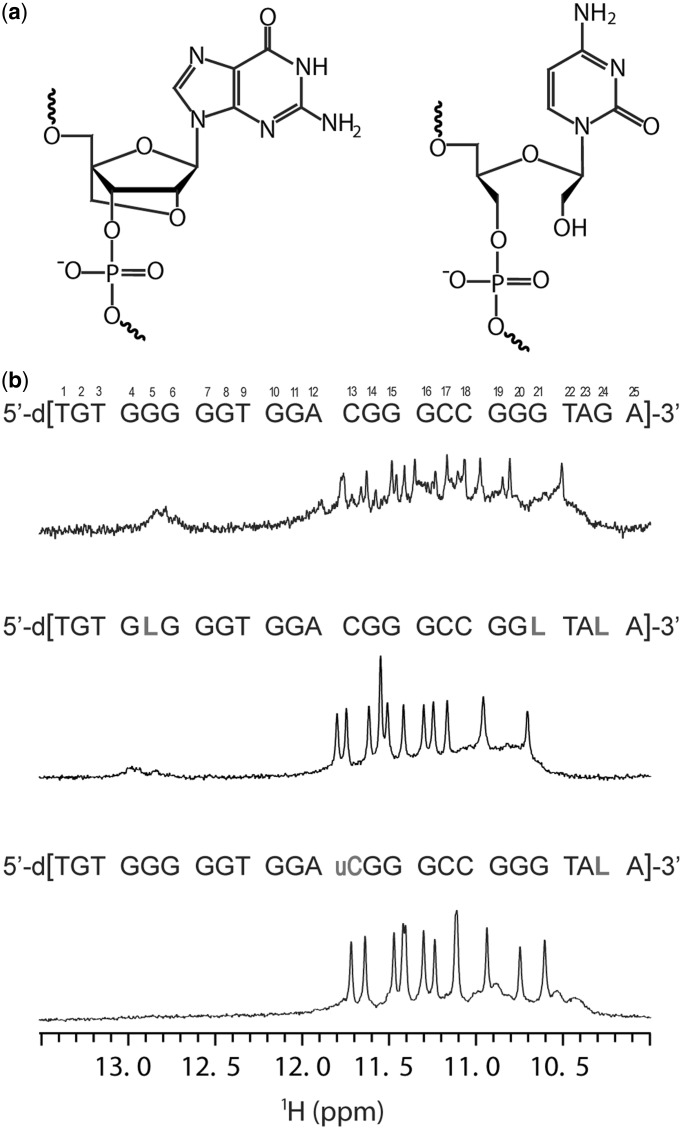
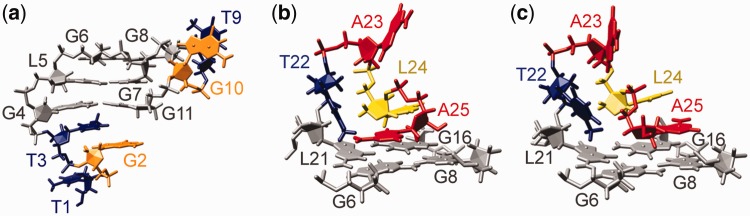
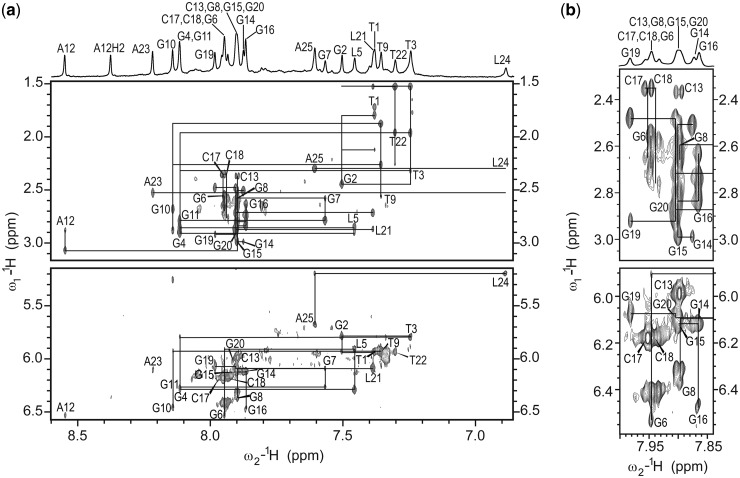
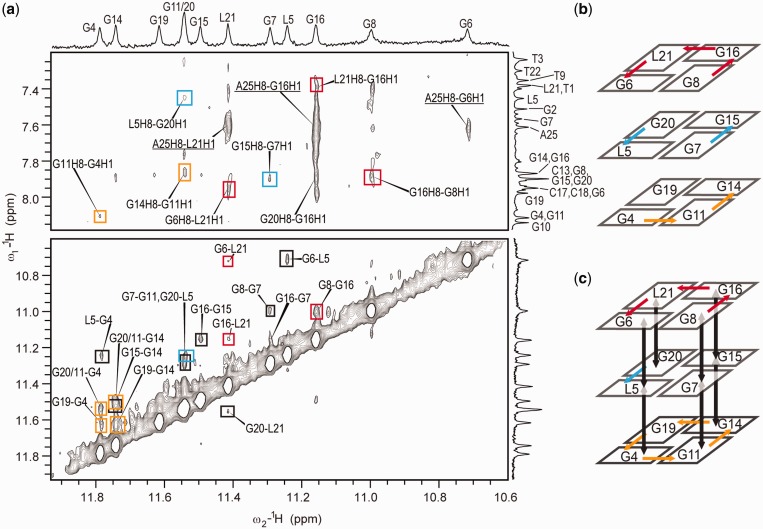
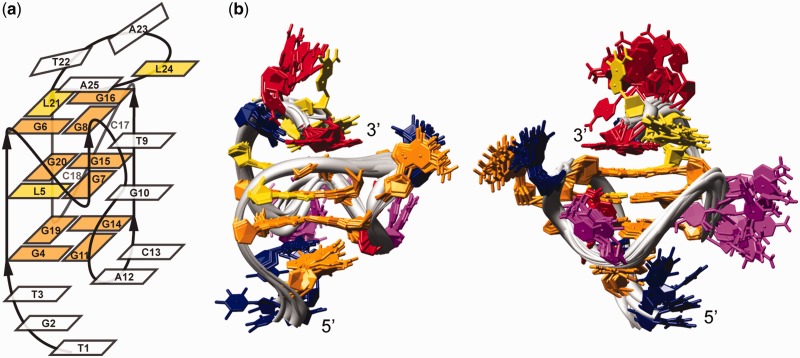
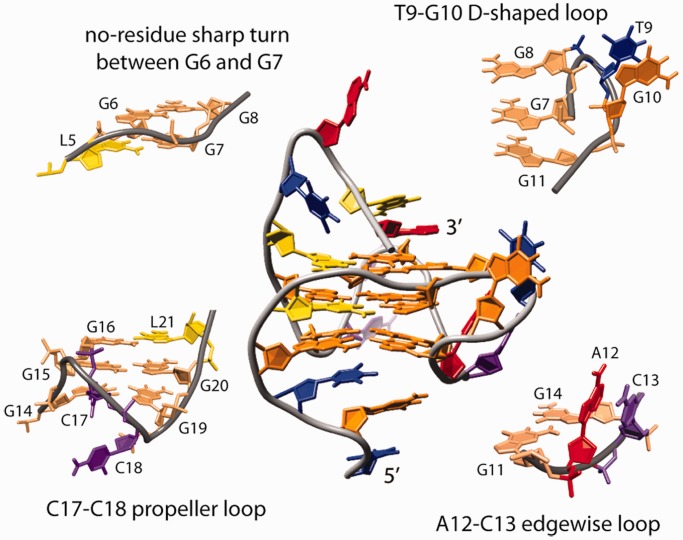
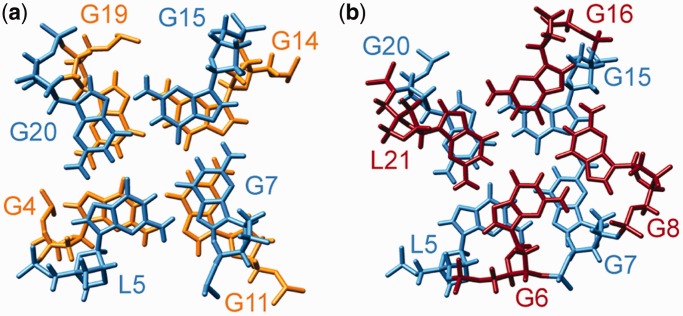
The formation of a single G-quadruplex structure adopted by a promising 25 nt G-rich vascular endothelial growth factor aptamer in a K(+) rich environment was facilitated by locked nucleic acid modifications. An unprecedented all parallel-stranded monomeric G-quadruplex with three G-quartet planes exhibits several unique structural features. Five consecutive guanine residues are all involved in G-quartet formation and occupy positions in adjacent DNA strands, which are bridged with a no-residue propeller-type loop. A two-residue D-shaped loop facilitates inclusion of an isolated guanine residue into the vacant spot within the G-quartet. The remaining two G-rich tracts of three residues each adopt parallel orientation and are linked with edgewise and propeller loops. Both 5' with 3 nt and 3' with 4 nt overhangs display well-defined conformations, with latter adopting a basket handle topology. Locked residues contribute to thermal stabilization of the adopted structure and formation of structurally pre-organized intermediates that facilitate folding into a single G-quadruplex. Understanding the impact of chemical modifications on folding, thermal stability and structural polymorphism of G-quadruplexes provides means for the improvement of vascular endothelial growth factor aptamers and advances our insights into driving nucleic acid structure by locking or unlocking the conformation of sugar moieties of nucleotides in general.
在富含 K+的环境中,一种有前途的 25 个核苷酸富含血管内皮生长因子适体形成了单个 G-四链体结构,这得益于锁核酸修饰。一个前所未有的全平行单链单体 G-四链体具有三个 G-四聚体平面,具有几个独特的结构特征。五个连续的鸟嘌呤残基都参与 G-四聚体的形成,并占据相邻 DNA 链的位置,这些位置通过无残基推进器型环桥接。一个由两个残基组成的 D 形环有助于将孤立的鸟嘌呤残基纳入 G-四聚体的空位中。其余两个各有三个残基的富含 G 的片段采用平行取向,并与边缘和推进器环相连。5'端带有 3 个核苷酸和 3'端带有 4 个核苷酸的突出端都呈现出明确的构象,后者采用篮柄拓扑结构。锁核苷酸残基有助于所采用结构的热稳定性和结构预组织中间体的形成,这些中间体有利于折叠成单个 G-四链体。了解化学修饰对 G-四链体折叠、热稳定性和结构多态性的影响,为改善血管内皮生长因子适体提供了手段,并深入了解通过锁定或解锁核苷酸糖部分的构象来驱动核酸结构的一般机制。