Laboratory of Parasitic Diseases, National Institute of Allergy and Infectious Diseases, National Institutes of Health, Bethesda, Maryland, United States of America.
PLoS Genet. 2013;9(7):e1003672. doi: 10.1371/journal.pgen.1003672. Epub 2013 Jul 25.
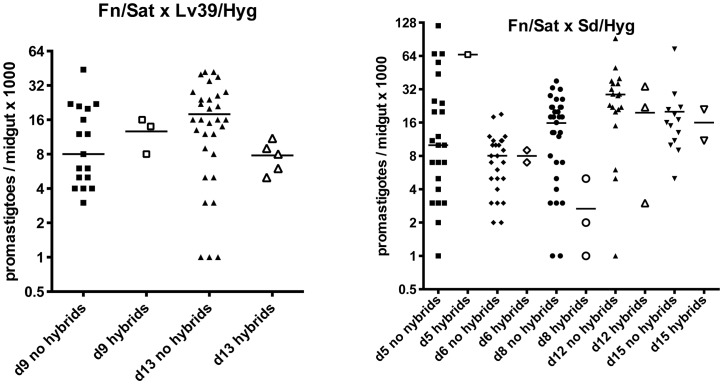
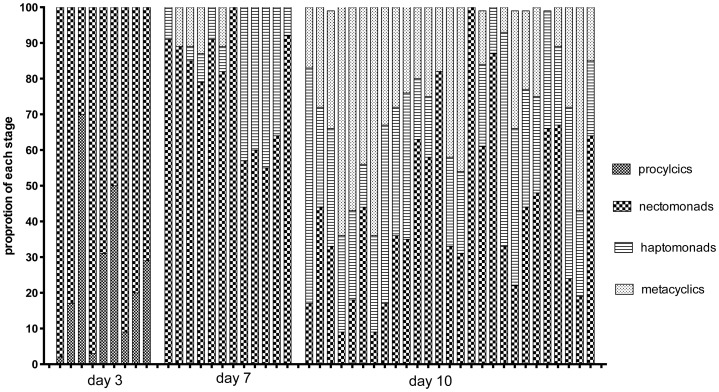
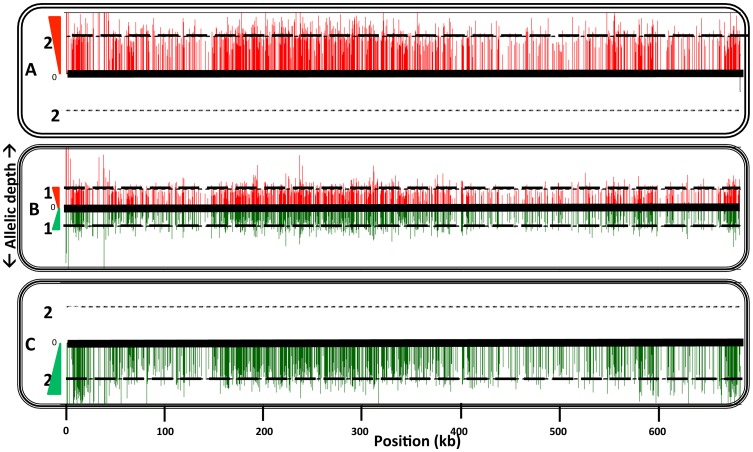
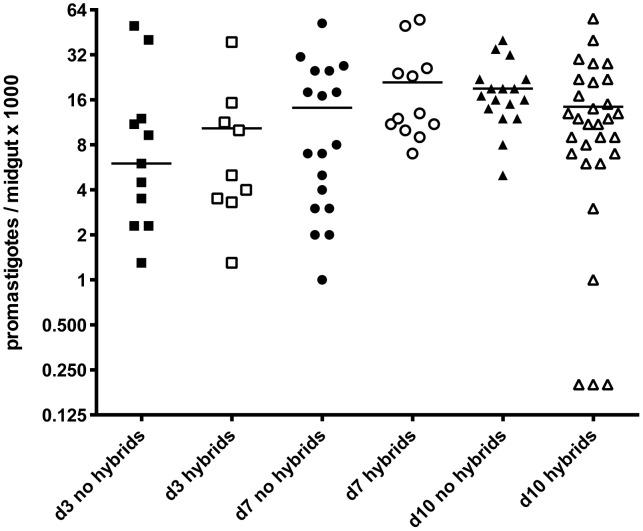
Invertebrate stages of Leishmania are capable of genetic exchange during their extracellular growth and development in the sand fly vector. Here we explore two variables: the ability of diverse L. major strains from across its natural range to undergo mating in pairwise tests; and the timing of the appearance of hybrids and their developmental stage associations within both natural (Phlebotomus duboscqi) and unnatural (Lutzomyia longipalpis) sand fly vectors. Following co-infection of flies with parental lines bearing independent drug markers, doubly-drug resistant hybrid progeny were selected, from which 96 clonal lines were analyzed for DNA content and genotyped for parent alleles at 4-6 unlinked nuclear loci as well as the maxicircle DNA. As seen previously, the majority of hybrids showed '2n' DNA contents, but with a significant number of '3n' and one '4n' offspring. In the natural vector, 97% of the nuclear loci showed both parental alleles; however, 3% (4/150) showed only one parental allele. In the unnatural vector, the frequency of uniparental inheritance rose to 10% (27/275). We attribute this to loss of heterozygosity after mating, most likely arising from aneuploidy which is both common and temporally variable in Leishmania. As seen previously, only uniparental inheritance of maxicircle kDNA was observed. Hybrids were recovered at similar efficiencies in all pairwise crosses tested, suggesting that L. major lacks detectable 'mating types' that limit free genetic exchange. In the natural vector, comparisons of the timing of hybrid formation with the presence of developmental stages suggest nectomonads as the most likely sexually competent stage, with hybrids emerging well before the first appearance of metacyclic promastigotes. These studies provide an important perspective on the prevalence of genetic exchange in natural populations of L. major and a guide for experimental studies to understand the biology of mating.
无鞭毛体阶段的利什曼原虫在白蛉媒介的细胞外生长和发育过程中能够进行遗传交换。在这里,我们探讨了两个变量:来自其自然范围内的不同 L. major 菌株在成对测试中进行交配的能力;以及杂种的出现时间及其在自然(Phlebotomus duboscqi)和非自然(Lutzomyia longipalpis)白蛉媒介中的发育阶段关联。在将携带独立药物标记的亲代系共同感染苍蝇后,从其中选择了双重耐药杂种后代,对 96 个克隆系进行了 DNA 含量分析,并对 4-6 个不连锁核基因座的亲本等位基因进行了基因分型,以及大环状 DNA。与之前的研究一样,大多数杂种显示出“2n”的 DNA 含量,但也有相当数量的“3n”和一个“4n”后代。在自然媒介中,97%的核基因座显示出两个亲本等位基因;然而,3%(4/150)仅显示出一个亲本等位基因。在非自然媒介中,单亲遗传的频率上升到 10%(27/275)。我们将其归因于交配后的杂合性丢失,最有可能是由于非整倍体,在利什曼原虫中既常见又具有时间变异性。与之前的研究一样,仅观察到大环状 kDNA 的单亲遗传。在所有测试的成对杂交中,杂种的回收率相似,这表明 L. major 缺乏可检测的“交配型”来限制自由遗传交换。在自然媒介中,杂种形成时间与发育阶段存在的比较表明,营养体是最有可能具有性能力的阶段,杂种在首次出现循环亲代前体之前就已经出现。这些研究为了解 L. major 自然种群中遗传交换的普遍性提供了重要视角,并为理解交配生物学的实验研究提供了指导。