Fundación Pública Galega de Medicina Xenómica-Servicio Galego de Saúde, Grupo de Medicina Xenómica-Universidade de Santiago de Compostela, Spanish Network on Rare Diseases (CIBERER), Instituto de Investigaciones Sanitarias de Santiago, Santiago de Compostela, A Coruña, Spain.
PLoS One. 2013 Jul 23;8(7):e67538. doi: 10.1371/journal.pone.0067538. Print 2013.
The PALB2 gene, also known as FANCN, forms a bond and co-localizes with BRCA2 in DNA repair. Germline mutations in PALB2 have been identified in approximately 1% of familial breast cancer and 3-4% of familial pancreatic cancer. The goal of this study was to determine the prevalence of PALB2 mutations in a population of BRCA1/BRCA2 negative breast cancer patients selected from either a personal or family history of pancreatic cancer.
132 non-BRCA1/BRCA2 breast/ovarian cancer families with at least one pancreatic cancer case were included in the study. PALB2 mutational analysis was performed by direct sequencing of all coding exons and intron/exon boundaries, as well as multiplex ligation-dependent probe amplification.
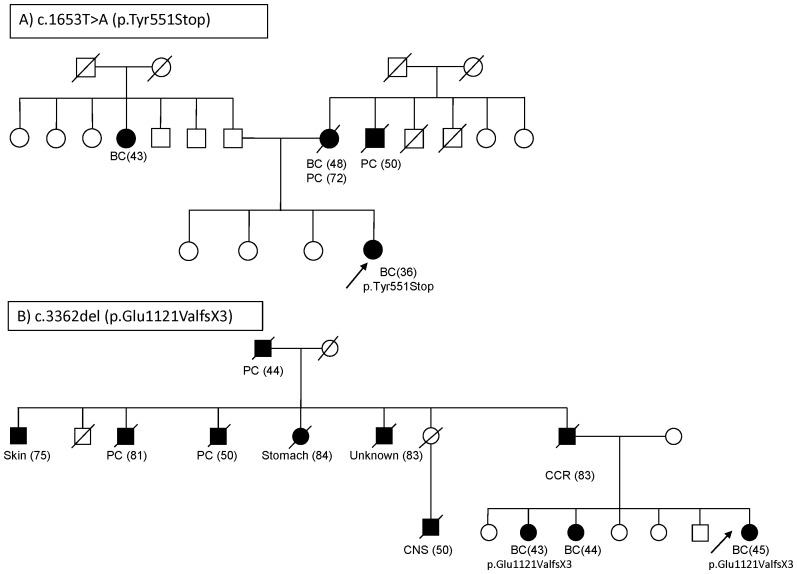
Two PALB2 truncating mutations, the c.1653T>A (p.Tyr551Stop) previously reported, and c.3362del (p.Gly1121ValfsX3) which is a novel frameshift mutation, were identified. Moreover, several PALB2 variants were detected; some of them were predicted as pathological by bioinformatic analysis. Considering truncating mutations, the prevalence rate of our population of BRCA1/2-negative breast cancer patients with pancreatic cancer is 1.5%.
The prevalence rate of PALB2 mutations in non-BRCA1/BRCA2 breast/ovarian cancer families, selected from either a personal or family pancreatic cancer history, is similar to that previously described for unselected breast/ovarian cancer families. Future research directed towards identifying other gene(s) involved in the development of breast/pancreatic cancer families is required.
PALB2 基因,也称为 FANCN,与 BRCA2 形成键并在 DNA 修复中协同定位。PALB2 的种系突变已在约 1%的家族性乳腺癌和 3-4%的家族性胰腺癌中被发现。本研究的目的是确定从个人或家族胰腺癌史中选择的 BRCA1/BRCA2 阴性乳腺癌患者群体中 PALB2 突变的流行率。
本研究纳入了 132 个非 BRCA1/BRCA2 乳腺癌/卵巢癌家族,其中至少有 1 例胰腺癌病例。通过直接对所有编码外显子和内含子/外显子边界以及多重连接依赖性探针扩增进行测序,对 PALB2 突变进行分析。
鉴定出两种 PALB2 截断突变,先前报道的 c.1653T>A(p.Tyr551Stop)和 c.3362del(p.Gly1121ValfsX3),这是一种新的移码突变。此外,还检测到几种 PALB2 变体,其中一些通过生物信息学分析预测为病理性的。考虑到截断突变,我们的 BRCA1/2 阴性乳腺癌患者群体中具有胰腺癌的患病率为 1.5%。
从个人或家族胰腺癌史中选择的非 BRCA1/BRCA2 乳腺癌/卵巢癌家族中 PALB2 突变的患病率与先前描述的未选择的乳腺癌/卵巢癌家族相似。需要进行未来的研究,以确定其他参与乳腺癌/胰腺癌家族发生的基因。