Center for Environmental Health Sciences, Biomedical and Pharmaceutical Sciences, The University of Montana, Missoula, Montana, United States of America.
PLoS One. 2013 Jul 25;8(7):e70351. doi: 10.1371/journal.pone.0070351. Print 2013.
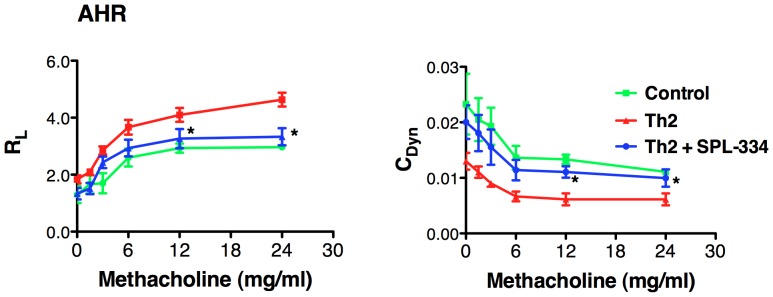
Allergic asthma is characterized by Th2 type inflammation, leading to airway hyperresponsivenes, mucus hypersecretion and tissue remodeling. S-Nitrosoglutathione reductase (GSNOR) is an alcohol dehydrogenase involved in the regulation of intracellular levels of S-nitrosothiols. GSNOR activity has been shown to be elevated in human asthmatic lungs, resulting in diminished S-nitrosothiols and thus contributing to increased airway hyperreactivity. Using a mouse model of allergic airway inflammation, we report that intranasal administration of a new selective inhibitor of GSNOR, SPL-334, caused a marked reduction in airway hyperreactivity, allergen-specific T cells and eosinophil accumulation, and mucus production in the lungs in response to allergen inhalation. Moreover, SPL-334 treatment resulted in a significant decrease in the production of the Th2 cytokines IL-5 and IL-13 and the level of the chemokine CCL11 (eotaxin-1) in the airways. Collectively, these observations reveal that GSNOR inhibitors are effective not only in reducing airway hyperresponsiveness but also in limiting lung inflammatory responses mediated by CD4(+) Th2 cells. These findings suggest that the inhibition of GSNOR may provide a novel therapeutic approach for the treatment of allergic airway inflammation.
变应性哮喘的特征是 Th2 型炎症,导致气道高反应性、黏液高分泌和组织重塑。S-亚硝基谷胱甘肽还原酶 (GSNOR) 是一种参与调节细胞内 S-亚硝基硫醇水平的醇脱氢酶。研究表明,GSNOR 活性在人类哮喘肺中升高,导致 S-亚硝基硫醇减少,从而导致气道高反应性增加。我们使用变应原性气道炎症的小鼠模型报告说,鼻内给予一种新型 GSNOR 选择性抑制剂 SPL-334,可显著降低气道高反应性、变应原特异性 T 细胞和嗜酸性粒细胞在吸入变应原时在肺部的积聚以及黏液生成。此外,SPL-334 治疗导致气道中 Th2 细胞因子 IL-5 和 IL-13 的产生以及趋化因子 CCL11(嗜酸性粒细胞趋化因子-1)的水平显著降低。总之,这些观察结果表明,GSNOR 抑制剂不仅有效降低气道高反应性,而且有效限制 CD4+Th2 细胞介导的肺炎症反应。这些发现表明抑制 GSNOR 可能为治疗变应性气道炎症提供一种新的治疗方法。