Complex Carbohydrate Research Center, University of Georgia , 315 Riverbend Road, Athens, Georgia 30602, United States.
Anal Chem. 2013 Sep 17;85(18):8692-9. doi: 10.1021/ac4015935. Epub 2013 Aug 27.
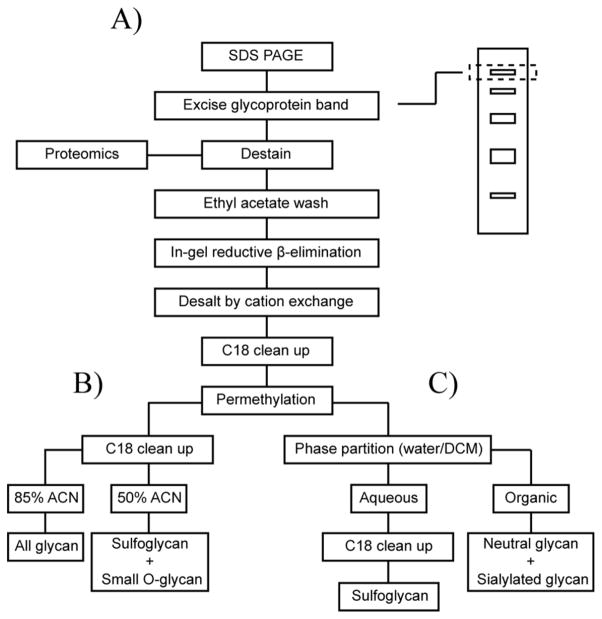
Sodium dodecyl sulfate-polyacrylamide gel electrophoresis (SDS-PAGE) is a widely used technique for protein separation, and in-gel tryptic digestion of resolved protein bands has enhanced the resolution of protoeomic analysis. To augment this technology and expand its usefulness for glycoproteomics, we have developed and improved methods to release and recover O-linked glycans from proteins resolved in SDS-PAGE gels for subsequent analysis by mass spectrometry (MS). Gel pieces containing target proteins are washed to remove contaminants. O-linked glycans are released through reductive β-elimination by hydrating gel pieces in base and adding reductant. Following straightforward sample cleanup, this simple treatment of glycoprotein gel pieces produces material suitable for MS analysis. We have applied this method to the analysis of mucin-type glycoproteins that are expected to carry high densities of sialylated and sulfated O-linked glycans. However, the strongly acidic nature of the sulfate moiety suppresses MS signal intensities, hampering detection and quantitative analysis. To enhance detection, we present an improved method for sulfoglycomics. A mixture of sulflo-, sialo-, and neutral glycans were permethylated and partitioned into a water-dichloromethane (DCM) solvent mixture. Sulfated glycans were selectively recovered from the aqueous phase, while neutral and sialylated glycans remained in the DCM phase. When applied to the analysis of human mucin salivary glycans, this partition method generated material of sufficient quality to identify more than 60 glycan structures by NSI-MS (LTQ-Orbitrap) in positive and negative ion modes. Also, nearly 100% of the sulfated O-linked glycans were recovered in the aqueous phase, demonstrating the feasibility of in-depth sulfoglycomic analysis using SDS-PAGE resolved proteins.
十二烷基硫酸钠-聚丙烯酰胺凝胶电泳(SDS-PAGE)是一种广泛用于蛋白质分离的技术,而胶内酶解技术增强了蛋白质组学分析的分辨率。为了增强这项技术并扩大其在糖蛋白质组学中的应用,我们开发并改进了从 SDS-PAGE 凝胶中分离的蛋白质中释放和回收 O-连接聚糖的方法,以便随后通过质谱(MS)进行分析。含有目标蛋白质的凝胶块经过清洗以去除污染物。通过在碱中使凝胶块水合并添加还原剂来进行还原β消除,从而释放 O-连接聚糖。在进行简单的样品净化后,这种简单的糖蛋白凝胶块处理方法可产生适合 MS 分析的材料。我们已经将这种方法应用于分析预期带有高密度唾液酸化和硫酸化 O-连接聚糖的粘蛋白型糖蛋白。但是,硫酸酯部分的强酸性抑制了 MS 信号强度,阻碍了检测和定量分析。为了增强检测,我们提出了一种改进的硫酸糖组学方法。将混合的硫酸基、唾液酸化和中性聚糖进行甲基化,并将其分配到水-二氯甲烷(DCM)溶剂混合物中。硫酸化聚糖从水相选择性回收,而中性和唾液酸化聚糖则留在 DCM 相中。当应用于人类粘蛋白唾液糖聚糖的分析时,这种分配方法产生的材料质量足以通过 NSI-MS(LTQ-Orbitrap)在正离子和负离子模式下鉴定 60 多种聚糖结构。此外,将近 100%的硫酸化 O-连接聚糖被回收至水相,证明了使用 SDS-PAGE 分离的蛋白质进行深入硫酸糖组学分析的可行性。