Department of Obstetrics and Gynaecology, Sahlgrenska Academy, Sahlgrenska University Hospital/Östra, SE-416 85 Göteborg, Sweden.
BMC Pregnancy Childbirth. 2013 Aug 12;13:160. doi: 10.1186/1471-2393-13-160.
Health authorities in numerous countries recommend periconceptional folic acid to pregnant women to prevent neural tube defects. The objective of this study was to examine the association of folic acid supplementation during different periods of pregnancy and of dietary folate intake with the risk of spontaneous preterm delivery (PTD).
The Norwegian Mother and Child Cohort Study is a population-based prospective cohort study. A total of 65,668 women with singleton pregnancies resulting in live births in 1999-2009 were included. Folic acid supplementation was self-reported from 26 weeks before pregnancy until week 24 during pregnancy. At gestational week 22, the women completed a food frequency questionnaire, which allowed the calculation of their average total folate intake from foods and supplements for the first 4-5 months of pregnancy. Spontaneous PTD was defined as the spontaneous onset of delivery between weeks 22+0 and 36+6 (n = 1,628).
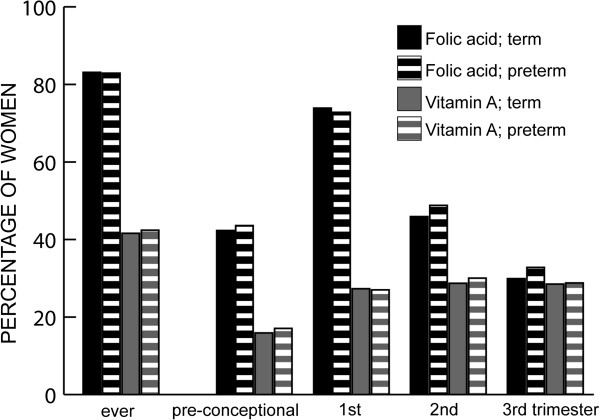
The median total folate intake was 266 μg/d (interquartile range IQR 154-543) in the overall population and 540 μg/d (IQR 369-651) in the supplement users. Eighty-three percent reported any folic acid supplementation from <8 weeks before to 24 weeks after conception while 42% initiated folic acid supplementation before their pregnancy. Cox regression analysis showed that the amount of folate intake from the diet (hazard ratio HR 1.16; confidence interval CI 0.65-2.08) and from the folic acid supplements (HR 1.04; CI 0.95-1.13) was not significantly associated with the risk of PTD. The initiation of folic acid supplementation more than 8 weeks before conception was associated with an increased risk for PTD (HR 1.19; CI 1.05-1.34) compared to no folic acid supplementation pre-conception. There was no significant association with PTD when supplementation was initiated within 8 weeks pre-conception (HR 1.01; CI 0.88-1.16). All analyses were adjusted for maternal characteristics and socioeconomic, health and dietary variables.
Our findings do not support a protective effect of dietary folate intake or folic acid supplementation on spontaneous PTD. Pre-conceptional folic acid supplementation starting more than 8 weeks before conception was associated with an increased risk of PTD. These results require further investigation before discussing an expansion of folic acid supplementation guidelines.
许多国家的卫生当局建议孕妇在受孕前补充叶酸,以预防神经管缺陷。本研究的目的是探讨在不同孕期补充叶酸和饮食叶酸摄入与自发性早产(PTD)风险的关系。
挪威母婴队列研究是一项基于人群的前瞻性队列研究。共有 1999-2009 年期间 65668 名单胎活产孕妇纳入研究。叶酸补充情况自受孕前 26 周开始报告,直至妊娠 24 周。在妊娠 22 周时,孕妇完成了一份食物频率问卷,该问卷允许计算她们在妊娠前 4-5 个月内从食物和补充剂中获得的平均总叶酸摄入量。自发性早产定义为妊娠 22+0 周至 36+6 周期间的自发性分娩(n=1628)。
在总体人群中,总叶酸摄入量的中位数为 266μg/d(四分位距 IQR 154-543),补充剂使用者为 540μg/d(IQR 369-651)。83%的人报告在受孕前 8 周至受孕后 24 周期间服用过任何叶酸补充剂,而 42%的人在受孕前开始服用叶酸补充剂。Cox 回归分析显示,饮食中叶酸的摄入量(危险比 HR 1.16;95%置信区间 CI 0.65-2.08)和叶酸补充剂(HR 1.04;CI 0.95-1.13)与 PTD 的风险无显著相关性。与受孕前不服用叶酸补充剂相比,受孕前 8 周以上开始服用叶酸补充剂与 PTD 风险增加相关(HR 1.19;CI 1.05-1.34)。受孕前 8 周内开始补充叶酸与 PTD 无显著相关性(HR 1.01;CI 0.88-1.16)。所有分析均调整了母体特征以及社会经济、健康和饮食变量。
我们的研究结果不支持饮食叶酸摄入或叶酸补充对自发性 PTD 的保护作用。受孕前 8 周以上开始补充叶酸与 PTD 风险增加相关。在讨论扩大叶酸补充剂指南之前,还需要进一步研究这些结果。