Department of Pharmacology, University of Oxford, Oxford, United Kingdom.
PLoS One. 2013 Aug 5;8(8):e70600. doi: 10.1371/journal.pone.0070600. Print 2013.
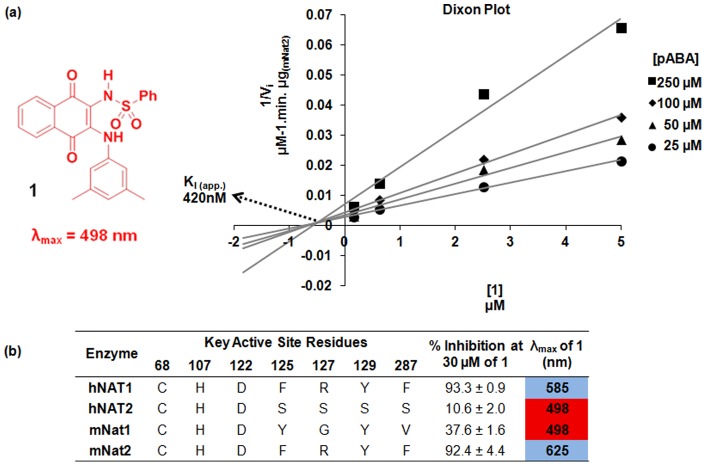
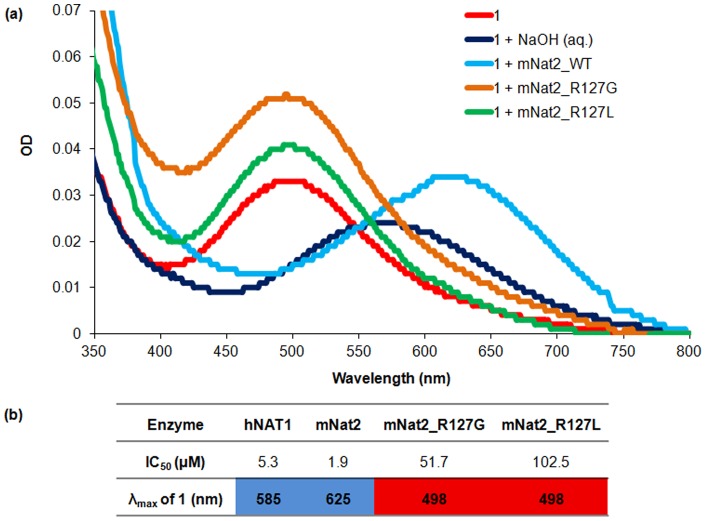
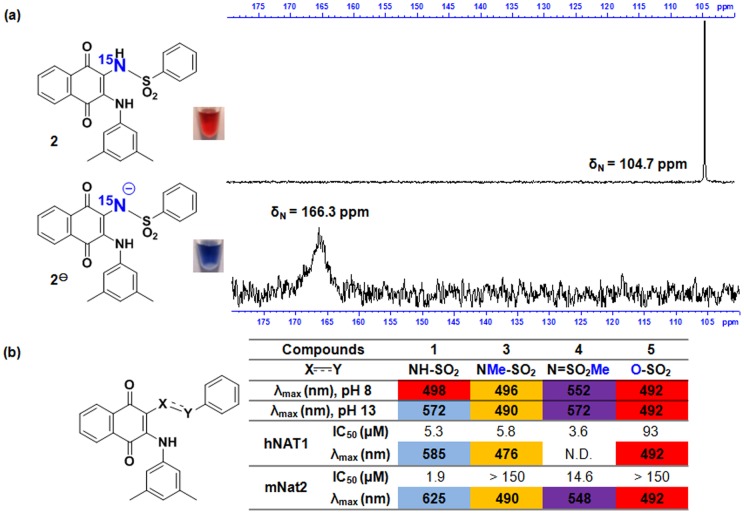
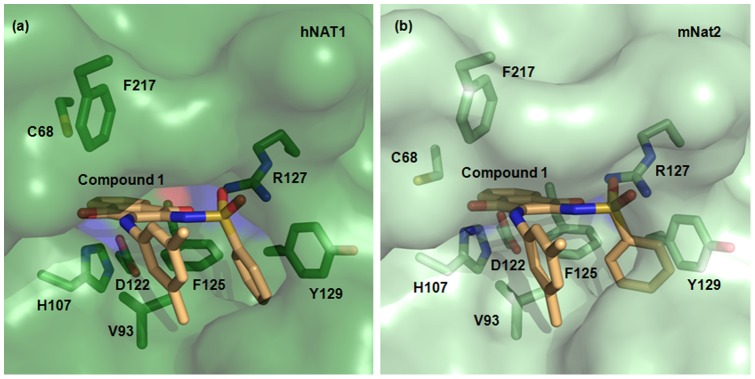
Human arylamine N-acetyltransferase 1 (hNAT1) has become an attractive potential biomarker for estrogen-receptor-positive breast cancers. We describe here the mechanism of action of a selective non-covalent colorimetric biosensor for the recognition of hNAT1 and its murine homologue, mNat2, over their respective isoenzymes, leading to new opportunities in diagnosis. On interaction with the enzyme, the naphthoquinone probe undergoes an instantaneous and striking visible color change from red to blue. Spectroscopic, chemical, molecular modelling and biochemical studies reported here show that the color change is mediated by selective recognition between the conjugate base of the sulfonamide group within the probe and the conjugate acid of the arginine residue within the active site of both hNAT1 and mNat2. This represents a new mechanism for selective biomarker sensing and may be exploited as a general approach to the specific detection of biomarkers in disease.
人类芳香胺 N-乙酰基转移酶 1(hNAT1)已成为雌激素受体阳性乳腺癌有吸引力的潜在生物标志物。我们在这里描述了一种选择性非共价比色生物传感器的作用机制,用于识别 hNAT1 及其鼠同源物 mNat2,并在各自的同工酶上进行识别,从而为诊断带来了新的机会。与酶相互作用时,萘醌探针会立即发生明显的可见颜色变化,从红色变为蓝色。这里报道的光谱、化学、分子建模和生化研究表明,颜色变化是由探针中磺酰胺基团的共轭碱与 hNAT1 和 mNat2 活性位点中精氨酸残基的共轭酸之间的选择性识别介导的。这代表了一种用于选择性生物标志物传感的新机制,并可能被用作疾病中生物标志物特异性检测的一般方法。