Laboratory of Biomechanics and Implant Research, Clinic for Orthopedics and Trauma Surgery, Heidelberg University Hospital, Heidelberg, Germany.
PLoS One. 2013 Aug 7;8(8):e71622. doi: 10.1371/journal.pone.0071622. Print 2013.
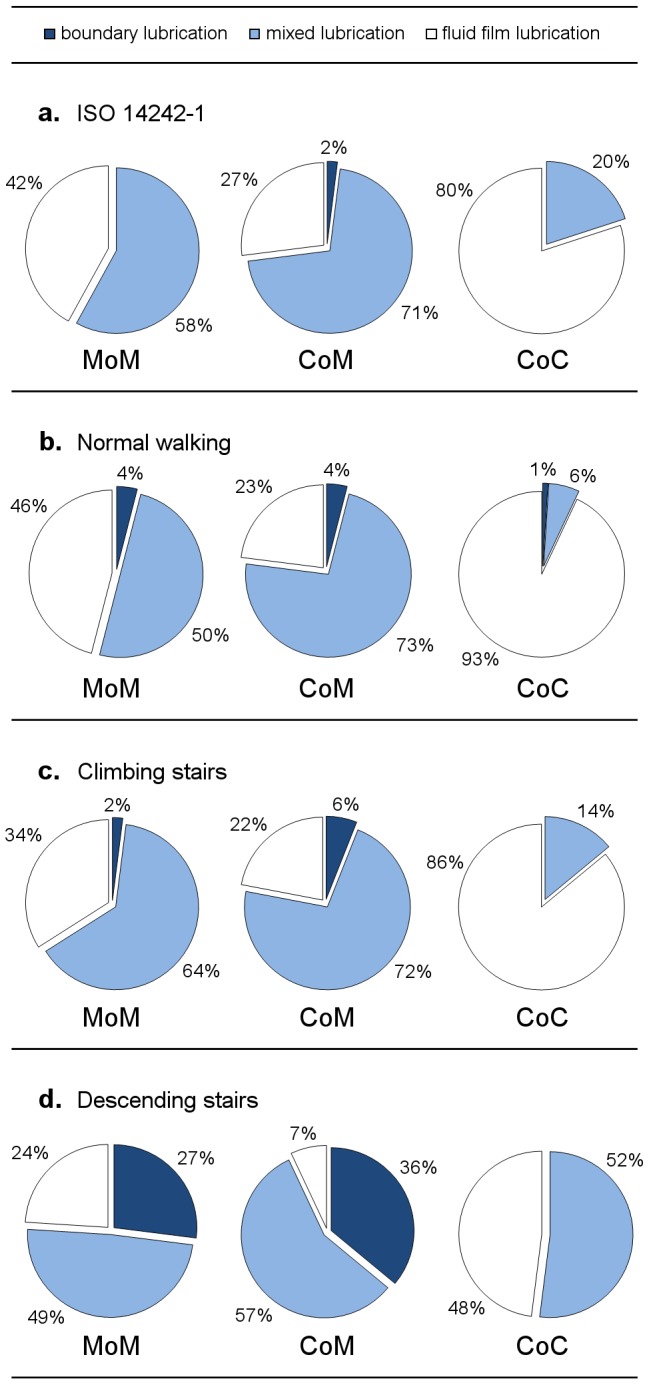
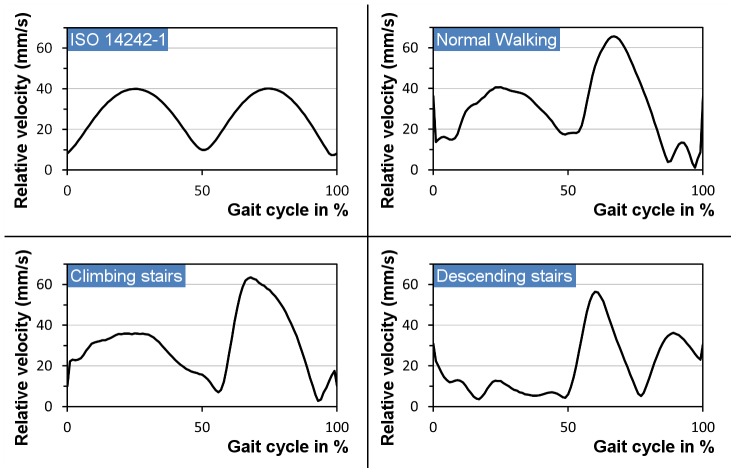
The tribological performance of an artificial hip joint has a particularly strong influence on its success. The principle causes for failure are adverse short- and long-term reactions to wear debris and high frictional torque in the case of poor lubrication that may cause loosening of the implant. Therefore, using experimental and theoretical approaches models have been developed to evaluate lubrication under standardized conditions. A steady-state numerical model has been extended with dynamic experimental data for hard-on-hard bearings used in total hip replacements to verify the tribological relevance of the ISO 14242-1 gait cycle in comparison to experimental data from the Orthoload database and instrumented gait analysis for three additional loading conditions: normal walking, climbing stairs and descending stairs. Ceramic-on-ceramic bearing partners show superior lubrication potential compared to hard-on-hard bearings that work with at least one articulating metal component. Lubrication regimes during the investigated activities are shown to strongly depend on the kinematics and loading conditions. The outcome from the ISO gait is not fully confirmed by the normal walking data and more challenging conditions show evidence of inferior lubrication. These findings may help to explain the differences between the in vitro predictions using the ISO gait cycle and the clinical outcome of some hard-on-hard bearings, e.g., using metal-on-metal.
人工髋关节的摩擦学性能对其成功与否有着特别强烈的影响。失效的主要原因是在磨损颗粒的不利短期和长期反应,以及在润滑不良的情况下会产生高摩擦扭矩,从而导致植入物松动。因此,使用实验和理论方法已经开发出了模型,以在标准化条件下评估润滑性能。针对全髋关节置换中使用的硬对硬轴承,扩展了一个稳态数值模型,并结合来自 Orthoload 数据库的实验数据和用于三个附加加载条件的仪器化步态分析(即正常行走、爬楼梯和下楼梯)的动态实验数据进行验证,这些条件与 ISO 14242-1 步态周期相比具有摩擦学相关性。与至少有一个关节金属部件的硬对硬轴承相比,陶瓷对陶瓷轴承具有更好的润滑潜力。研究活动中的润滑状态表明,其强烈依赖于运动学和加载条件。ISO 步态的结果不能完全被正常行走数据所证实,更具挑战性的条件表明润滑效果较差。这些发现可能有助于解释使用 ISO 步态周期进行体外预测与某些硬对硬轴承(例如金属对金属)的临床结果之间的差异。