Carus Andreas, Gurney Howard, Gebski Val, Harnett Paul, Hui Rina, Kefford Richard, Wilcken Nicholas, Ladekarl Morten, von der Maase Hans, Donskov Frede
J Transl Med. 2013 Aug 15;11:189. doi: 10.1186/1479-5876-11-189.
Chronic inflammation has been recognized to foster tumour development. Whether chemotherapy can be used to neutralize chronic inflammation is unclear.
We evaluated baseline and nadir neutrophils in 111 patients (pts.) with non-small cell lung cancer (NSCLC) and 118 pts. with ovarian cancer (OC) treated with chemotherapy administered with dose-individualization to achieve nadir neutropenia of 1.5. We used predefined baseline neutrophil cut-offs 4.5 × 10⁹/L (NSCLC) and 3.9 × 10⁹/L (OC).
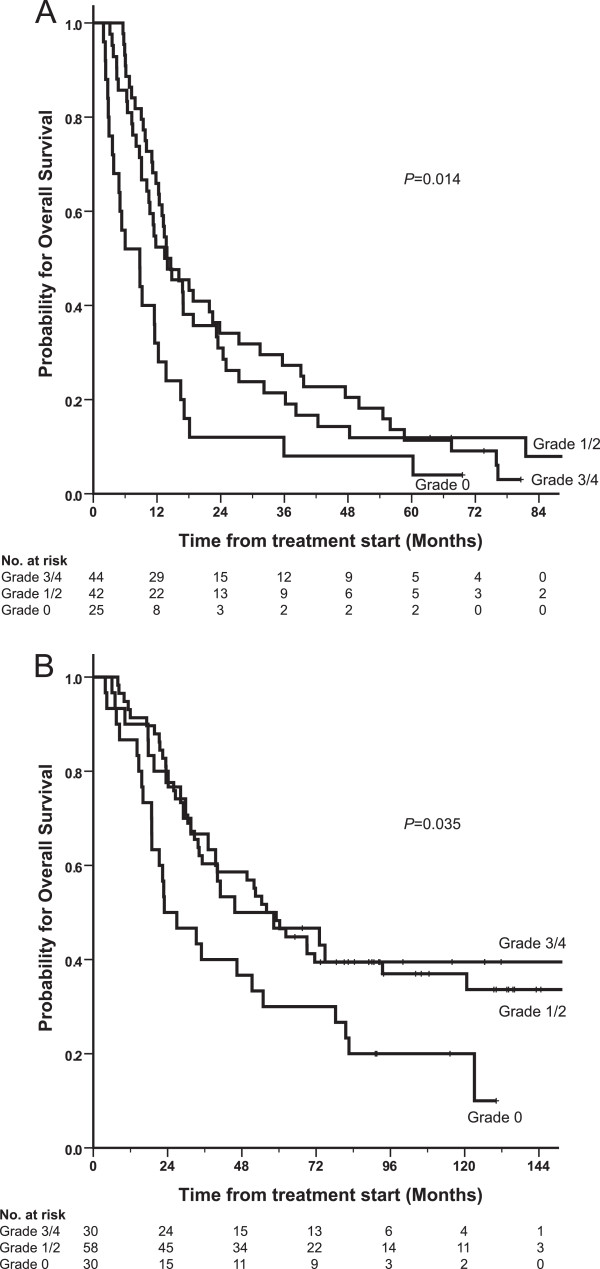
Absence of chemotherapy-induced nadir neutropenia (CTCAE grade 0, neutrophils ≥ LLN) was seen in 23% of OC and 25% of NSCLC pts. Absence of nadir neutropenia was associated with decreased overall survival (OS) compared with presence (>grade 0) of neutropenia (9 vs. 14 months, P=0.004 for NSCLC and 23 vs. 56 months; P=0.01 for OC). Obtaining grade 3/4 neutropenia did not improve survival compared with grade 1/2 neutropenia. In multivariate analyses, baseline neutrophils ≥ 4.5 × 10⁹/L (HR: 2.0; 95% CI: 1.11-3.44;P = 0.02) and absence of nadir neutropenia (HR: 1.6; 95% CI: 1.02-2.65;P = 0.04) for NSCLC and absence of nadir neutropenia (HR: 1.7; 95% CI: 1.04;2.93;P = 0.04) for OC were independently associated with short OS.
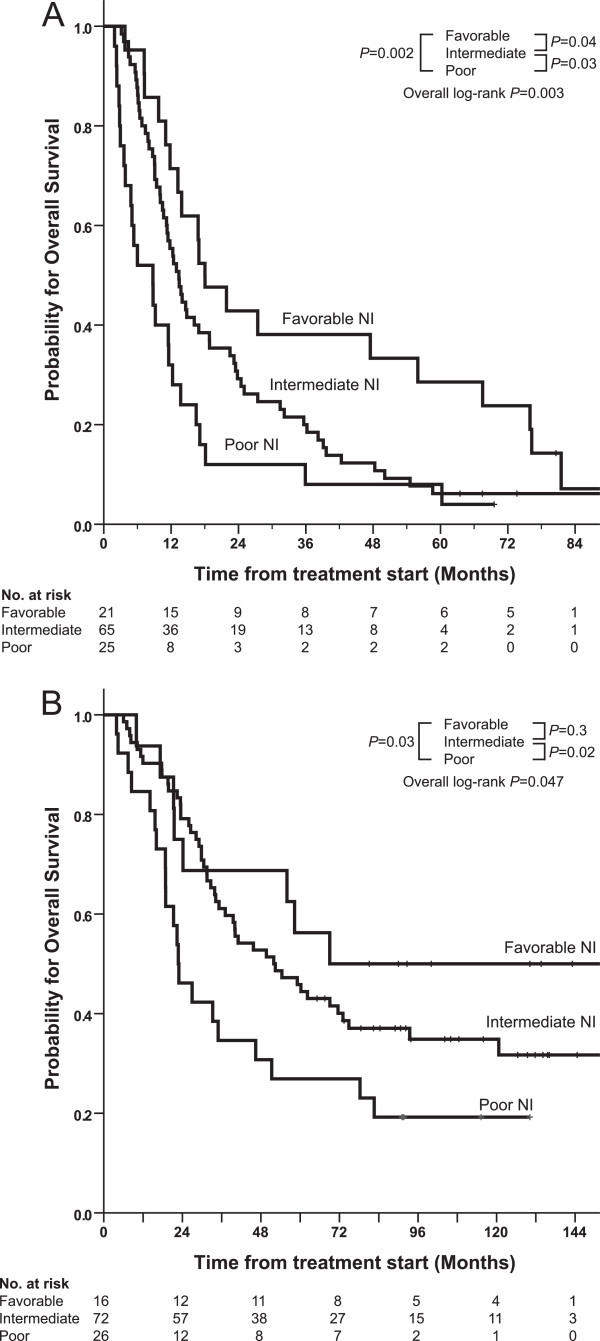
A neutrophil index comprising elevated baseline neutrophils and absence of neutropenia identified a high risk group of NSCLC and ovarian cancer patients with only modest effect of chemotherapy. New treatment options for this subset of patients are required.
慢性炎症被认为会促进肿瘤发展。化疗是否可用于中和慢性炎症尚不清楚。
我们评估了111例接受剂量个体化化疗以实现最低点中性粒细胞减少至1.5的非小细胞肺癌(NSCLC)患者和118例卵巢癌(OC)患者的基线和最低点中性粒细胞。我们使用预先定义的基线中性粒细胞临界值4.5×10⁹/L(NSCLC)和3.9×10⁹/L(OC)。
23%的OC患者和25%的NSCLC患者未出现化疗诱导的最低点中性粒细胞减少(CTCAE 0级,中性粒细胞≥下限值)。与存在中性粒细胞减少(>0级)相比,未出现最低点中性粒细胞减少与总生存期(OS)缩短相关(NSCLC患者中分别为9个月对14个月,P = 0.004;OC患者中分别为23个月对56个月,P = 0.01)。与1/2级中性粒细胞减少相比,出现3/4级中性粒细胞减少并未改善生存期。在多变量分析中,NSCLC患者基线中性粒细胞≥4.5×10⁹/L(HR:2.0;95%CI:1.11 - 3.44;P = 0.02)以及未出现最低点中性粒细胞减少(HR:1.6;95%CI:1.02 - 2.65;P = 0.04),OC患者未出现最低点中性粒细胞减少(HR:1.7;95%CI:1.04 - 2.93;P = 0.04)均与OS缩短独立相关。
一个包含基线中性粒细胞升高和未出现中性粒细胞减少的中性粒细胞指数可识别出化疗效果有限的NSCLC和卵巢癌高风险患者组。需要为这部分患者提供新的治疗选择。