Department of Biochemistry, University of Cambridge, UK, and Cancer Research UK Cambridge Research Institute, Cambridge, UK.
NMR Biomed. 2013 Dec;26(12):1696-704. doi: 10.1002/nbm.3005. Epub 2013 Aug 15.
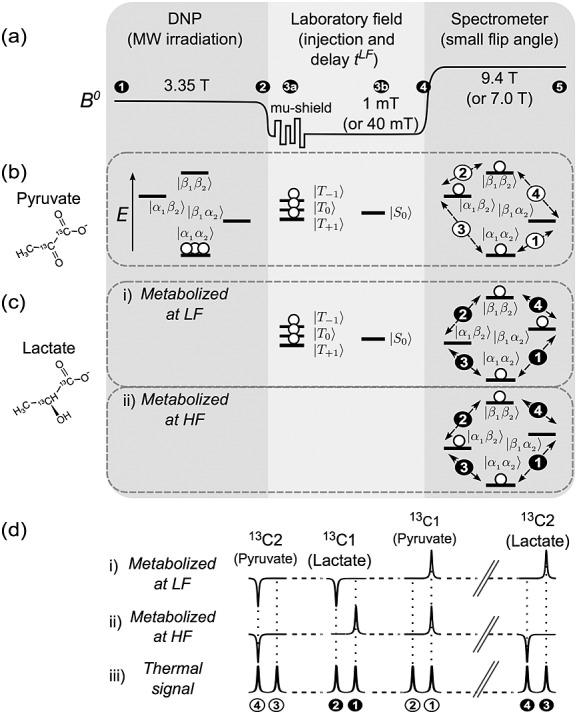
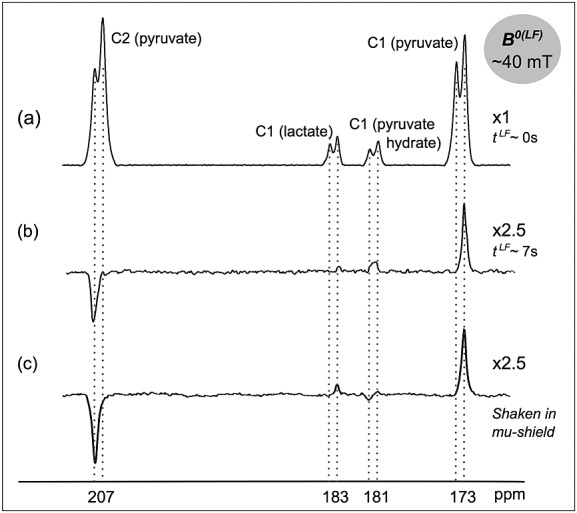
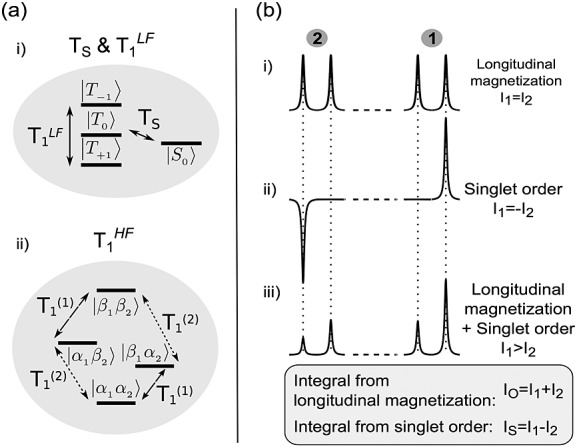
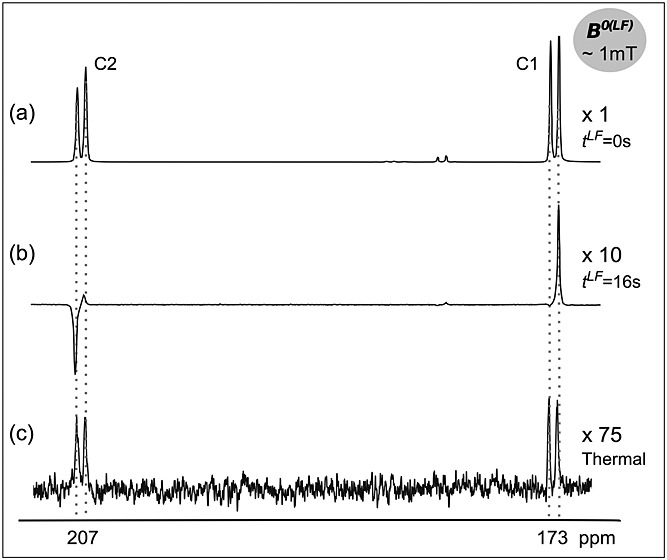
Hyperpolarized NMR is a promising technique for non-invasive imaging of tissue metabolism in vivo. However, the pathways that can be studied are limited by the fast T1 decay of the nuclear spin order. In metabolites containing pairs of coupled nuclear spins-1/2, the spin order may be maintained by exploiting the non-magnetic singlet (spin-0) state of the pair. This may allow preservation of the hyperpolarization in vivo during transport to tissues of interest, such as tumors, or to detect slower metabolic reactions. We show here that in human blood and in a mouse in vivo at millitesla fields the (13)C singlet lifetime of [1,2-(13)C2]pyruvate was significantly longer than the (13)C T1, although it was shorter than the T1 at field strengths of several tesla. We also examine the singlet-derived NMR spectrum observed for hyperpolarized [1,2-(13)C2]lactate, originating from the metabolism of [1,2-(13)C2]pyruvate.
超极化 NMR 是一种有前途的非侵入性活体组织代谢成像技术。然而,能够研究的途径受到核自旋序快速 T1 衰减的限制。在含有耦合核自旋-1/2 对的代谢物中,可以通过利用对的非磁性单重态(自旋-0 态)来保持自旋序。这可能允许在将极化向感兴趣的组织(如肿瘤)或检测较慢的代谢反应运输过程中在体内保持极化。我们在这里表明,在毫特斯拉场中的人血液和体内的小鼠中,[1,2-(13)C2]丙酮酸的(13)C 单重态寿命明显长于(13)C T1,尽管它比在几个特斯拉场强下的 T1 短。我们还检查了超极化[1,2-(13)C2]乳酸的单重态衍生 NMR 谱,其来源于[1,2-(13)C2]丙酮酸的代谢。