HudsonAlpha Institute for Biotechnology, Huntsville, Alabama, USA.
PLoS Genet. 2013;9(8):e1003678. doi: 10.1371/journal.pgen.1003678. Epub 2013 Aug 8.
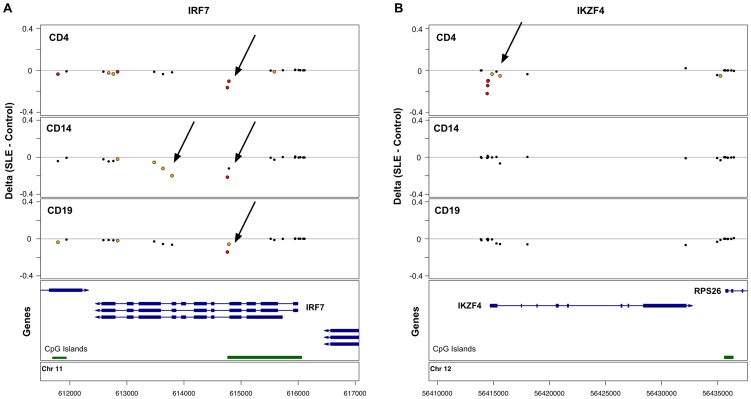
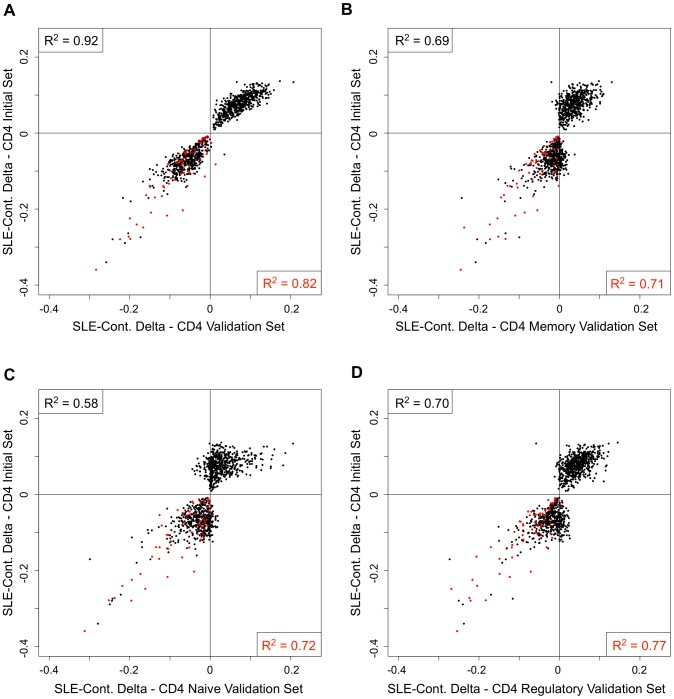
Systemic lupus erythematosus (SLE) is an autoimmune disease with known genetic, epigenetic, and environmental risk factors. To assess the role of DNA methylation in SLE, we collected CD4+ T-cells, CD19+ B-cells, and CD14+ monocytes from 49 SLE patients and 58 controls, and performed genome-wide DNA methylation analysis with Illumina Methylation 450 microarrays. We identified 166 CpGs in B-cells, 97 CpGs in monocytes, and 1,033 CpGs in T-cells with highly significant changes in DNA methylation levels (p < 1 × 10(-8)) among SLE patients. Common to all three cell-types were widespread and severe hypomethylation events near genes involved in interferon signaling (type I). These interferon-related changes were apparent in patients collected during active and quiescent stages of the disease, suggesting that epigenetically-mediated hypersensitivity to interferon persists beyond acute stages of the disease and is independent of circulating interferon levels. This interferon hypersensitivity was apparent in memory, naïve and regulatory T-cells, suggesting that this epigenetic state in lupus patients is established in progenitor cell populations. We also identified a widespread, but lower amplitude shift in methylation in CD4+ T-cells (> 16,000 CpGs at FDR < 1%) near genes involved in cell division and MAPK signaling. These cell type-specific effects are consistent with disease-specific changes in the composition of the CD4+ population and suggest that shifts in the proportion of CD4+ subtypes can be monitored at CpGs with subtype-specific DNA methylation patterns.
系统性红斑狼疮(SLE)是一种自身免疫性疾病,已知存在遗传、表观遗传和环境风险因素。为了评估 DNA 甲基化在 SLE 中的作用,我们收集了 49 名 SLE 患者和 58 名对照者的 CD4+T 细胞、CD19+B 细胞和 CD14+单核细胞,并使用 Illumina Methylation 450 微阵列进行了全基因组 DNA 甲基化分析。我们在 SLE 患者中鉴定出 B 细胞中 166 个 CpG、单核细胞中 97 个 CpG 和 T 细胞中 1033 个 CpG 的 DNA 甲基化水平发生了高度显著变化(p < 1 × 10(-8))。所有三种细胞类型均存在广泛且严重的低甲基化事件,这些事件发生在涉及干扰素信号(I 型)的基因附近。这些与干扰素相关的变化在疾病活动期和静止期采集的患者中均可见,表明对干扰素的表观遗传敏感性在疾病的急性阶段之后仍然存在,并且独立于循环干扰素水平。这种干扰素敏感性在记忆性、幼稚性和调节性 T 细胞中很明显,表明狼疮患者的这种表观遗传状态是在祖细胞群体中建立的。我们还在涉及细胞分裂和 MAPK 信号的基因附近的 CD4+T 细胞中(FDR < 1%时> 16,000 个 CpG)发现了广泛但幅度较低的甲基化变化。这些细胞类型特异性效应与 CD4+细胞群组成的疾病特异性变化一致,并表明可以在具有亚类特异性 DNA 甲基化模式的 CpG 上监测 CD4+亚类比例的变化。