• 文献检索
  • 文档翻译
  • 深度研究
  • 学术资讯
  • Suppr Zotero 插件Zotero 插件
  • 邀请有礼
  • 套餐&价格
  • 历史记录
应用&插件
Suppr Zotero 插件Zotero 插件浏览器插件Mac 客户端Windows 客户端微信小程序
定价
高级版会员购买积分包购买API积分包
服务
文献检索文档翻译深度研究API 文档MCP 服务
关于我们
关于 Suppr公司介绍联系我们用户协议隐私条款
关注我们

Suppr 超能文献

核心技术专利:CN118964589B侵权必究
粤ICP备2023148730 号-1Suppr @ 2026

文献检索

告别复杂PubMed语法,用中文像聊天一样搜索,搜遍4000万医学文献。AI智能推荐,让科研检索更轻松。

立即免费搜索

文件翻译

保留排版,准确专业,支持PDF/Word/PPT等文件格式,支持 12+语言互译。

免费翻译文档

深度研究

AI帮你快速写综述,25分钟生成高质量综述,智能提取关键信息,辅助科研写作。

立即免费体验

生命周期进化:后生动物的祖先是否是全浮游、浮游营养性的原肠胚?

Life cycle evolution: was the eumetazoan ancestor a holopelagic, planktotrophic gastraea?

机构信息

Zoological Museum, The Natural History Museum of Denmark, University of Copenhagen, Universitetsparken 15, DK-2100, Copenhagen, Denmark.

出版信息

BMC Evol Biol. 2013 Aug 16;13:171. doi: 10.1186/1471-2148-13-171.

DOI:10.1186/1471-2148-13-171
PMID:23957497
原文链接:https://pmc.ncbi.nlm.nih.gov/articles/PMC3751718/
Abstract

BACKGROUND

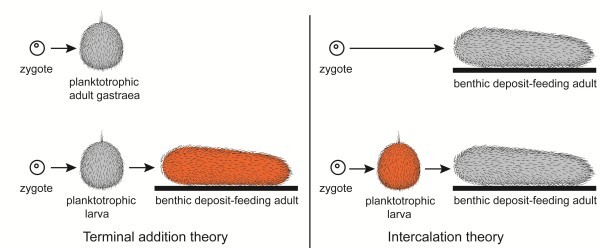
Two theories for the origin of animal life cycles with planktotrophic larvae are now discussed seriously: The terminal addition theory proposes a holopelagic, planktotrophic gastraea as the ancestor of the eumetazoans with addition of benthic adult stages and retention of the planktotrophic stages as larvae, i.e. the ancestral life cycles were indirect. The intercalation theory now proposes a benthic, deposit-feeding gastraea as the bilaterian ancestor with a direct development, and with planktotrophic larvae evolving independently in numerous lineages through specializations of juveniles.

RESULTS

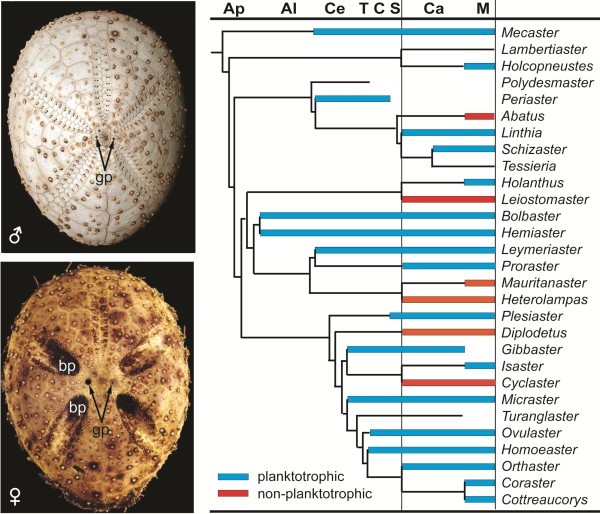
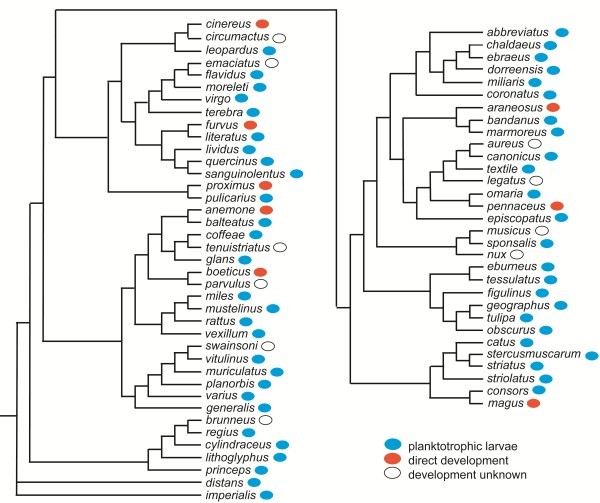
Information from the fossil record, from mapping of developmental types onto known phylogenies, from occurrence of apical organs, and from genetics gives no direct information about the ancestral eumetazoan life cycle; however, there are plenty of examples of evolution from an indirect development to direct development, and no unequivocal example of evolution in the opposite direction. Analyses of scenarios for the two types of evolution are highly informative. The evolution of the indirect spiralian life cycle with a trochophora larva from a planktotrophic gastraea is explained by the trochophora theory as a continuous series of ancestors, where each evolutionary step had an adaptational advantage. The loss of ciliated larvae in the ecdysozoans is associated with the loss of outer ciliated epithelia. A scenario for the intercalation theory shows the origin of the planktotrophic larvae of the spiralians through a series of specializations of the general ciliation of the juvenile. The early steps associated with the enhancement of swimming seem probable, but the following steps which should lead to the complicated downstream-collecting ciliary system are without any advantage, or even seem disadvantageous, until the whole structure is functional. None of the theories account for the origin of the ancestral deuterostome (ambulacrarian) life cycle.

CONCLUSIONS

All the available information is strongly in favor of multiple evolution of non-planktotrophic development, and only the terminal addition theory is in accordance with the Darwinian theory by explaining the evolution through continuous series of adaptational changes. This implies that the ancestor of the eumetazoans was a holopelagic, planktotrophic gastraea, and that the adult stages of cnidarians (sessile) and bilaterians (creeping) were later additions to the life cycle. It further implies that the various larval types are of considerable phylogenetic value.

摘要

背景

目前有两种理论可以解释动物生命周期和浮游幼虫的起源:末端添加理论提出,一个全海洋浮游、浮游幼虫的后生动物作为有添加底栖成体阶段和保留浮游幼虫阶段的后生动物祖先,即祖先的生命周期是间接的。插入理论现在提出,一个底栖、沉积食性的原肠胚作为两侧对称动物的祖先,具有直接发育,并且通过幼体的特化,浮游幼虫在许多谱系中独立进化。

结果

来自化石记录、发育类型映射到已知系统发育、顶端器官的出现以及遗传学的信息并没有直接提供关于祖先后生动物生命周期的信息;然而,有很多从间接发育到直接发育的进化例子,没有明确的相反方向进化的例子。对这两种进化类型的情景分析非常有启发性。从浮游幼虫的螺旋形间接生命循环的进化,通过原肠胚理论解释为一个连续的祖先系列,其中每一个进化步骤都有适应优势。蜕皮动物中纤毛幼虫的丧失与外纤毛上皮的丧失有关。插入理论的一个情景表明,螺旋形动物的浮游幼虫起源于幼体一般纤毛的一系列特化。与增强游泳能力相关的早期步骤似乎是可能的,但是随后的步骤应该导致复杂的下游收集纤毛系统,没有任何优势,甚至似乎是不利的,直到整个结构是功能的。这两种理论都没有解释祖先后口动物(步带动物)生命周期的起源。

结论

所有可用的信息都强烈支持非浮游幼虫发育的多向进化,只有末端添加理论通过解释通过连续的适应变化的进化与达尔文理论相符。这意味着后生动物的祖先是一个全海洋浮游、浮游幼虫的后生动物,刺胞动物(固着)和两侧对称动物(爬行)的成体阶段是生命周期的后来添加。这进一步意味着各种幼虫类型具有相当大的系统发育价值。
https://cdn.ncbi.nlm.nih.gov/pmc/blobs/70c3/3751718/5d6b94514c76/1471-2148-13-171-14.jpg
https://cdn.ncbi.nlm.nih.gov/pmc/blobs/70c3/3751718/4ff3e7e5ad82/1471-2148-13-171-1.jpg
https://cdn.ncbi.nlm.nih.gov/pmc/blobs/70c3/3751718/eb2380ebfa65/1471-2148-13-171-2.jpg
https://cdn.ncbi.nlm.nih.gov/pmc/blobs/70c3/3751718/cfaafacf3664/1471-2148-13-171-3.jpg
https://cdn.ncbi.nlm.nih.gov/pmc/blobs/70c3/3751718/98cb1ce20ef5/1471-2148-13-171-4.jpg
https://cdn.ncbi.nlm.nih.gov/pmc/blobs/70c3/3751718/86e6f8480025/1471-2148-13-171-5.jpg
https://cdn.ncbi.nlm.nih.gov/pmc/blobs/70c3/3751718/dfecc6276bea/1471-2148-13-171-6.jpg
https://cdn.ncbi.nlm.nih.gov/pmc/blobs/70c3/3751718/08d22b79c53c/1471-2148-13-171-7.jpg
https://cdn.ncbi.nlm.nih.gov/pmc/blobs/70c3/3751718/e2d5aeb00389/1471-2148-13-171-8.jpg
https://cdn.ncbi.nlm.nih.gov/pmc/blobs/70c3/3751718/d5aff95cc86d/1471-2148-13-171-9.jpg
https://cdn.ncbi.nlm.nih.gov/pmc/blobs/70c3/3751718/3a2f63ad1f83/1471-2148-13-171-10.jpg
https://cdn.ncbi.nlm.nih.gov/pmc/blobs/70c3/3751718/cf595e8ebe7d/1471-2148-13-171-11.jpg
https://cdn.ncbi.nlm.nih.gov/pmc/blobs/70c3/3751718/81024d980854/1471-2148-13-171-12.jpg
https://cdn.ncbi.nlm.nih.gov/pmc/blobs/70c3/3751718/b880bc660aa4/1471-2148-13-171-13.jpg
https://cdn.ncbi.nlm.nih.gov/pmc/blobs/70c3/3751718/5d6b94514c76/1471-2148-13-171-14.jpg
https://cdn.ncbi.nlm.nih.gov/pmc/blobs/70c3/3751718/4ff3e7e5ad82/1471-2148-13-171-1.jpg
https://cdn.ncbi.nlm.nih.gov/pmc/blobs/70c3/3751718/eb2380ebfa65/1471-2148-13-171-2.jpg
https://cdn.ncbi.nlm.nih.gov/pmc/blobs/70c3/3751718/cfaafacf3664/1471-2148-13-171-3.jpg
https://cdn.ncbi.nlm.nih.gov/pmc/blobs/70c3/3751718/98cb1ce20ef5/1471-2148-13-171-4.jpg
https://cdn.ncbi.nlm.nih.gov/pmc/blobs/70c3/3751718/86e6f8480025/1471-2148-13-171-5.jpg
https://cdn.ncbi.nlm.nih.gov/pmc/blobs/70c3/3751718/dfecc6276bea/1471-2148-13-171-6.jpg
https://cdn.ncbi.nlm.nih.gov/pmc/blobs/70c3/3751718/08d22b79c53c/1471-2148-13-171-7.jpg
https://cdn.ncbi.nlm.nih.gov/pmc/blobs/70c3/3751718/e2d5aeb00389/1471-2148-13-171-8.jpg
https://cdn.ncbi.nlm.nih.gov/pmc/blobs/70c3/3751718/d5aff95cc86d/1471-2148-13-171-9.jpg
https://cdn.ncbi.nlm.nih.gov/pmc/blobs/70c3/3751718/3a2f63ad1f83/1471-2148-13-171-10.jpg
https://cdn.ncbi.nlm.nih.gov/pmc/blobs/70c3/3751718/cf595e8ebe7d/1471-2148-13-171-11.jpg
https://cdn.ncbi.nlm.nih.gov/pmc/blobs/70c3/3751718/81024d980854/1471-2148-13-171-12.jpg
https://cdn.ncbi.nlm.nih.gov/pmc/blobs/70c3/3751718/b880bc660aa4/1471-2148-13-171-13.jpg
https://cdn.ncbi.nlm.nih.gov/pmc/blobs/70c3/3751718/5d6b94514c76/1471-2148-13-171-14.jpg

相似文献

1
Life cycle evolution: was the eumetazoan ancestor a holopelagic, planktotrophic gastraea?生命周期进化:后生动物的祖先是否是全浮游、浮游营养性的原肠胚?
BMC Evol Biol. 2013 Aug 16;13:171. doi: 10.1186/1471-2148-13-171.
2
How did indirect development with planktotrophic larvae evolve?具有浮游生物营养型幼虫的间接发育是如何进化的?
Biol Bull. 2009 Jun;216(3):203-15. doi: 10.1086/BBLv216n3p203.
3
Six major steps in animal evolution: are we derived sponge larvae?动物进化的六个主要步骤:我们是由海绵幼虫演化而来的吗?
Evol Dev. 2008 Mar-Apr;10(2):241-57. doi: 10.1111/j.1525-142X.2008.00231.x.
4
Molluscan larvae: Pelagic juveniles or slowly metamorphosing larvae?软体动物幼虫:海洋幼体还是缓慢变态的幼虫?
Biol Bull. 2009 Jun;216(3):216-25. doi: 10.1086/BBLv216n3p216.
5
The origin of the pelagobenthic metazoan life cycle: what's sex got to do with it?后生动物浮游-底栖生活史的起源:性在其中有何作用?
Integr Comp Biol. 2006 Dec;46(6):683-90. doi: 10.1093/icb/icl028. Epub 2006 Aug 15.
6
From trochophore to pilidium and back again - a larva's journey.从担轮幼虫到帽状幼虫,再回归原样——幼虫的旅程。
Int J Dev Biol. 2014;58(6-8):585-91. doi: 10.1387/ijdb.140090sm.
7
Coordinated shifts to non-planktotrophic development in spatangoid echinoids during the Late Cretaceous.晚白垩世期间,楯形海胆向非浮游幼体发育的协同转变。
Biol Lett. 2009 Oct 23;5(5):647-50. doi: 10.1098/rsbl.2009.0302. Epub 2009 Jun 10.
8
Embryonic and post-embryonic development of the polyclad flatworm Maritigrella crozieri; implications for the evolution of spiralian life history traits.多肠目平涡虫 Maritigrella crozieri 的胚胎和胚胎后发育;对螺旋体生命史特征进化的启示。
Front Zool. 2010 Apr 28;7:12. doi: 10.1186/1742-9994-7-12.
9
The significance of moulting in Ecdysozoan evolution.蜕皮在蜕皮动物进化中的意义。
Evol Dev. 2000 May-Jun;2(3):152-6. doi: 10.1046/j.1525-142x.2000.00043.x.
10
Larval and adult brains.幼虫和成虫的大脑。
Evol Dev. 2005 Sep-Oct;7(5):483-9. doi: 10.1111/j.1525-142X.2005.05051.x.

引用本文的文献

1
Neurons with larval synaptic targets pioneer the later nervous system in the annelid .具有幼虫突触靶点的神经元在环节动物中引导后期神经系统的发育。
Front Neurosci. 2025 Jan 13;18:1439897. doi: 10.3389/fnins.2024.1439897. eCollection 2024.
2
Contrasting the development of larval and adult body plans during the evolution of biphasic lifecycles in sea urchins.比较海胆二相生活史演化过程中幼虫和成虫体式发育的差异。
Development. 2024 Oct 15;151(20). doi: 10.1242/dev.203015. Epub 2024 Oct 28.
3
Gene Regulatory Network that Shaped the Evolution of Larval Apical Organ in Cnidaria.

本文引用的文献

1
Structure and swimming behavior of the larva of Haliclona tubifera (Porifera: Demospongiae).管形扁海绵(多孔动物门:寻常海绵纲)幼虫的结构与游泳行为
J Morphol. 1993 Dec;218(3):301-321. doi: 10.1002/jmor.1052180306.
2
Life Cycle Evolution in Asteroids: What is a Larva?小行星的生命周期演化:什么是幼虫?
Biol Bull. 1993 Jun;184(3):255-268. doi: 10.2307/1542444.
3
Functional and Evolutionary Implications of Opposed Bands, Big Mouths, and Extensive Oral Ciliation in Larval Opheliids and Echiurids (Annelida).幼虫阶段的矶沙蚕和螠虫(环节动物门)中相对的带纹、大口以及广泛的口腔纤毛的功能和进化意义
塑造刺胞动物幼虫顶端器官进化的基因调控网络。
Mol Biol Evol. 2024 Jan 3;41(1). doi: 10.1093/molbev/msad285.
4
Molecular and cellular architecture of the larval sensory organ in the cnidarian Nematostella vectensis.腔肠动物 Nematostella vectensis 幼虫感觉器官的分子和细胞结构。
Development. 2022 Aug 15;149(16). doi: 10.1242/dev.200833. Epub 2022 Aug 24.
5
Anatomy and the type concept in biology show that ontologies must be adapted to the diagnostic needs of research.解剖学和生物学中的类型概念表明,本体论必须适应研究的诊断需求。
J Biomed Semantics. 2022 Jun 27;13(1):18. doi: 10.1186/s13326-022-00268-2.
6
Ctenophores are direct developers that reproduce continuously beginning very early after hatching.栉水母是直接发育的动物,从孵化后不久就开始持续不断地进行繁殖。
Proc Natl Acad Sci U S A. 2022 May 3;119(18):e2122052119. doi: 10.1073/pnas.2122052119. Epub 2022 Apr 27.
7
Evolutionary transcriptomics of metazoan biphasic life cycle supports a single intercalation origin of metazoan larvae.后生动物两性生活史的进化转录组学支持后生动物幼虫的单一插入起源。
Nat Ecol Evol. 2020 May;4(5):725-736. doi: 10.1038/s41559-020-1138-1. Epub 2020 Mar 16.
8
Does the frontal sensory organ in adults of the hoplonemertean originate from the larval apical organ?Hoplonemertean成虫的额感觉器官是否起源于幼虫的顶器?
Front Zool. 2020 Jan 6;17:2. doi: 10.1186/s12983-019-0347-4. eCollection 2020.
9
A Screen for Gene Paralogies Delineating Evolutionary Branching Order of Early Metazoa.用于基因旁系同源物筛选的屏幕,可描绘早期后生动物进化分支顺序。
G3 (Bethesda). 2020 Feb 6;10(2):811-826. doi: 10.1534/g3.119.400951.
10
Origin of the trochophora larva.担轮幼虫的起源。
R Soc Open Sci. 2018 Jul 25;5(7):180042. doi: 10.1098/rsos.180042. eCollection 2018 Jul.
Biol Bull. 1999 Aug;197(1):14-25. doi: 10.2307/1542993.
4
Late Larval Development and Onset of Symbiosis in the Scleractinian Coral Fungia scutaria.石珊瑚角蜂巢珊瑚的晚期幼体发育与共生开始
Biol Bull. 1999 Feb;196(1):70-9. doi: 10.2307/1543169.
5
Analysis of ciliary band formation in the mollusc Ilyanassa obsoleta.分析软体动物美洲石鳖的纤毛带形成。
Dev Genes Evol. 2013 Jul;223(4):225-35. doi: 10.1007/s00427-013-0440-1. Epub 2013 Apr 17.
6
Embryos, polyps and medusae of the Early Cambrian scyphozoan Olivooides.早寒武世曳鳃动物Oliviooides 的胚胎、息肉和水螅体。
Proc Biol Sci. 2013 Feb 27;280(1757):20130071. doi: 10.1098/rspb.2013.0071. Print 2013 Apr 22.
7
Cnidarian phylogenetic relationships as revealed by mitogenomics.动物线粒体基因组学揭示的刺胞动物系统发育关系。
BMC Evol Biol. 2013 Jan 9;13:5. doi: 10.1186/1471-2148-13-5.
8
The other gastropod larvae: larval morphogenesis in a marine neritimorph.其他腹足纲幼虫:海洋窄盐性形态幼虫的形态发生
J Morphol. 2013 Apr;274(4):412-28. doi: 10.1002/jmor.20103. Epub 2012 Nov 29.
9
[Ontogeny, systematics, and phylogenetics: space of future synthesis and a new model of the evolution of bilateria].[个体发育、系统分类学与系统发生学:未来综合的空间及两侧对称动物进化的新模型]
Izv Akad Nauk Ser Biol. 2012 Sep-Oct(5):469-77.
10
A Silurian armoured aplacophoran and implications for molluscan phylogeny.志留纪具甲的无棱齿贝类及其对软体动物系统发育的意义。
Nature. 2012 Oct 4;490(7418):94-7. doi: 10.1038/nature11328.