Institute of Aquaculture, School of Natural Sciences, University of Stirling, Stirling, Scotland, FK9 4LA, UK.
BMC Genomics. 2013 Aug 20;14:566. doi: 10.1186/1471-2164-14-566.
Atlantic halibut (Hippoglossus hippoglossus) is a high-value, niche market species for cold-water marine aquaculture. Production of monosex female stocks is desirable in commercial production since females grow faster and mature later than males. Understanding the sex determination mechanism and developing sex-associated markers will shorten the time for the development of monosex female production, thus decreasing the costs of farming.
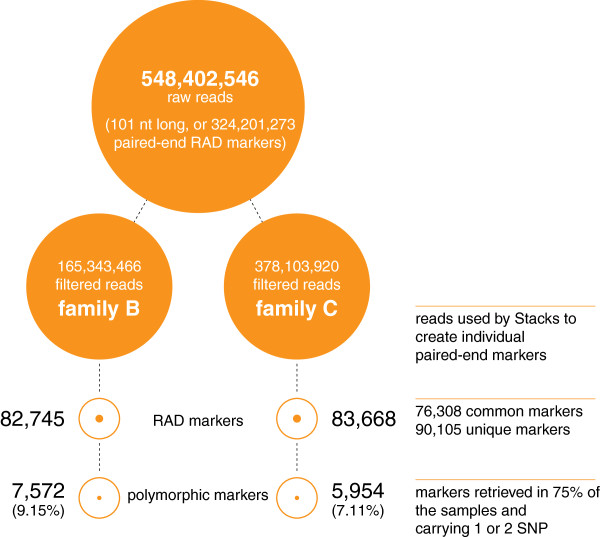
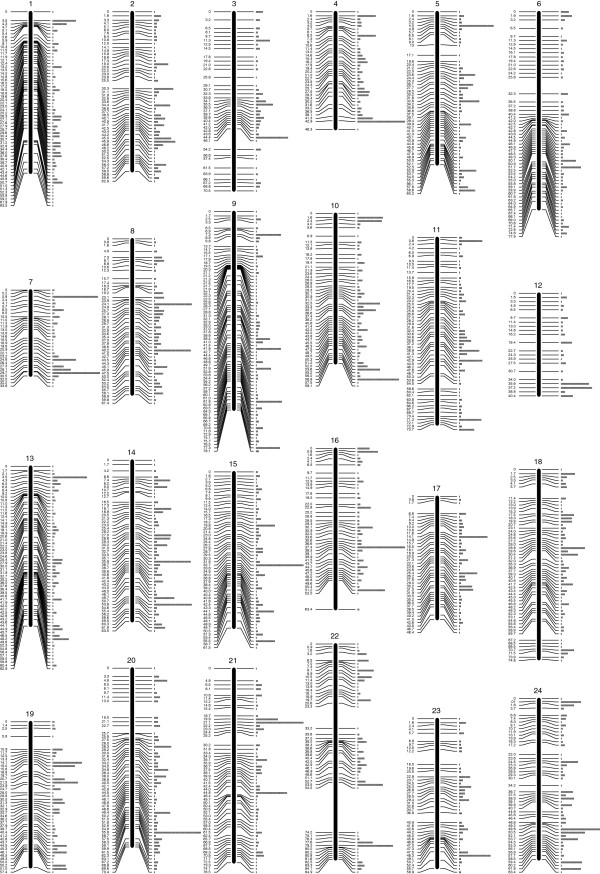
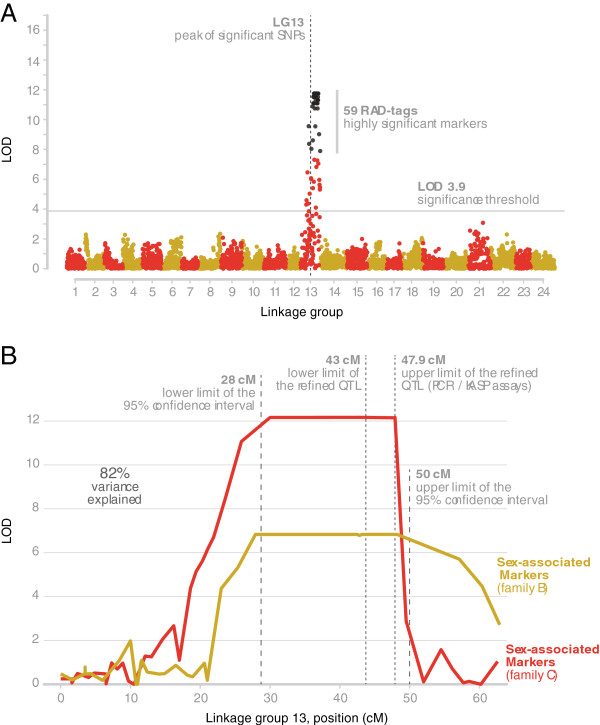
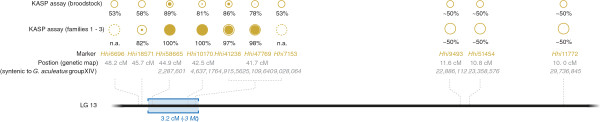
Halibut juveniles were masculinised with 17 α-methyldihydrotestosterone (MDHT) and grown to maturity. Progeny groups from four treated males were reared and sexed. Two of these groups (n = 26 and 70) consisted of only females, while the other two (n = 30 and 71) contained balanced sex ratios (50% and 48% females respectively). DNA from parents and offspring from the two mixed-sex families were used as a template for Restriction-site Associated DNA (RAD) sequencing. The 648 million raw reads produced 90,105 unique RAD-tags. A linkage map was constructed based on 5703 Single Nucleotide Polymorphism (SNP) markers and 7 microsatellites consisting of 24 linkage groups, which corresponds to the number of chromosome pairs in this species. A major sex determining locus was mapped to linkage group 13 in both families. Assays for 10 SNPs with significant association with phenotypic sex were tested in both population data and in 3 additional families. Using a variety of machine-learning algorithms 97% correct classification could be obtained with the 3% of errors being phenotypic males predicted to be females.
Altogether our findings support the hypothesis that the Atlantic halibut has an XX/XY sex determination system. Assays are described for sex-associated DNA markers developed from the RAD sequencing analysis to fast track progeny testing and implement monosex female halibut production for an immediate improvement in productivity. These should also help to speed up the inclusion of neomales derived from many families to maintain a larger effective population size and ensure long-term improvement through selective breeding.
大西洋比目鱼(Hippoglossus hippoglossus)是冷水海洋水产养殖中的一种高价值、利基市场物种。在商业生产中,生产单性雌性种群是理想的,因为雌性比雄性生长更快,成熟更晚。了解性别决定机制并开发与性别相关的标记物将缩短单性雌性生产的开发时间,从而降低养殖成本。
用 17α-甲基二氢睾酮(MDHT)使比目鱼幼鱼雄性化并生长至成熟。来自 4 只处理过的雄性的后代群体被饲养和性别鉴定。这两个群体(n=26 和 70)仅由雌性组成,而另外两个群体(n=30 和 71)则包含平衡的性别比例(分别为 50%和 48%的雌性)。来自父母和两个混合性别家族后代的 DNA 被用作限制性相关 DNA(RAD)测序的模板。产生的 6.48 亿个原始读数产生了 90,105 个独特的 RAD 标签。基于 5703 个单核苷酸多态性(SNP)标记和 7 个微卫星构建了连锁图谱,由 24 个连锁群组成,与该物种的染色体对数相对应。在两个家族中,一个主要的性别决定基因座被定位到连锁群 13。在两个群体数据和另外 3 个家族中,对与表型性别有显著关联的 10 个 SNP 进行了检测。使用多种机器学习算法,可以正确分类 97%的样本,其中 3%的错误是预测为雌性的表型雄性。
总之,我们的研究结果支持大西洋比目鱼具有 XX/XY 性别决定系统的假设。描述了从 RAD 测序分析中开发的与性别相关的 DNA 标记物的检测方法,以快速进行后代测试,并实施单性雌性比目鱼生产,立即提高生产力。这些标记物还应该有助于加快包含来自许多家族的新雄性的纳入,以保持更大的有效种群大小,并确保通过选择性育种进行长期改进。