Peter Medawar Building for Pathogen Research, Nuffield Department of Medicine, University of Oxford , Oxford , UK ; Institute of Cellular Medicine, Newcastle University , Newcastle upon Tyne , UK.
Front Immunol. 2013 Aug 6;4:223. doi: 10.3389/fimmu.2013.00223. eCollection 2013.
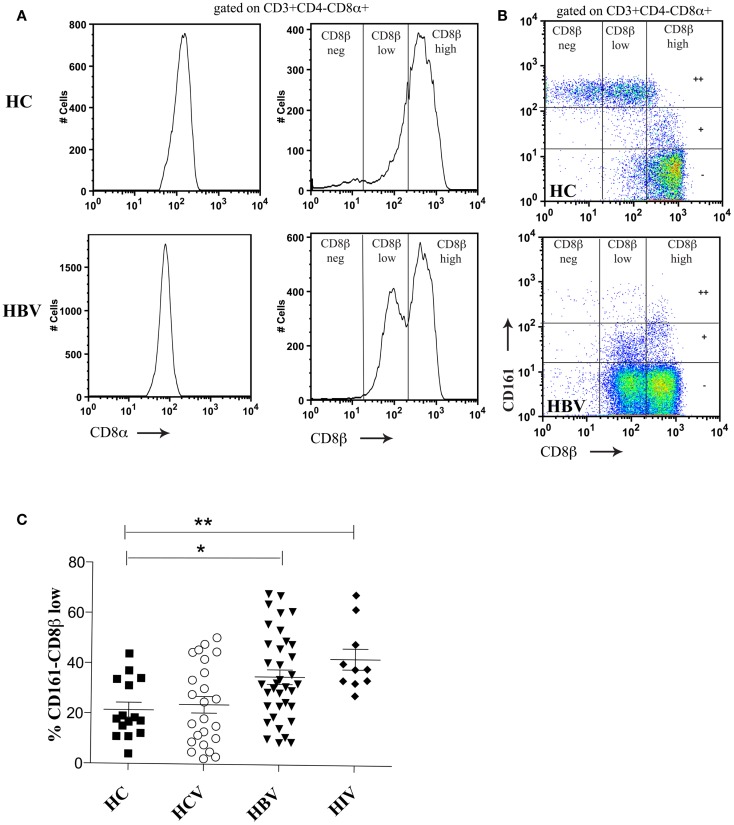
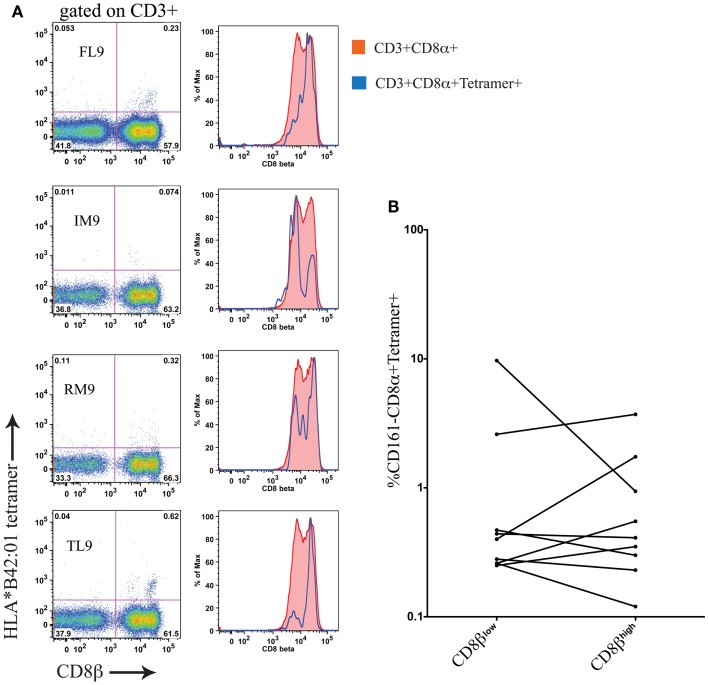
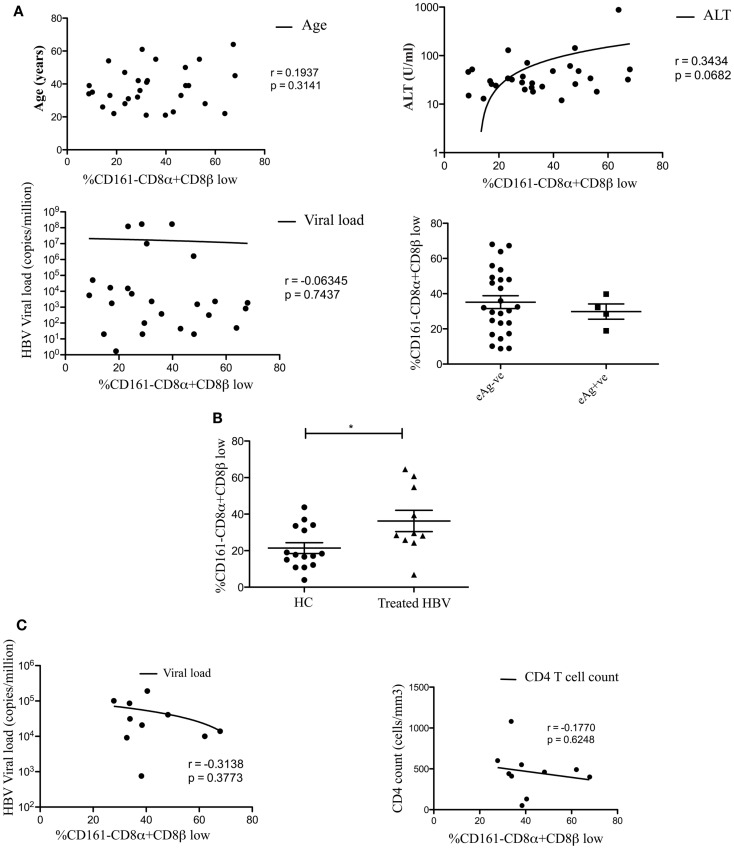
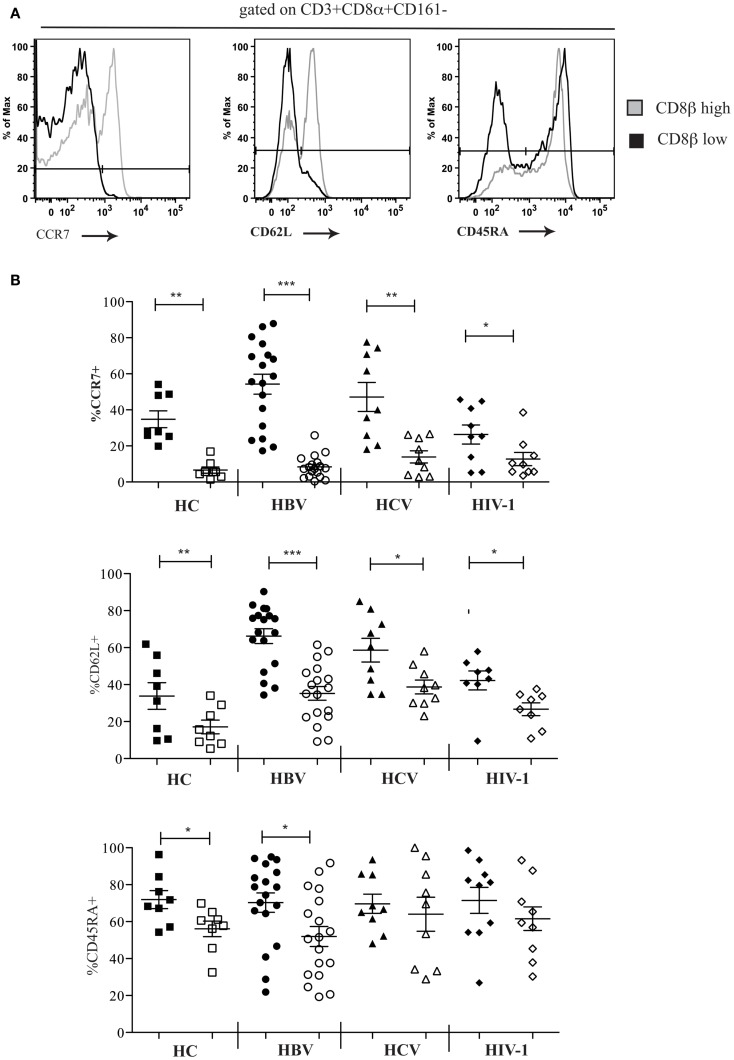
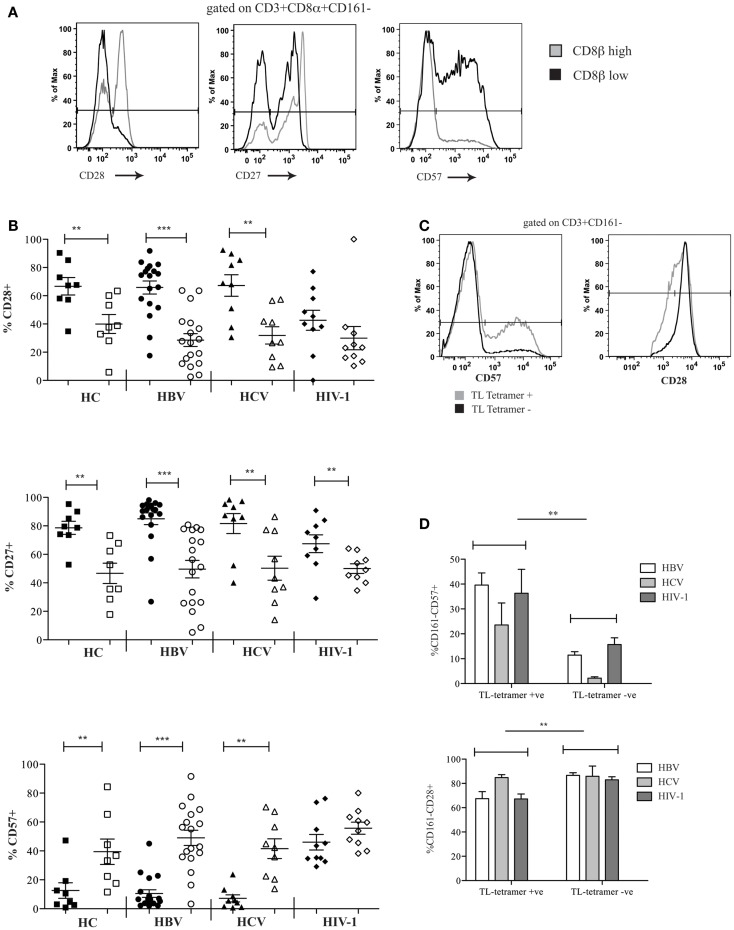
The T cell co-receptor CD8αβ enhances T cell sensitivity to antigen, however studies indicate CD8αα has the converse effect and acts as a co-repressor. Using a combination of Thymic Leukemia (TL) antigen tetramer, which directly binds CD8αα, anti-CD161, and anti-Vα7.2 antibodies we have been able for the first time to clearly define CD8αα expression on human CD8 T cells subsets. In healthy controls CD8αα is most highly expressed by CD161 "bright" (CD161++) mucosal associated invariant T (MAIT) cells, with CD8αα expression highly restricted to the TCR Vα7.2+ cells of this subset. We also identified CD8αα-expressing populations within the CD161 "mid" (CD161+) and "negative" (CD161-) non-MAIT CD8 T cell subsets and show TL-tetramer binding to correlate with expression of CD8β at low levels in the context of maintained CD8α expression (CD8α+CD8β(low)). In addition, we found CD161-CD8α+CD8β(low) populations to be significantly expanded in the peripheral blood of HIV-1 and hepatitis B (mean of 47 and 40% of CD161- T cells respectively) infected individuals. Such CD8αα expressing T cells are an effector-memory population (CD45RA-, CCR7-, CD62L-) that express markers of activation and maturation (HLA-DR+, CD28-, CD27-, CD57+) and are functionally distinct, expressing greater levels of TNF-α and IFN-γ on stimulation and perforin at rest than their CD8α+CD8β(high) counterparts. Antigen-specific T cells in HLA-B(∗)4201+HIV-1 infected patients are found within both the CD161-CD8α+CD8β(high) and CD161-CD8α+CD8β(low) populations. Overall we have clearly defined CD8αα expressing human T cell subsets using the TL-tetramer, and have demonstrated CD161-CD8α+CD8β(low) populations, highly expanded in disease settings, to co-express CD8αβ and CD8αα. Co-expression of CD8αα on CD8αβ T cells may impact on their overall function in vivo and contribute to the distinctive phenotype of highly differentiated populations in HBV and HIV-1 infection.
T 细胞共受体 CD8αβ 增强了 T 细胞对抗原的敏感性,然而研究表明 CD8αα 具有相反的作用,充当共抑制剂。我们使用胸腺白血病 (TL) 抗原四聚体、抗 CD161 和抗 Vα7.2 抗体的组合,首次能够清楚地定义人类 CD8 T 细胞亚群上的 CD8αα 表达。在健康对照中,CD8αα 主要由 CD161“明亮”(CD161++)黏膜相关不变 T (MAIT) 细胞表达,CD8αα 表达高度局限于该亚群的 TCR Vα7.2+细胞。我们还在 CD161“中”(CD161+)和“阴性”(CD161-)非 MAIT CD8 T 细胞亚群中鉴定出表达 CD8αα 的群体,并表明 TL-四聚体结合与 CD8β 在 CD8α 表达水平维持的情况下的低水平表达相关(CD8α+CD8β(low))。此外,我们发现 CD161-CD8α+CD8β(low)群体在外周血中显著扩增,在 HIV-1 和乙型肝炎 (分别为平均 47%和 40%的 CD161-T 细胞)感染个体中。这种表达 CD8αα 的 T 细胞是一种效应记忆群体(CD45RA-、CCR7-、CD62L-),表达激活和成熟的标志物(HLA-DR+、CD28-、CD27-、CD57+),并且功能不同,在刺激时表达更高水平的 TNF-α和 IFN-γ,在静止时表达更高水平的穿孔素比其 CD8α+CD8β(high)对应物。在 HLA-B(∗)4201+HIV-1 感染患者中,抗原特异性 T 细胞存在于 CD161-CD8α+CD8β(high)和 CD161-CD8α+CD8β(low)群体中。总体而言,我们使用 TL-四聚体清楚地定义了表达 CD8αα 的人类 T 细胞亚群,并证明了在疾病状态下高度扩增的 CD161-CD8α+CD8β(low)群体共同表达 CD8αβ 和 CD8αα。CD8αα 在 CD8αβ T 细胞上的共表达可能会影响其体内的整体功能,并导致乙型肝炎病毒和 HIV-1 感染中高度分化群体的独特表型。