Boyacioglu Murat, Turgut Hulya, Akgullu Cagdas, Eryilmaz Ufuk, Kum Cavit, Onbasili Osman Alper
Department of Pharmacology and Toxicology, Faculty of Veterinary Medicine, Adnan Menderes University, Aydin, Turkey.
J Vet Med Sci. 2014 Jan;76(1):1-8. doi: 10.1292/jvms.13-0202. Epub 2013 Aug 20.
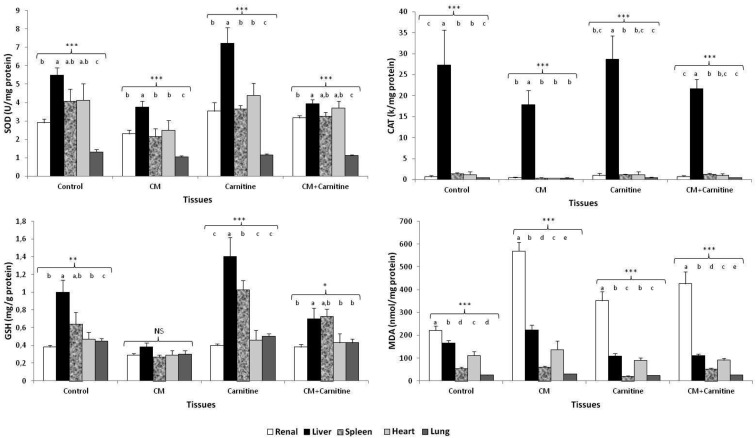
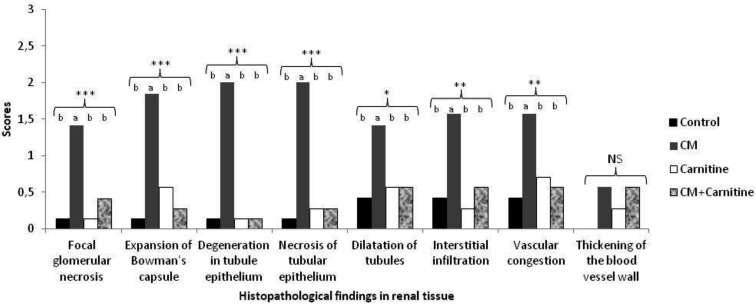
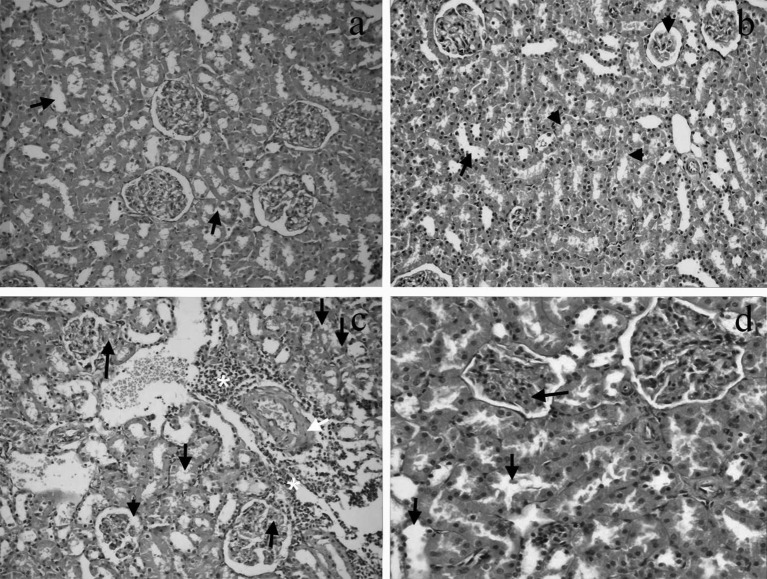
This study was conducted to investigate the prophylactic effects of carnitine against contrast-induced nephropathy (CIN) and its relation to oxidant/antioxidant status in kidney, liver, heart, spleen and lung tissues in a CIN rat model. Twenty-eight adult male Wistar rats were divided into 4 groups, the control, contrast media (CM), carnitine and contrast media+carnitine (CM+carnitine) groups. Animals were placed in individual metabolism cages, and on the 2nd day, rats were deprived of water for 24 hr. On the 3rd day, contrast media were administered to groups CM and CM+carnitine. L-carnitine was administered on days 2, 3 and 4. Histopathological changes were evaluated in the right kidney after euthanization. Superoxide dismutase (SOD) and catalase (CAT) activities and glutathione (GSH) and malondialdehyde (MDA) levels were measured in renal, liver, heart, spleen and lung tissues. The SOD activities in the renal (P<0.05), liver (P<0.001) and spleen (P<0.05) tissues were increased in the carnitine group. The CAT activities in the spleen tissue were decreased (P<0.01) only in the CM group. Renal (P<0.05), liver (P<0.001), spleen (P<0.001) and lung tissue (P<0.01) GSH levels were found to be higher in the carnitine group. In renal, liver and lung tissues, the MDA levels increased in the CM group (P<0.001). The histopathological findings showed that L-carnitine may have a preventative effect in alleviating the negative effects of CIN. Similar to this, L-carnitine may play a major role in the stability of the antioxidant status in the kidney, liver, spleen and lung of the CIN rat model.
本研究旨在探讨肉碱对造影剂肾病(CIN)的预防作用及其与CIN大鼠模型肾、肝、心、脾和肺组织中氧化/抗氧化状态的关系。28只成年雄性Wistar大鼠分为4组,即对照组、造影剂(CM)组、肉碱组和造影剂+肉碱(CM+肉碱)组。将动物置于单独的代谢笼中,第2天,大鼠禁食禁水24小时。第3天,对CM组和CM+肉碱组给予造影剂。在第2、3和4天给予左旋肉碱。安乐死后评估右肾的组织病理学变化。测定肾、肝、心、脾和肺组织中的超氧化物歧化酶(SOD)和过氧化氢酶(CAT)活性以及谷胱甘肽(GSH)和丙二醛(MDA)水平。肉碱组肾(P<0.05)、肝(P<0.001)和脾(P<0.05)组织中的SOD活性增加。仅CM组脾组织中的CAT活性降低(P<0.01)。发现肉碱组肾(P<0.05)、肝(P<0.001)、脾(P<0.001)和肺组织(P<0.01)中的GSH水平较高。在肾、肝和肺组织中,CM组的MDA水平升高(P<0.001)。组织病理学结果表明,左旋肉碱可能对减轻CIN的负面影响具有预防作用。与此类似,左旋肉碱可能在CIN大鼠模型的肾、肝、脾和肺的抗氧化状态稳定性中起主要作用。