Computer Architecture, Electronics and ET, University of Córdoba, Córdoba 14071, Spain.
Sensors (Basel). 2013 Aug 20;13(8):10981-1006. doi: 10.3390/s130810981.
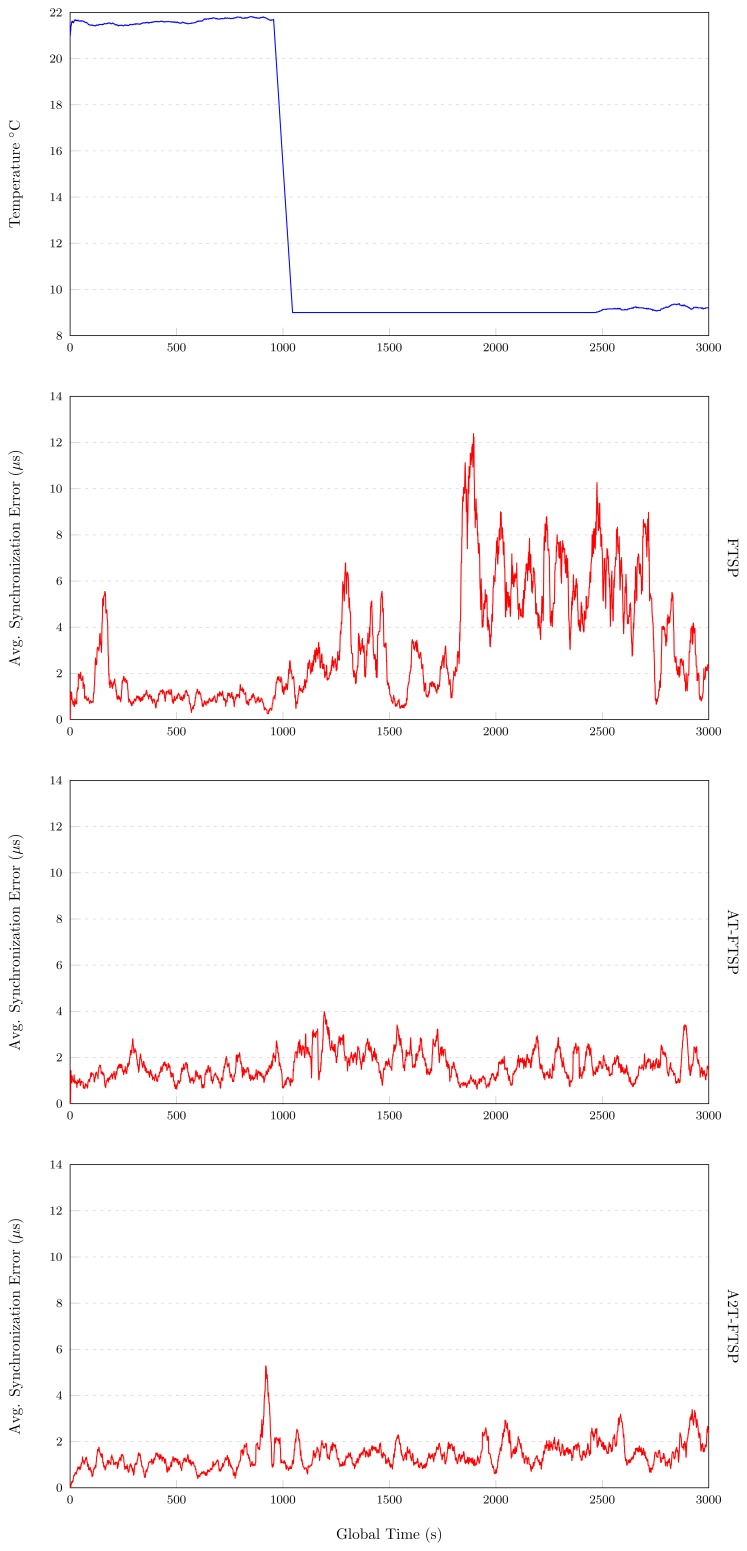
This work analyzes several drift compensation mechanisms in wireless sensor networks (WSN). Temperature is an environmental factor that greatly affects oscillators shipped in every WSN mote. This behavior creates the need of improving drift compensation mechanisms in synchronization protocols. Using the Flooding Time Synchronization Protocol (FTSP), this work demonstrates that crystal oscillators are affected by temperature variations. Thus, the influence of temperature provokes a low performance of FTSP in changing conditions of temperature. This article proposes an innovative correction factor that minimizes the impact of temperature in the clock skew. By means of this factor, two new mechanisms are proposed in this paper: the Adjusted Temperature (AT) and the Advanced Adjusted Temperature (A2T). These mechanisms have been combined with FTSP to produce AT-FTSP and A2T-FTSP. Both have been tested in a network of TelosB motes running TinyOS. Results show that both AT-FTSP and A2T-FTSP improve the average synchronization errors compared to FTSP and other temperature-compensated protocols (Environment-Aware Clock Skew Estimation and Synchronization for WSN (EACS) and Temperature Compensated Time Synchronization (TCTS)).
本工作分析了无线传感器网络(WSN)中的几种漂移补偿机制。温度是影响每个 WSN 微节点中振荡器的环境因素。这种行为需要改进同步协议中的漂移补偿机制。使用 Flooding Time Synchronization Protocol(FTSP),本工作表明晶体振荡器受到温度变化的影响。因此,温度的影响会导致 FTSP 在温度变化的情况下性能降低。本文提出了一种创新的校正因子,可最大程度地减少时钟偏移中的温度影响。通过该因子,本文提出了两种新的机制:调整温度(AT)和高级调整温度(A2T)。这两种机制都与 FTSP 相结合,产生了 AT-FTSP 和 A2T-FTSP。这两种机制都在运行 TinyOS 的 TelosB mote 网络中进行了测试。结果表明,与 FTSP 和其他温度补偿协议(用于 WSN 的环境感知时钟偏移估计和同步(EACS)和温度补偿时间同步(TCTS))相比,AT-FTSP 和 A2T-FTSP 都能提高平均同步误差。