Department of Food Safety and Veterinary Public Health, Istituto Superiore di Sanità, Rome, Italy.
PLoS One. 2013 Aug 15;8(8):e71324. doi: 10.1371/journal.pone.0071324. eCollection 2013.
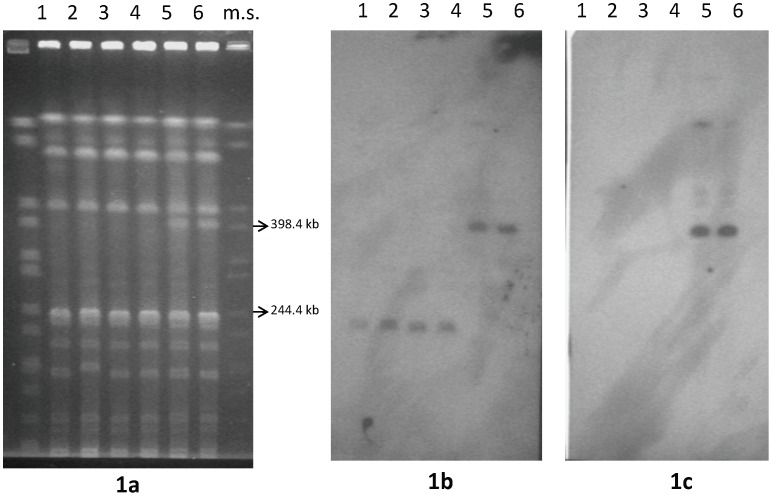
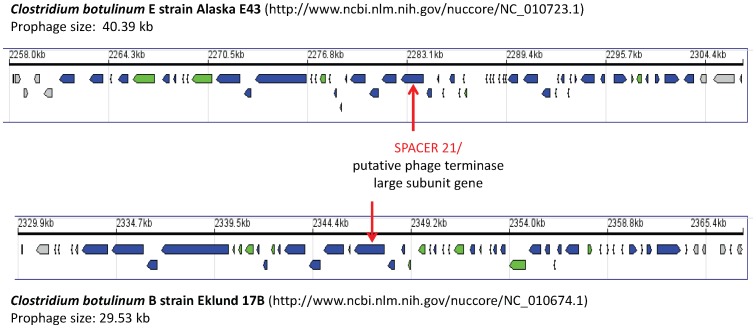
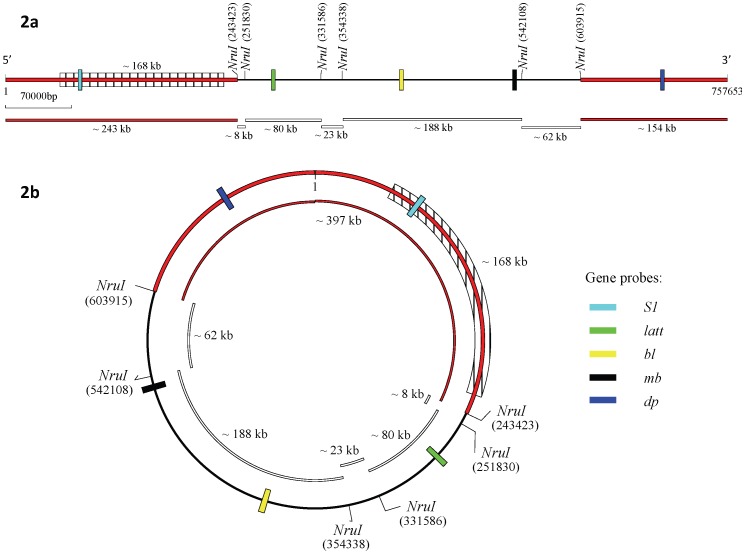
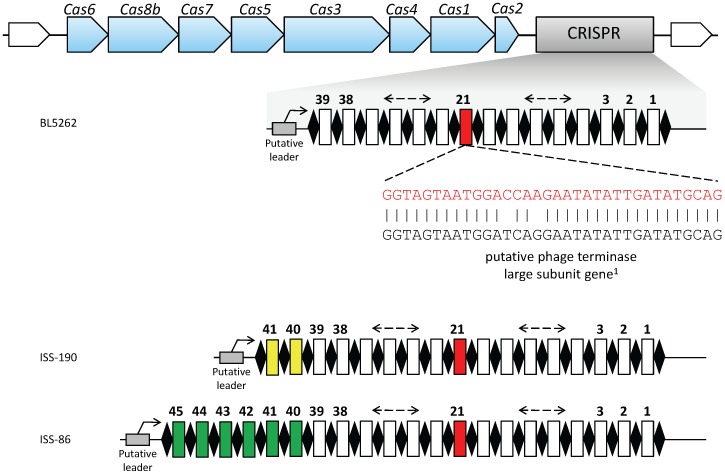
We determined the genetic maps of the megaplasmids of six neutoroxigenic Clostridium butyricum type E strains from Italy using molecular and bioinformatics techniques. The megaplasmids are circular, not linear as we had previously proposed. The differently-sized megaplasmids share a genetic region that includes structural, metabolic and regulatory genes. In addition, we found that a 168 kb genetic region is present only in the larger megaplasmids of two tested strains, whereas it is absent from the smaller megaplasmids of the four remaining strains. The genetic region unique to the larger megaplasmids contains, among other features, a locus for clustered regularly interspaced short palindromic repeats (CRISPR) and CRISPR associated (cas) genes, i.e. a bacterial adaptive immune system providing sequence-specific protection from invading genetic elements. Some CRISPR spacer sequences of the neurotoxigenic C. butyricum type E strains showed homology to prophage, phage and plasmid sequences from closely related clostridia species or from distant species, all sharing the intestinal habitat, suggesting that the CRISPR locus might be involved in the microorganism adaptation to the human or animal intestinal environment. Besides, we report here that each of four distinct CRISPR spacers partially matched DNA sequences of different prophages and phages, at identical nucleotide locations. This suggests that, at least in neurotoxigenic C. butyricum type E, the CRISPR locus is potentially able to recognize the same conserved DNA sequence of different invading genetic elements, besides targeting sequences unique to previously encountered invading DNA, as currently predicted for a CRISPR locus. Thus, the results of this study introduce the possibility that CRISPR loci can provide resistance to a wider range of invading DNA elements than previously appreciated. Whether it is more advantageous for the peculiar neurotoxigenic C. butyricum type E strains to maintain or to lose the CRISPR-cas system remains an open question.
我们使用分子和生物信息学技术确定了来自意大利的六种神经毒性梭菌丁酸型 E 菌株的巨型质粒的遗传图谱。这些巨型质粒是圆形的,而不是我们之前提出的线性的。不同大小的巨型质粒共享一个包括结构、代谢和调节基因的遗传区域。此外,我们发现,一个 168 kb 的遗传区域仅存在于两个测试菌株的较大巨型质粒中,而在其余四个菌株的较小巨型质粒中不存在。这个仅存在于较大巨型质粒中的遗传区域包含了其他特征,例如一个成簇规律间隔短回文重复序列(CRISPR)和 CRISPR 相关(cas)基因的基因座,即细菌适应性免疫系统,为入侵遗传元件提供序列特异性保护。一些神经毒性梭菌丁酸型 E 菌株的 CRISPR 间隔序列与密切相关的梭菌种或来自远缘物种的噬菌体和质粒序列具有同源性,所有这些都具有肠道栖息地,这表明 CRISPR 基因座可能参与微生物对人类或动物肠道环境的适应。此外,我们在这里报告,四个不同的 CRISPR 间隔序列中的每一个都与不同的前噬菌体和噬菌体的 DNA 序列部分匹配,在相同的核苷酸位置。这表明,至少在神经毒性梭菌丁酸型 E 中,CRISPR 基因座有可能识别不同入侵遗传元件的相同保守 DNA 序列,除了针对以前遇到的入侵 DNA 的独特序列,如目前预测的 CRISPR 基因座。因此,这项研究的结果提出了这样一种可能性,即 CRISPR 基因座可以提供对更广泛的入侵 DNA 元素的抗性,这比以前认为的更为广泛。对于特殊的神经毒性梭菌丁酸型 E 菌株来说,维持或失去 CRISPR-cas 系统是否更有利,这仍然是一个悬而未决的问题。