Division of Endocrinology, Stanford University, Stanford, California, United States of America.
PLoS One. 2013 Aug 14;8(8):e72367. doi: 10.1371/journal.pone.0072367. eCollection 2013.
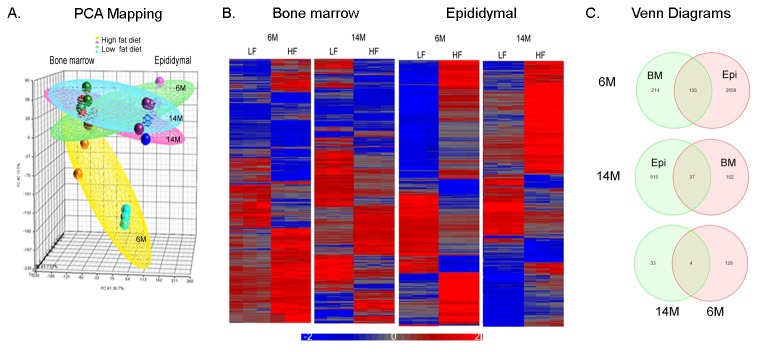
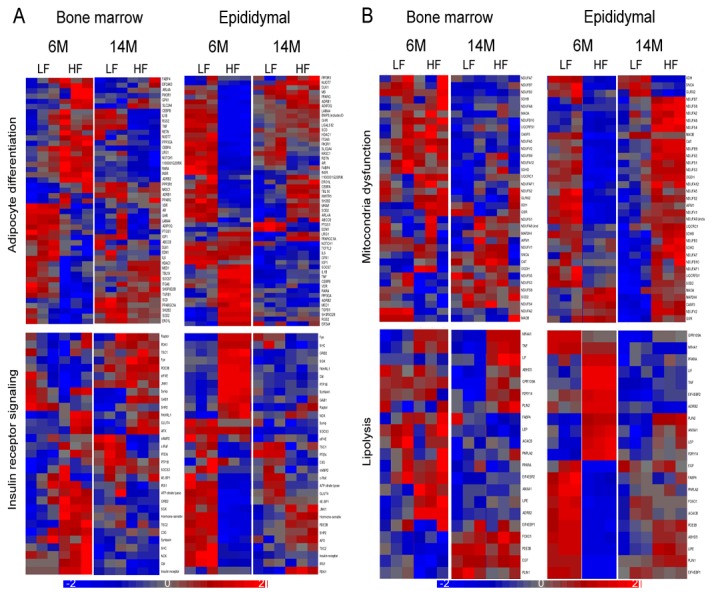
This study aimed to characterize and compare the effects of obesity on gene expression profiles in two distinct adipose depots, epididymal and bone marrow, at two different ages in mice. Alterations in gene expression were analyzed in adipocytes isolated from diet-induced obese (DIO) C57BL/6J male mice at 6 and 14 months of age and from leptin deficient mice (ob/ob) at 6 months of age using microarrays. DIO affected gene expression in both depots at 6 and 14 months, but more genes were altered in epididymal than bone marrow adipocytes at each age and younger mice displayed more changes than older animals. In epididymal adipocytes a total of 2789 (9.6%) genes were differentially expressed at 6-months with DIO, whereas 952 (3.3%) were affected at 14-months. In bone marrow adipocytes, 347 (1.2%) genes were differentially expressed at 6-months with DIO, whereas only 189 (0.66%) were changed at 14-months. 133 genes were altered by DIO in both fat depots at 6-months, and 37 genes at 14-months. Only four genes were altered in both depots at both ages with DIO. Bone marrow adipocytes are less responsive to DIO than epididymal adipocytes and the response of both depots to DIO declines with age. This loss of responsiveness with age is likely due to age-associated changes in expression of genes related to adipogenesis, inflammation and mitochondrial function that are similar to and obscure the changes commonly associated with DIO. Patterns of gene expression were generally similar in epididymal adipocytes from ob/ob and DIO mice; however, several genes were differentially expressed in bone marrow adipocytes from ob/ob and DIO mice, perhaps reflecting the importance of leptin signaling for bone metabolism. In conclusion, obesity affects age-associated alterations in gene expression in both epididymal and bone marrow adipocytes regardless of diet or genetic background.
这项研究旨在描述和比较肥胖对两种不同脂肪组织(附睾和骨髓)中基因表达谱的影响,研究对象为在不同年龄的饮食诱导肥胖(DIO)C57BL/6J 雄性小鼠和 6 月龄瘦素缺陷(ob/ob)小鼠。使用微阵列分析从饮食诱导肥胖的 C57BL/6J 雄性小鼠(6 个月和 14 个月大)和瘦素缺陷(ob/ob)小鼠(6 个月大)分离的脂肪细胞中的基因表达变化。DIO 在 6 个月和 14 个月时都影响了两个部位的基因表达,但在每个年龄阶段,附睾脂肪细胞中改变的基因比骨髓脂肪细胞更多,年轻动物的变化比老年动物更多。在附睾脂肪细胞中,共有 2789 个(9.6%)基因在 6 个月时因 DIO 而表达差异,而在 14 个月时则有 952 个(3.3%)基因受影响。在骨髓脂肪细胞中,有 347 个(1.2%)基因在 6 个月时因 DIO 而表达差异,而在 14 个月时则只有 189 个(0.66%)基因受影响。在 6 个月时,133 个基因因 DIO 在两个脂肪组织中均发生改变,而在 14 个月时则有 37 个基因发生改变。只有 4 个基因在两个年龄阶段的两个脂肪组织中因 DIO 而改变。骨髓脂肪细胞对 DIO 的反应性低于附睾脂肪细胞,并且两个脂肪组织对 DIO 的反应随着年龄的增长而下降。这种随着年龄增长而丧失反应性的原因可能是与脂肪生成、炎症和线粒体功能相关的基因的表达随年龄而发生变化,这些变化与通常与 DIO 相关的变化相似且掩盖了这些变化。附睾脂肪细胞中基因表达的模式在 ob/ob 和 DIO 小鼠中通常相似;然而,ob/ob 和 DIO 小鼠的骨髓脂肪细胞中有几个基因表达差异,这可能反映了瘦素信号对骨代谢的重要性。总之,肥胖会影响附睾和骨髓脂肪细胞中与年龄相关的基因表达变化,无论饮食或遗传背景如何。