Monti Paolo, Piemonti Lorenzo
San Raffaele Diabetes Research Institute, San Raffaele Scientific Institute, Via Olgettina 60, 20132 Milan, Italy.
Clin Dev Immunol. 2013;2013:217934. doi: 10.1155/2013/217934. Epub 2013 Jul 22.
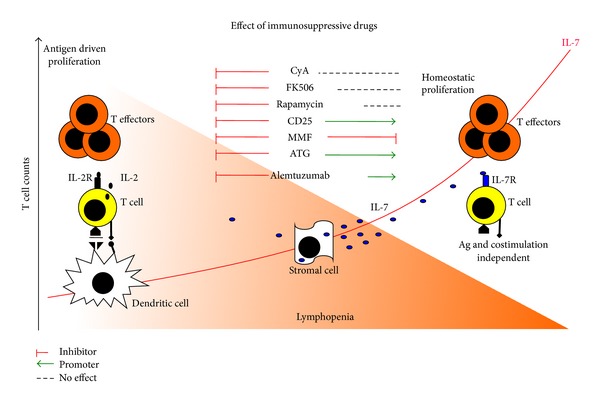
Pancreatic islet transplantation in patients with type 1 diabetes mellitus is performed under immunosuppression to avoid alloreactive T cell responses and to control the reactivation of autoreactive memory T cells. However, lymphopenia associated with immunosuppression and T cell depletion can induce a paradoxical expansion of lymphocyte subsets under the influence of homeostatic proliferation. Homeostatic T cell proliferation is mainly driven by the IL-7/IL-7 receptor axis, a molecular pathway which is not affected by standard immune-suppressive drugs and, consequently, represents a novel potential target for immuno-modulatory strategies. In this review, we will discuss how homeostatic T cell proliferation can support autoimmunity recurrence after islet transplantation and how it can be targeted by new therapeutic approaches.
1型糖尿病患者的胰岛移植在免疫抑制下进行,以避免同种异体反应性T细胞反应,并控制自身反应性记忆T细胞的重新激活。然而,与免疫抑制和T细胞耗竭相关的淋巴细胞减少可在稳态增殖的影响下诱导淋巴细胞亚群的反常扩增。稳态T细胞增殖主要由IL-7/IL-7受体轴驱动,这是一条不受标准免疫抑制药物影响的分子途径,因此,它是免疫调节策略的一个新的潜在靶点。在这篇综述中,我们将讨论稳态T细胞增殖如何支持胰岛移植后自身免疫复发,以及如何通过新的治疗方法对其进行靶向治疗。