Department of Orthopaedics and Rehabilitation, The University of Iowa, Iowa City, IA 52242-1088, USA.
Osteoarthritis Cartilage. 2013 Sep;21(9):1154-9. doi: 10.1016/j.joca.2013.05.016.
To determine whether quadriceps weakness is associated with elevated risk of worsening knee pain over 5 years.
The Multicenter Osteoarthritis Study (MOST) is a longitudinal study of 50-79-year-old adults with knee osteoarthritis (OA) or known risk factors for knee OA. The predictor variable was baseline isokinetic quadriceps strength. Covariates included baseline body mass index (BMI), physical activity level, and history of knee surgery. The outcome was worsening pain reported on the Western Ontario and McMaster Universities (WOMAC) Osteoarthritis Index pain subscale or knee replacement surgery between baseline and 5-year follow-up. Analyses were knee-based and used generalized estimating equations, stratified by sex to assess whether the lowest compared with the highest tertile of baseline quadriceps strength was associated with an increased risk of worsening knee pain at 5-year follow-up, controlling for age, BMI, history of knee surgery, and physical activity level as well as correlation between knees within participants.
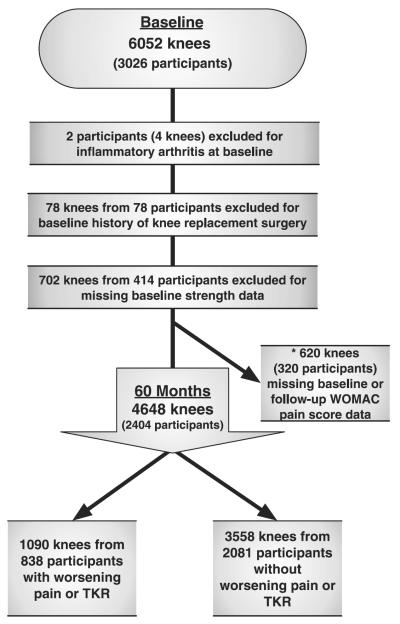
Analyses of worsening knee pain included 4,648 knees from 2,404 participants (61% female). Men with lower quadriceps strength did not have a higher risk of worsening knee pain (RR {95% CI} = 1.01 {0.78-1.32}, P = 0.9183). However, women in the lowest compared with the highest strength tertile had a 28% increased risk of worsening knee pain (RR {95% CI} = 1.28 {1.08-1.52}, P = 0.0052).
Quadriceps weakness was associated with an increased risk of worsening of knee pain over 5 years in women, but not in men.
确定股四头肌无力是否与 5 年内膝关节疼痛恶化的风险升高有关。
多中心骨关节炎研究(MOST)是一项针对 50-79 岁膝关节骨关节炎(OA)或膝关节 OA 已知危险因素患者的纵向研究。预测变量为基线等速股四头肌力量。协变量包括基线体重指数(BMI)、身体活动水平和膝关节手术史。结果是在基线和 5 年随访期间,根据 Western Ontario 和 McMaster 大学(WOMAC)骨关节炎指数疼痛子量表或膝关节置换手术报告的疼痛恶化。分析基于膝关节,使用广义估计方程,按性别分层,以评估与最高三分位相比,最低三分位的基线股四头肌力量是否与 5 年随访时膝关节疼痛恶化的风险增加相关,同时控制年龄、BMI、膝关节手术史和身体活动水平以及参与者膝关节之间的相关性。
分析膝关节疼痛恶化包括来自 2404 名参与者的 4648 个膝关节(61%为女性)。股四头肌力量较弱的男性膝关节疼痛恶化的风险没有增加(RR{95%CI}=1.01{0.78-1.32},P=0.9183)。然而,与最高力量三分位相比,最低力量三分位的女性膝关节疼痛恶化的风险增加了 28%(RR{95%CI}=1.28{1.08-1.52},P=0.0052)。
股四头肌无力与女性膝关节疼痛恶化风险升高相关,而与男性无关。