Mood and Anxiety Disorders Program, Department of Psychiatry, Icahn School of Medicine at Mount Sinai, New York, NY, USA.
Neuropsychiatr Dis Treat. 2013;9:1101-12. doi: 10.2147/NDT.S36689. Epub 2013 Aug 7.
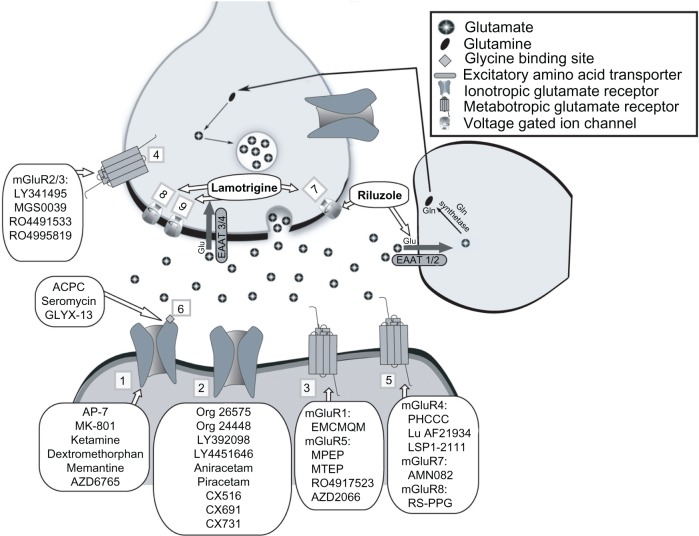
Mood disorders are common and debilitating, resulting in a significant public health burden. Current treatments are only partly effective and patients who have failed to respond to trials of existing antidepressant agents (eg, those who suffer from treatment-resistant depression [TRD]) require innovative therapeutics with novel mechanisms of action. Although neuroscience research has elucidated important aspects of the basic mechanisms of antidepressant action, most antidepressant drugs target monoaminergic mechanisms identified decades ago. Glutamate, the major excitatory neurotransmitter in the central nervous system, and glutamatergic dysfunction has been implicated in mood disorders. These data provide a rationale for the pursuit of glutamatergic agents as novel therapeutic agents. Here, we review preclinical and clinical investigations of glutamatergic agents in mood disorders with a focus on depression. We begin with discussion of evidence for the rapid antidepressant effects of ketamine, followed by studies of the antidepressant efficacy of the currently marketed drugs riluzole and lamotrigine. Promising novel agents currently in development, including N-methyl-D-aspartate (NMDA) receptor modulators, 2-amino-3-(3-hydroxy-5-methyl-isoxazol-4-yl) propanoic acid (AMPA) receptor modulators, and drugs with activity at the metabotropic glutamate (mGlu) receptors are then reviewed. Taken together, both preclinical and clinical evidence exists to support the pursuit of small molecule modulators of the glutamate system as novel therapeutic agents in mood disorders. It is hoped that by targeting neural systems outside of the monoamine system, more effective and perhaps faster acting therapeutics can be developed for patients suffering from these disabling disorders.
心境障碍很常见且使人虚弱,导致了巨大的公共卫生负担。目前的治疗方法仅部分有效,那些对现有抗抑郁药物试验无反应的患者(例如,患有治疗抵抗性抑郁症 [TRD] 的患者)需要具有新型作用机制的创新疗法。尽管神经科学研究阐明了抗抑郁作用的基本机制的重要方面,但大多数抗抑郁药物的靶点是几十年前确定的单胺能机制。谷氨酸是中枢神经系统中的主要兴奋性神经递质,谷氨酸能功能障碍与心境障碍有关。这些数据为开发谷氨酸能药物作为新型治疗药物提供了依据。在这里,我们综述了心境障碍中谷氨酸能药物的临床前和临床研究,重点是抑郁症。我们首先讨论了氯胺酮具有快速抗抑郁作用的证据,然后研究了目前市售药物利鲁唑和拉莫三嗪的抗抑郁疗效。然后还综述了目前正在开发的有前途的新型药物,包括 N-甲基-D-天冬氨酸(NMDA)受体调节剂、2-氨基-3-(3-羟基-5-甲基异恶唑-4-基)丙酸(AMPA)受体调节剂以及作用于代谢型谷氨酸(mGlu)受体的药物。综上所述,无论是临床前还是临床证据都支持将谷氨酸系统的小分子调节剂作为心境障碍的新型治疗药物进行研究。希望通过靶向单胺能系统以外的神经系统,可以为患有这些致残性疾病的患者开发出更有效、或许起效更快的治疗方法。