Cancer Registration and Statistics Branch, National Cancer Control Institute, National Cancer Center, Goyang, Korea.
PLoS One. 2013 Aug 16;8(8):e72012. doi: 10.1371/journal.pone.0072012. eCollection 2013.
Our study aims to describe changes in carcinoma in situ (CIS) and invasive cervical carcinoma (ICC) in Korean women diagnosed between 1993 and 2009.
All cases of CIS and invasive cervical carcinoma diagnosed from 1993 to 2009 in the Korean National Cancer Incidence database were analyzed. Age-standardized rates (ASRs) and annual percent changes (APCs) in incidence rates were compared according to age and histological type. Additionally, we used Korea National Health and Nutrition Examination Survey (KNHANES) to know the association between screening rate for cervical cancer and incidence rate of cervical cancer.
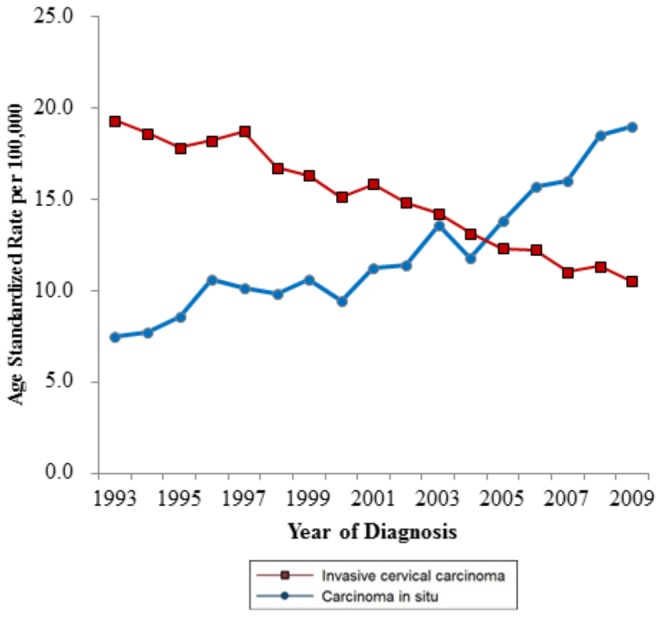
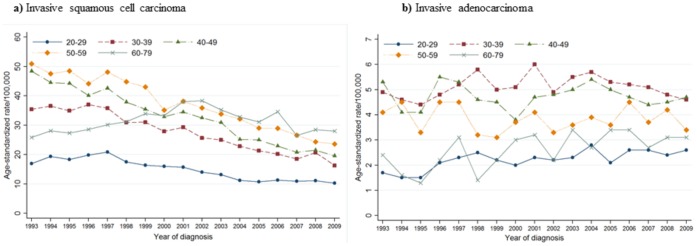
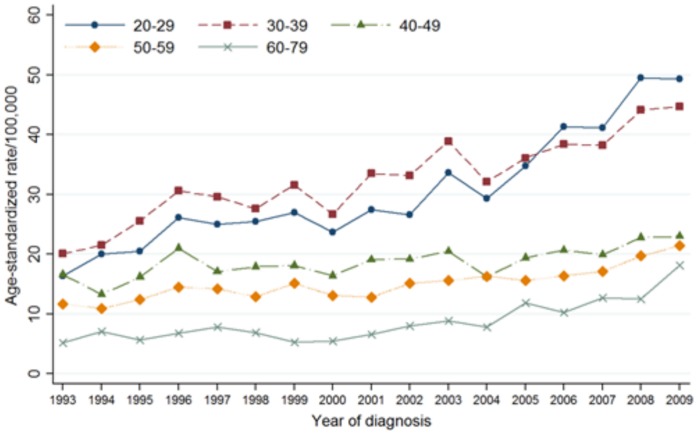
Between 1993 and 2009, 72,240 cases of ICC were reported in Korea. Total incidence rate of ICC was 14.7 per 100,000 females. ASRs of ICC declined 3.8% per year, from 19.3 per 100,000 in 1993 to 10.5 per 100,000 in 2009. Although the overall incidence rate of adenocarcinoma remained stable, invasive squamous cell carcinoma showed a decreasing trend (APC -4.2%). For women aged 60-79 years, ASRs for squamous cell carcinoma increased from 1993 to 2001, and decreased from 2001 to 2009 (APC: -4.6%). Total 62,300 cases of CIS were diagnosed from 1993 to 2009. Total incidence rate of CIS was 12.2 per 100,000 females. ASRs of CIS increased 5.7% per year, from 7.5 per 100,000 in 1993 to 19.0 per 100,000 in 2009. Adenocarcinoma in situ increased 13.2% per year. There was a strong positive correlation between screening rate for cervical cancer and incidence rate for CIS (p-value = 0.03) whereas screening rate showed a strong negative correlation with incidence rate for squamous ICC (p-value = 0.04).
The increasing trend in CIS, coupled with a decreasing trend in ICC, suggests the important role of cervix cancer screening. The incidence of adenocarcinoma showed a plateau, but the incidence of adenocarcinoma in situ showed an increasing trend.
本研究旨在描述 1993 年至 2009 年间在韩国被诊断为原位癌(CIS)和浸润性宫颈癌(ICC)的女性患者的变化情况。
对韩国国家癌症发病率数据库中 1993 年至 2009 年间诊断的所有 CIS 和浸润性宫颈癌病例进行分析。根据年龄和组织学类型比较发病率的年龄标准化率(ASR)和年度百分比变化(APC)。此外,我们还利用韩国国家健康与营养调查(KNHANES)了解宫颈癌筛查率与宫颈癌发病率之间的关系。
1993 年至 2009 年间,韩国共报告 72240 例 ICC。ICC 的总发病率为每 10 万名女性 14.7 例。ICC 的 ASR 每年下降 3.8%,从 1993 年的每 10 万人 19.3 例降至 2009 年的每 10 万人 10.5 例。尽管腺癌的总体发病率保持稳定,但浸润性鳞状细胞癌呈下降趋势(APC-4.2%)。对于 60-79 岁的女性,鳞状细胞癌的 ASR 从 1993 年至 2001 年增加,然后从 2001 年至 2009 年下降(APC:-4.6%)。1993 年至 2009 年间共诊断出 62300 例 CIS。CIS 的总发病率为每 10 万名女性 12.2 例。CIS 的 ASR 每年增加 5.7%,从 1993 年的每 10 万人 7.5 例增加到 2009 年的每 10 万人 19.0 例。原位腺癌每年增加 13.2%。宫颈癌筛查率与 CIS 发病率之间存在强正相关(p 值=0.03),而筛查率与鳞状 ICC 发病率之间存在强负相关(p 值=0.04)。
CIS 的上升趋势,加上 ICC 的下降趋势,表明宫颈癌筛查发挥了重要作用。腺癌的发病率呈平台期,但原位腺癌的发病率呈上升趋势。