Huang Cathy Chia-Yu, Ko Michael Lee, Ko Gladys Yi-Ping
Department of Veterinary Integrative Biosciences, College of Veterinary Medicine and Biomedical Sciences, Texas A&M University, College Station, Texas, United States of America.
PLoS One. 2013 Aug 19;8(8):e73315. doi: 10.1371/journal.pone.0073315. eCollection 2013.
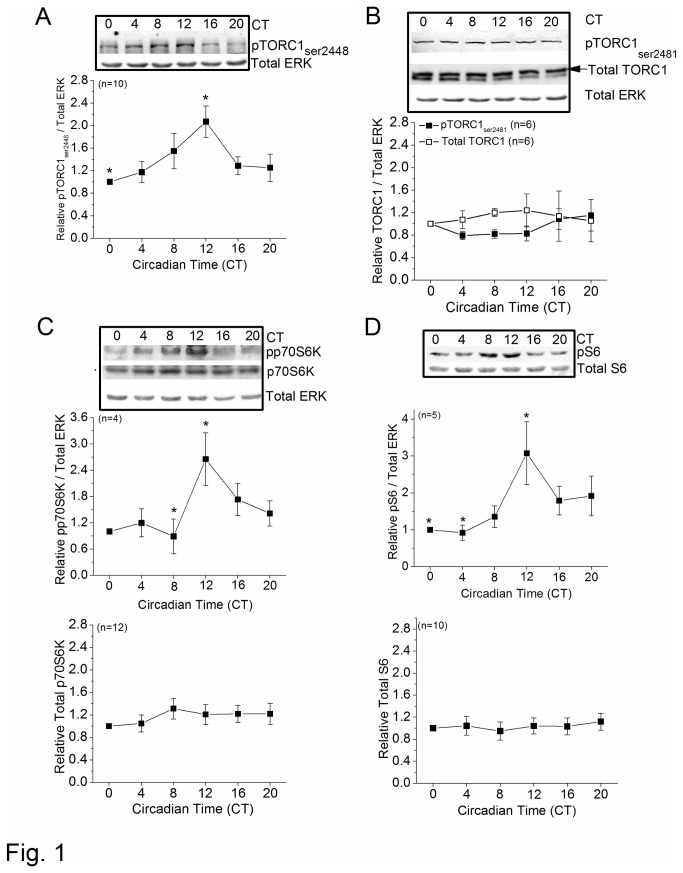
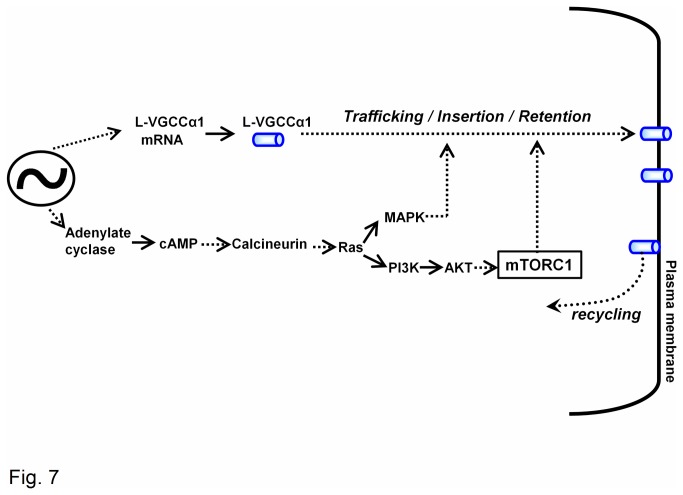
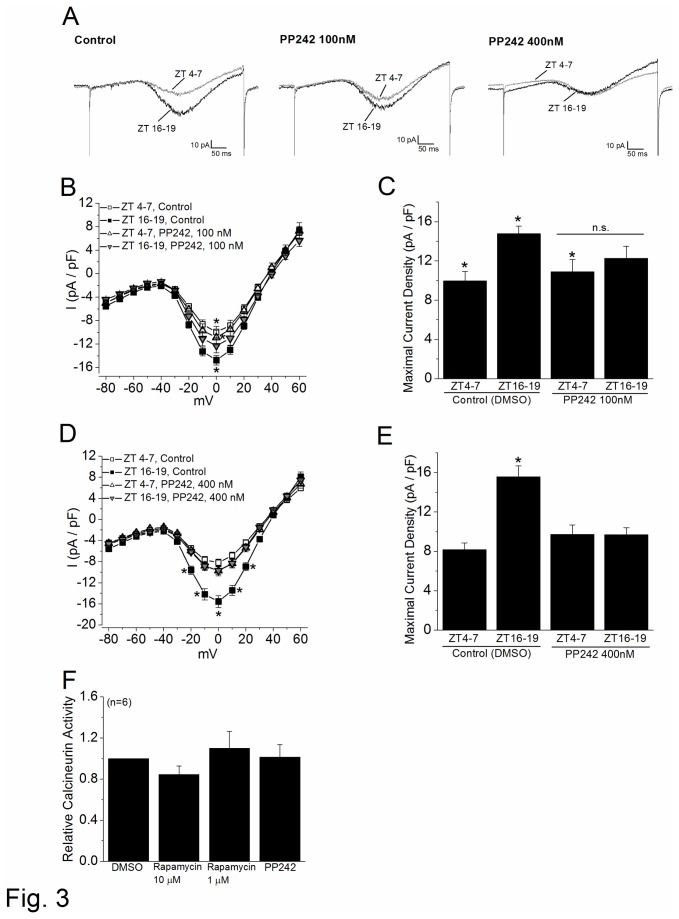
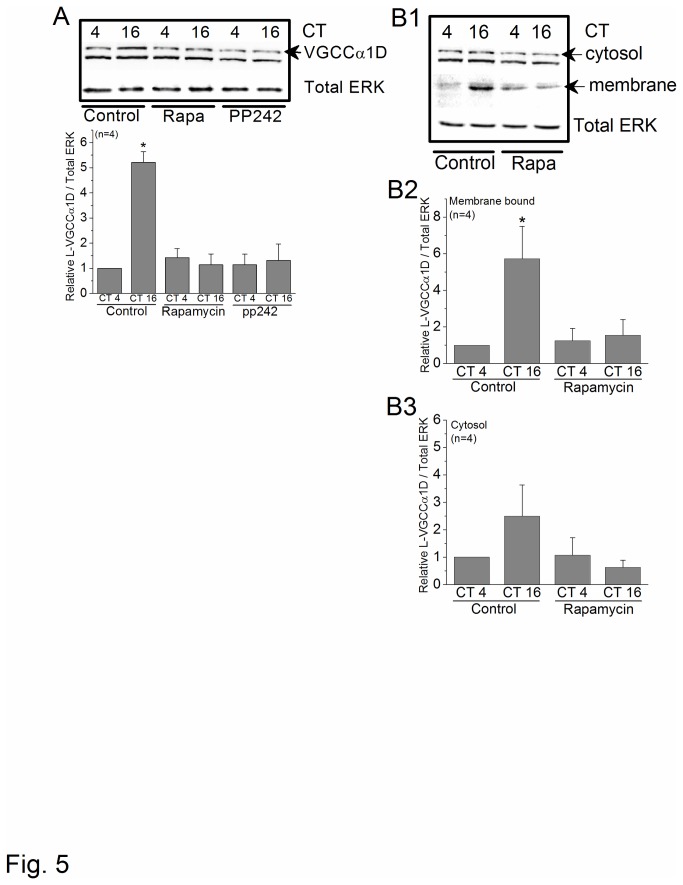
In the retina, the L-type voltage-gated calcium channels (L-VGCCs) are responsible for neurotransmitter release from photoreceptors and are under circadian regulation. Both the current densities and protein expression of L-VGCCs are significantly higher at night than during the day. However, the underlying mechanisms of circadian regulation of L-VGCCs in the retina are not completely understood. In this study, we demonstrated that the mechanistic/mammalian target of rapamycin complex (mTORC) signaling pathway participated in the circadian phase-dependent modulation of L-VGCCs. The activities of the mTOR cascade, from mTORC1 to its downstream targets, displayed circadian oscillations throughout the course of a day. Disruption of mTORC1 signaling dampened the L-VGCC current densities, as well as the protein expression of L-VGCCs at night. The decrease of L-VGCCs at night by mTORC1 inhibition was in part due to a reduction of L-VGCCα1 subunit translocation from the cytosol to the plasma membrane. Finally, we showed that mTORC1 was downstream of the phosphatidylionositol 3 kinase-protein kinase B (PI3K-AKT) signaling pathway. Taken together, mTORC1 signaling played a role in the circadian regulation of L-VGCCs, in part through regulation of ion channel trafficking and translocation, which brings to light a new functional role for mTORC1: the modulation of ion channel activities.
在视网膜中,L型电压门控钙通道(L-VGCCs)负责光感受器释放神经递质,并受昼夜节律调节。L-VGCCs的电流密度和蛋白表达在夜间均显著高于白天。然而,视网膜中L-VGCCs昼夜节律调节的潜在机制尚未完全明确。在本研究中,我们证明雷帕霉素机制性/哺乳动物靶标复合物(mTORC)信号通路参与了L-VGCCs的昼夜节律依赖性调节。从mTORC1到其下游靶点的mTOR级联活性在一天中呈现昼夜节律振荡。mTORC1信号通路的破坏减弱了L-VGCCs的电流密度以及夜间L-VGCCs的蛋白表达。mTORC1抑制导致夜间L-VGCCs减少部分是由于L-VGCCα1亚基从胞质溶胶向质膜的转运减少。最后,我们表明mTORC1位于磷脂酰肌醇3激酶-蛋白激酶B(PI3K-AKT)信号通路的下游。综上所述,mTORC1信号通路在L-VGCCs的昼夜节律调节中发挥作用,部分是通过调节离子通道的转运和易位实现的,这揭示了mTORC1的一个新功能:调节离子通道活性。