Andalib Alireza, Doulabi Hassan, Maracy Mohammad Reza, Rezaei Abbas, Hasheminia Seyed Javad
Department of Immunology, Isfahan Medical School, Isfahan University of Medical Sciences, Isfahan, Iran.
Adv Biomed Res. 2013 Mar 14;2:31. doi: 10.4103/2277-9175.108770. eCollection 2013.
CD4+(TH1, and TH2) cell groups in the point of view of chemokine receptor expression were considered in blood of stomach cancer patients.
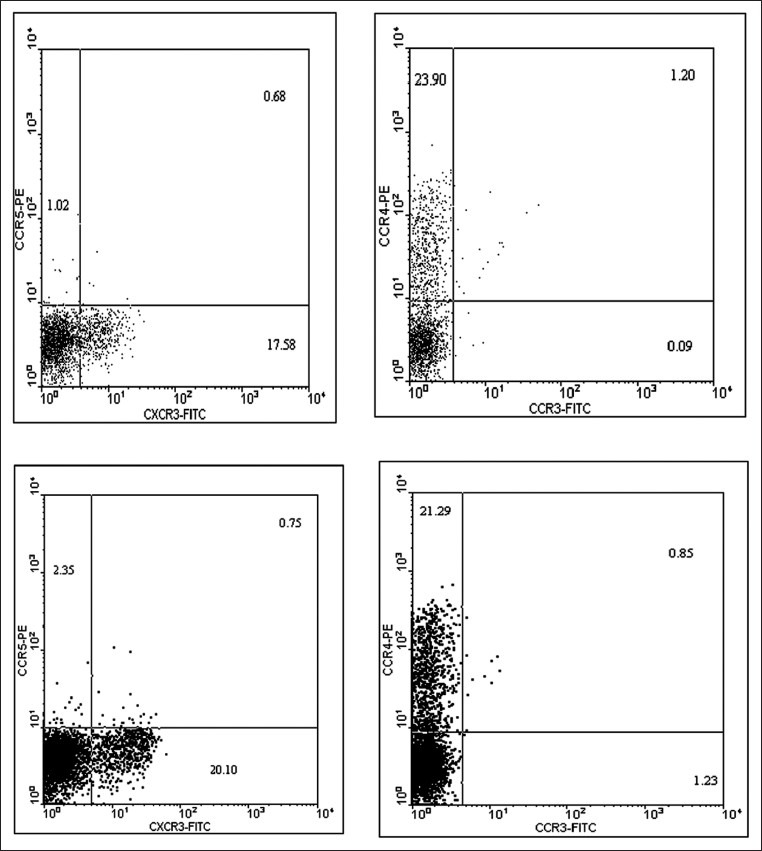
The percentage of blood CD4+ T cells expressing chemokine receptors (before and after gastrectomy) was determined by flow cytometry (Becton Dickinson, USA) using the following chemokine receptor antibodies: anti-CCR5, anti-CXCR3, anti-CCR3 and anti-CCR4.
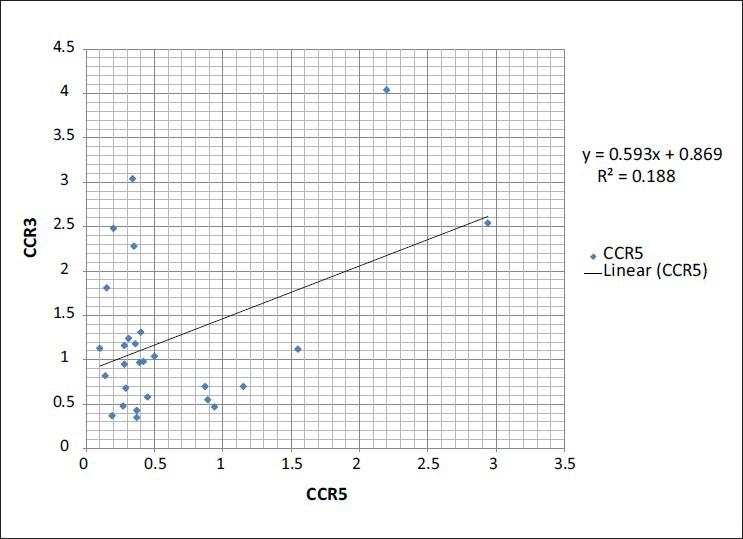
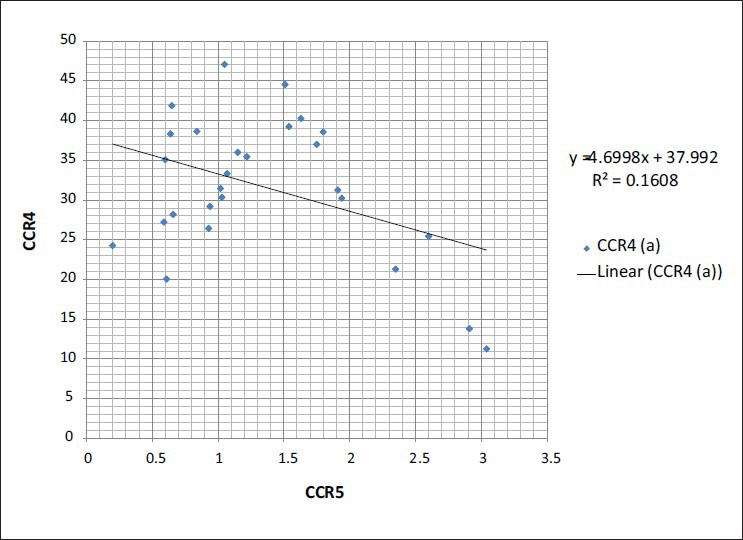
The means of CD4(+) CCR5(+) expressing cells was 1.23% ± 0.90, 0.83% ± 0.34 and 1.34% ± 0.74 in control, pre- and post-operation groups, respectively. CD4(+) CXCR3(+) expressing cells were 19.09% ± 8.4, 16.95% ± 5.71 and 25.08% ± 9.31, respectively. Similar pattern was seen for CD4(+) CCR3(+) and CD4(+) CCR4(+) expressing cells. Pearson correlation analysis shows no relationship between CCR3 and CCR4 expressions on TCD4 cells (r = 0.211, P = 0.126). The complex expression TH1 (CD4(+) CXCR3(+) CCR5(+)) receptors determined 1.14% ± 0.54 for control group, 0.86% ± 0.49 for pre-T and 1.57% ± 0.67 for post-T group. Moreover, the TH2 (CD4(+) CCR3(+) CCR4(+)) expression was 1.60% ± 1.05 for control group, 1.57% ± 0.83 for pre-T and 1.27% ± 0.66 for post-treatment group. Pearson correlation analysis shows that only the CCR3 and CCR5 expression was statistically correlated (r = 0.321, P = 0.018).
Due to low expression of CCR5 in TH1 and CCR3 in TH2 cells, it seems that utility of these is extremely limited for clinical evaluation, but not scientific purpose. Moreover, considering the CXCR3 for TH1 cells and CCR4 expression for TH2 cells, due to considerable expression, may be practical.
从趋化因子受体表达角度,对胃癌患者血液中的CD4 +(TH1和TH2)细胞群进行了研究。
采用流式细胞术(美国BD公司),使用以下趋化因子受体抗体,测定胃切除术前和术后血液中表达趋化因子受体的CD4 + T细胞百分比:抗CCR5、抗CXCR3、抗CCR3和抗CCR4。
对照组、术前组和术后组中,表达CD4(+) CCR5(+)的细胞均值分别为1.23% ± 0.90、0.83% ± 0.34和1.34% ± 0.74。表达CD4(+) CXCR3(+)的细胞分别为19.09% ± 8.4、16.95% ± 5.71和25.08% ± 9.31。表达CD4(+) CCR3(+)和CD4(+) CCR4(+)的细胞呈现类似模式。Pearson相关性分析显示,TCD4细胞上CCR3和CCR4的表达之间无相关性(r = 0.211,P = 0.126)。TH1(CD4(+) CXCR3(+) CCR5(+))受体的复合表达在对照组中为1.14% ± 0.54,术前组为0.86% ± 0.49,术后组为1.57% ± 0.67。此外,TH2(CD4(+) CCR3(+) CCR4(+))的表达在对照组中为1.60% ± 1.05,术前组为1.57% ± 0.83,治疗后组为1.27% ± 0.66。Pearson相关性分析显示,只有CCR3和CCR5的表达具有统计学相关性(r = 0.321,P = 0.018)。
由于TH1细胞中CCR5和TH2细胞中CCR3的表达较低,似乎它们在临床评估中的应用极为有限,但并非出于科学目的。此外,考虑到TH1细胞的CXCR3和TH2细胞的CCR4表达,由于表达量可观,可能具有实用性。