Department of Psychology, University of California-Riverside.
Psychol Aging. 2013 Sep;28(3):802-12. doi: 10.1037/a0033289. Epub 2013 Aug 26.
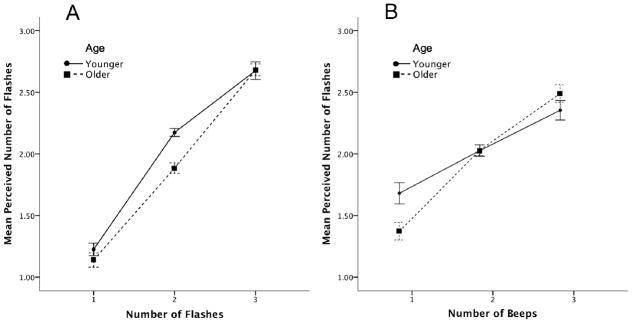
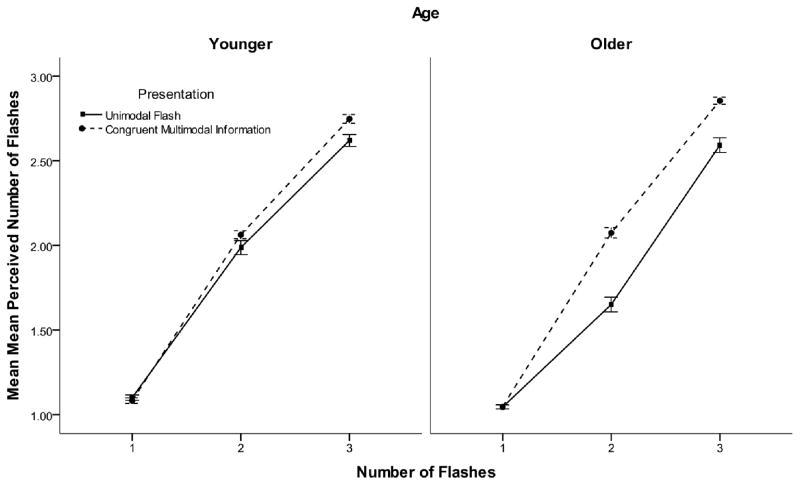
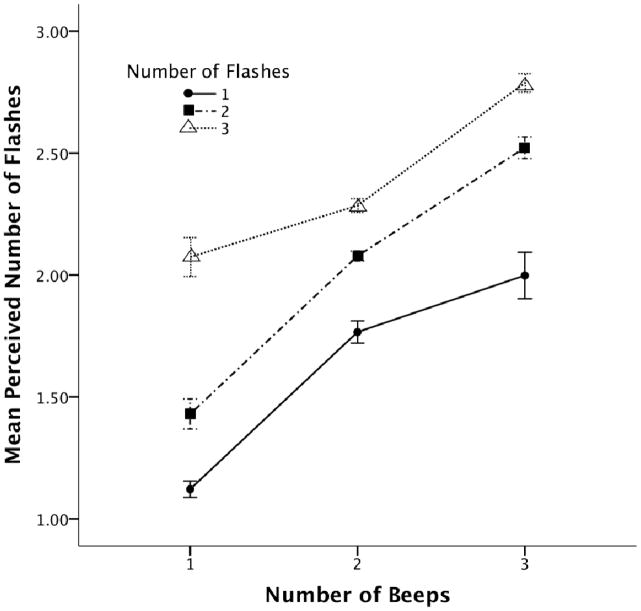
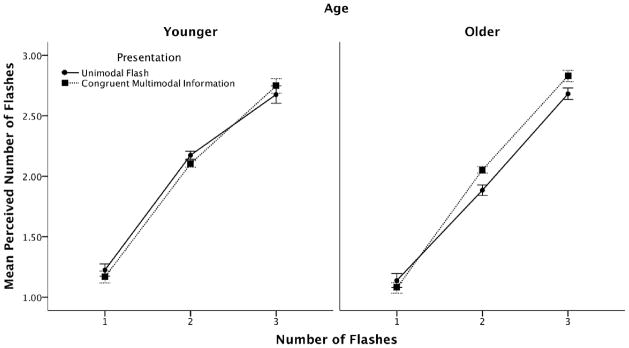
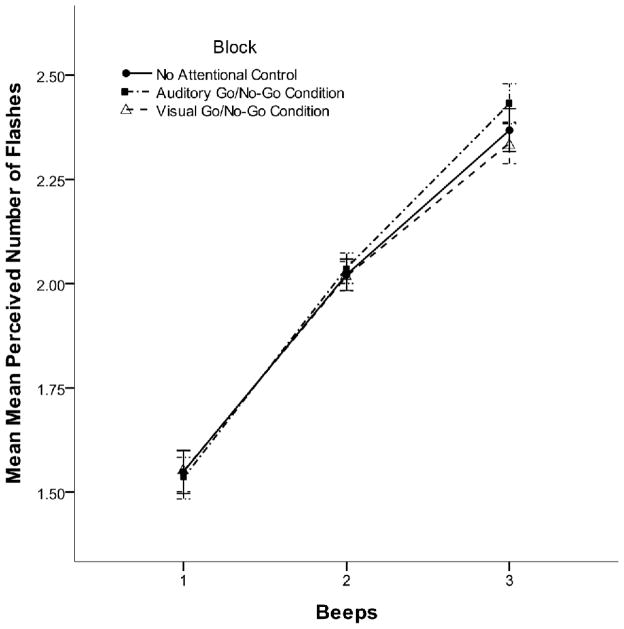
The present study examined age-related differences in multisensory integration and the role of attention in age-related differences in multisensory integration. The sound-induced flash illusion--the misperception of the number of visual flashes due to the simultaneous presentation of a different number of auditory beeps--was used to examine the strength of multisensory integration in older and younger observers. The effects of integration were examined when discriminating 1-3 flashes, 1-3 beeps, or 1-3 flashes presented with 1-3 beeps. Stimulus conditions were blocked according to these conditions with baseline (unisensory) performance assessed during the multisensory block. Older participants demonstrated greater multisensory integration--a greater influence of the beeps when judging the number of visual flashes--than younger observers. In a second experiment, the role of attention was assessed using a go/no-go paradigm. The results of Experiment 2 replicated those of Experiment 1. In addition, the strength of the illusion was modulated by the sensory domain of the go/no-go task, though this did not differ by age group. In the visual go/no-go task we found a decrease in the illusion, yet in the auditory go/no-go task we found an increase in the illusion. These results demonstrate that older individuals exhibit increased multisensory integration compared with younger individuals. Attention was also found to modulate the strength of the sound-induced flash illusion. However, the results also suggest that attention was not likely to be a factor in the age-related differences in multisensory integration.
本研究考察了年龄相关的多感觉整合差异,以及注意力在年龄相关的多感觉整合差异中的作用。声音诱导的闪光错觉——由于同时呈现不同数量的听觉哔哔声而导致视觉闪光数量的错误感知——被用来检查老年和年轻观察者的多感觉整合强度。在辨别 1-3 个闪光、1-3 个哔哔声或同时呈现 1-3 个闪光和 1-3 个哔哔声时,检查了整合的效果。根据这些条件,用基线(单感觉)表现来评估感觉条件,这些条件在多感觉块中进行。与年轻观察者相比,老年参与者表现出更强的多感觉整合——当判断视觉闪光数量时,哔哔声的影响更大。在第二个实验中,使用 Go/No-Go 范式评估了注意力的作用。实验 2 的结果复制了实验 1 的结果。此外,尽管这与年龄组无关,但感觉域的 Go/No-Go 任务对错觉的强度进行了调制。在视觉 Go/No-Go 任务中,我们发现错觉减弱了,而在听觉 Go/No-Go 任务中,我们发现错觉增强了。这些结果表明,与年轻个体相比,老年个体表现出更强的多感觉整合。注意力也被发现可以调节声音诱导的闪光错觉的强度。然而,结果也表明,注意力不太可能是多感觉整合年龄差异的一个因素。