Schroth Robert J, Halchuk Shelley, Star Leona
Faculty of Dentistry, Department of Preventive Dental Science, University of Manitoba, Winnipeg, Canada.
Int J Circumpolar Health. 2013 Aug 5;72. doi: 10.3402/ijch.v72i0.21167. eCollection 2013.
The high prevalence and severity of caries among Canadian First Nations children is a growing concern. Dental surgery in hospital is often necessary to treat the signs of decay but does not address the underlying factors contributing to its development. The purpose of this study was to determine the prevalence and risk factors of caregiver-reported Baby Bottle Tooth Decay (BBTD), or Severe Early Childhood Caries (S-ECC), among preschool children recruited in Phase 2 of the First Nations Regional Longitudinal Health Survey (RHS).
Cross-sectional study including interviews with caregivers.
This study was limited to data from Manitoba First Nations participating in the RHS Phase 2 (2008-10). Data were restricted to caregiver interviews for their child < 72 months of age. The main variable of interest was caregiver-reported BBTD, an antecedent term for S-ECC. Data analysis included descriptive statistics and bivariate analyses; p ≤ 0.05 was significant.
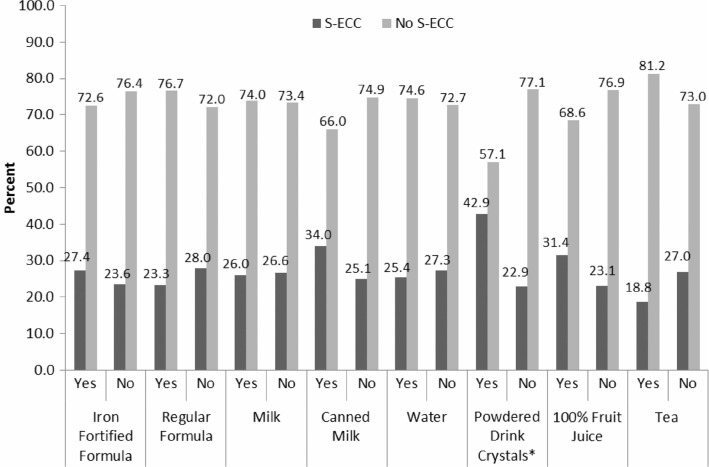
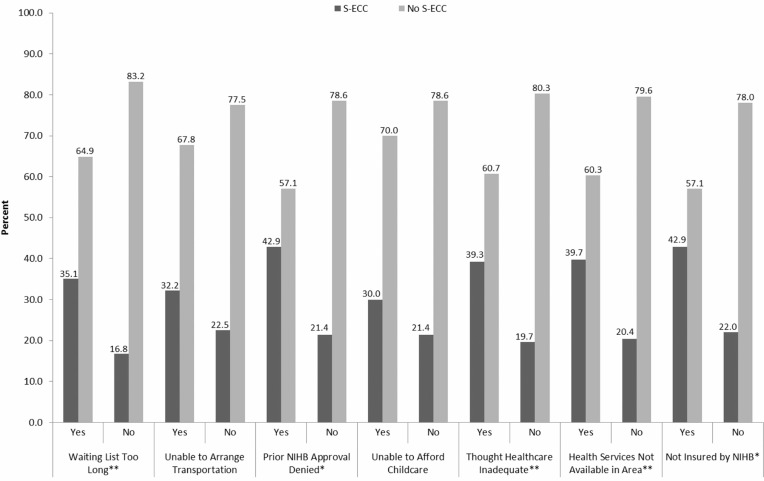
Overall, caregivers of 431 preschool children responded. According to caregiver reports, 102/410 (24.9%) children had S-ECC. Further, 65.0% responded that their child had already undergone treatment for caries. Children with S-ECC were significantly older than those without. S-ECC was also associated with paternal education levels and employment status, and maternal smoking during pregnancy. Breastfed children were less likely to have S-ECC, while consuming drink crystal beverages in bottles, and daily intake of soft drinks, juice, sweets and fast food were associated with increased risk. Those who reported that healthcare services were not available and were not culturally appropriate were significantly more likely to have children with S-ECC.
Caregiver reports suggest that nearly 1 in every 4 children has been affected by S-ECC. Identified risk factors for Manitoba First Nations children included age, education and employment, dietary practices, access to care, and disruption to family and culture. This local evidence can be used to help inform future caries prevention activities in these Manitoba communities.
加拿大原住民儿童中龋齿的高患病率和严重程度日益受到关注。医院里的牙科手术通常是治疗龋齿症状所必需的,但并未解决导致龋齿发生的潜在因素。本研究的目的是确定在原住民地区纵向健康调查(RHS)第二阶段招募的学龄前儿童中,照料者报告的奶瓶龋(BBTD)或重度幼儿龋齿(S-ECC)的患病率及风险因素。
横断面研究,包括对照料者进行访谈。
本研究仅限于参与RHS第二阶段(2008 - 2010年)的曼尼托巴省原住民的数据。数据仅限于对照料者关于其72个月以下孩子的访谈。主要关注变量是照料者报告的BBTD,即S-ECC的先行术语。数据分析包括描述性统计和双变量分析;p≤0.05具有统计学意义。
总体而言,431名学龄前儿童的照料者做出了回应。根据照料者报告,102/410(24.9%)的儿童患有S-ECC。此外,65.0%的人回应称他们的孩子已经接受过龋齿治疗。患有S-ECC的儿童明显比未患龋齿的儿童年龄大。S-ECC还与父亲的教育水平和就业状况以及母亲孕期吸烟有关。母乳喂养的儿童患S-ECC的可能性较小,而用奶瓶喝水晶饮料以及每天摄入软饮料、果汁、糖果和快餐会增加患病风险。那些报告称无法获得医疗服务且医疗服务不符合文化习俗的人,其孩子患S-ECC的可能性显著更高。
照料者报告显示,近四分之一的儿童受到S-ECC的影响。确定的曼尼托巴省原住民儿童的风险因素包括年龄、教育和就业、饮食习惯、获得医疗服务的机会以及家庭和文化的破坏。这些本地证据可用于为曼尼托巴省这些社区未来的龋齿预防活动提供参考。