Adelaide Melanoma Unit, The University of Adelaide, Royal Adelaide Hospital Adelaide, SA, Australia.
Cancer Manag Res. 2013 Aug 20;5:243-9. doi: 10.2147/CMAR.S45746. eCollection 2013.
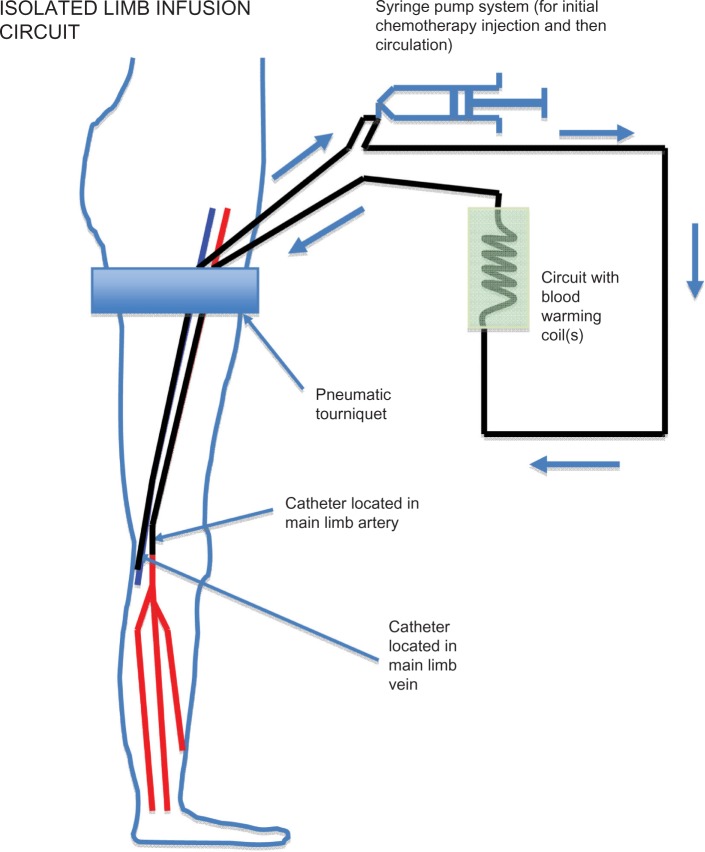
Isolated limb infusion (ILI) using cytotoxic agents has been demonstrated to be an effective and less invasive alternative modality than isolated limb perfusion for the treatment of melanoma localized to a limb. Percutaneous catheters were inserted into the axial artery and vein of the affected limb while using a pneumatic cuff to restrict limb vascular flow proximally to "isolate" the limb from the body and enable delivery of high-dose intra-arterial chemotherapy selectively to the limb. The ILI technique was developed at the Sydney Melanoma Unit (now renamed the Melanoma Institute Australia), and only a few other centers have reported separate results. We report our early results using the ILI technique for management of locally recurrent surgically nonresectable melanoma.
Twenty-eight ILI procedures were performed in 20 patients treated with one or more procedures between 1997 and 2007. Patient parameters and clinical responses were evaluated. The median follow-up duration was 15.9 months after the first ILI, with an overall response rate after one or more infusions of 70%, of which 35% were complete responders and 35% were partial responders, with a further 20% showing stable disease, giving a "clinically significant" response rate of 90%. After one ILI (n = 20), the overall response rate was 70%, with 20% complete responders and 50% partial responders, and 20% with stable disease. Low limb toxicities were generally observed, and no amputations were required.
ILI chemotherapy is a useful technique, which can be readily repeated for control of melanoma in the limb. It is generally well tolerated, and is capable of achieving a cure, delayed progression, or effective palliation in selected cases. The longest survivors in this series were 8 and 10 years from the last ILI.
与孤立肢体灌注相比,细胞毒性药物的孤立肢体输注(ILI)已被证明是一种更有效、创伤更小的治疗肢体局部黑色素瘤的替代方法。在使用气动袖带限制肢体近端血管血流以“隔离”肢体与身体并使高剂量动脉内化疗选择性输送至肢体的同时,将经皮导管插入受影响肢体的轴向动、静脉中。ILI 技术由悉尼黑色素瘤中心(现更名为澳大利亚黑色素瘤研究所)开发,仅有少数其他中心报告了单独的结果。我们报告了使用 ILI 技术治疗局部复发性手术不可切除黑色素瘤的早期结果。
20 名患者在 1997 年至 2007 年期间接受了一次或多次 ILI 治疗,共进行了 28 次 ILI 手术。评估了患者的参数和临床反应。第一次 ILI 后中位随访时间为 15.9 个月,一次或多次输注后的总体反应率为 70%,其中完全缓解率为 35%,部分缓解率为 35%,稳定疾病率为 20%,即“有临床意义”的反应率为 90%。在一次 ILI(n=20)后,总体反应率为 70%,完全缓解率为 20%,部分缓解率为 50%,稳定疾病率为 20%。下肢毒性通常较低,无需截肢。
ILI 化疗是一种有用的技术,可重复用于控制肢体黑色素瘤。它通常具有良好的耐受性,并且能够在选定病例中实现治愈、延迟进展或有效缓解。该系列中存活时间最长的患者在最后一次 ILI 后分别存活了 8 年和 10 年。