Computational Biology and Bioinformatics Group, Pacific Northwest National Laboratory, Richland, Washington, United States of America.
PLoS Comput Biol. 2013;9(8):e1003201. doi: 10.1371/journal.pcbi.1003201. Epub 2013 Aug 22.
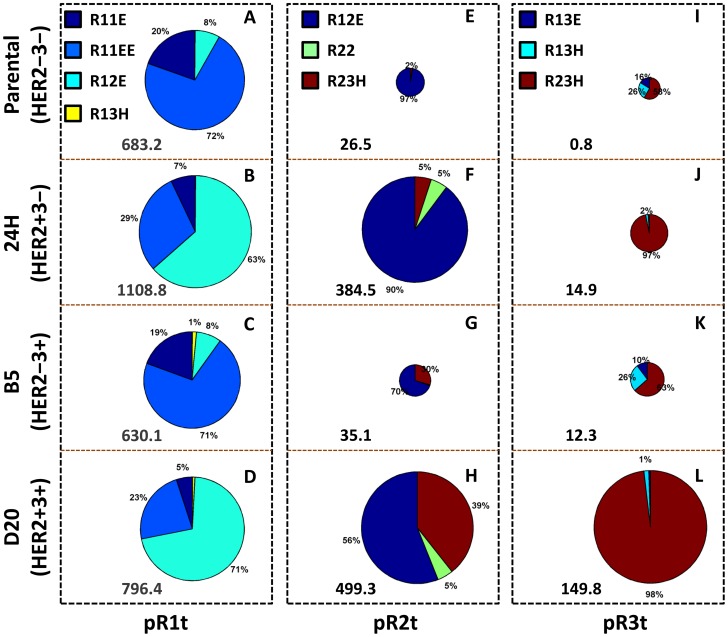
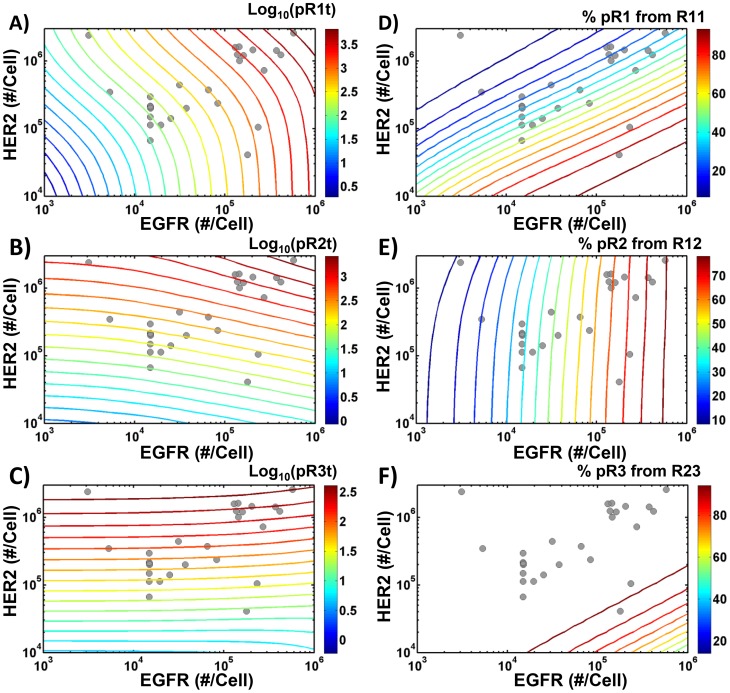
The HER/ErbB family of receptor tyrosine kinases drives critical responses in normal physiology and cancer, and the expression levels of the various HER receptors are critical determinants of clinical outcomes. HER activation is driven by the formation of various dimer complexes between members of this receptor family. The HER dimer types can have differential effects on downstream signaling and phenotypic outcomes. We constructed an integrated mathematical model of HER activation, and trafficking to quantitatively link receptor expression levels to dimerization and activation. We parameterized the model with a comprehensive set of HER phosphorylation and abundance data collected in a panel of human mammary epithelial cells expressing varying levels of EGFR/HER1, HER2 and HER3. Although parameter estimation yielded multiple solutions, predictions for dimer phosphorylation were in agreement with each other. We validated the model using experiments where pertuzumab was used to block HER2 dimerization. We used the model to predict HER dimerization and activation patterns in a panel of human mammary epithelial cells lines with known HER expression levels in response to stimulations with ligands EGF and HRG. Simulations over the range of expression levels seen in various cell lines indicate that: i) EGFR phosphorylation is driven by HER1-HER1 and HER1-HER2 dimers, and not HER1-HER3 dimers, ii) HER1-HER2 and HER2-HER3 dimers both contribute significantly to HER2 activation with the EGFR expression level determining the relative importance of these species, and iii) the HER2-HER3 dimer is largely responsible for HER3 activation. The model can be used to predict phosphorylated dimer levels for any given HER expression profile. This information in turn can be used to quantify the potencies of the various HER dimers, and can potentially inform personalized therapeutic approaches.
HER/ErbB 家族受体酪氨酸激酶驱动着正常生理和癌症中的关键反应,而各种 HER 受体的表达水平是临床结果的关键决定因素。HER 的激活是由该受体家族成员之间形成的各种二聚体复合物驱动的。HER 二聚体类型可以对下游信号转导和表型结果产生不同的影响。我们构建了一个 HER 激活和运输的综合数学模型,以定量地将受体表达水平与二聚化和激活联系起来。我们用一组全面的 HER 磷酸化和丰度数据来参数化模型,这些数据是在一组表达不同水平 EGFR/HER1、HER2 和 HER3 的人乳腺上皮细胞中收集的。虽然参数估计产生了多个解,但二聚体磷酸化的预测结果是相互一致的。我们使用曲妥珠单抗阻断 HER2 二聚化的实验来验证模型。我们使用该模型来预测一组具有已知 HER 表达水平的人乳腺上皮细胞系在 EGF 和 HRG 配体刺激下的 HER 二聚化和激活模式。在各种细胞系中观察到的表达水平范围内的模拟表明:i)EGFR 磷酸化是由 HER1-HER1 和 HER1-HER2 二聚体驱动的,而不是由 HER1-HER3 二聚体驱动的,ii)HER1-HER2 和 HER2-HER3 二聚体都对 HER2 激活有重要贡献,而 EGFR 表达水平决定了这些物种的相对重要性,iii)HER2-HER3 二聚体主要负责 HER3 激活。该模型可用于预测任何给定 HER 表达谱的磷酸化二聚体水平。反过来,这些信息可以用于量化各种 HER 二聚体的效力,并可能为个性化治疗方法提供信息。