Ponnaiya Brian, Amundson Sally A, Ghandhi Shanaz A, Smilenov Lubomir B, Geard Charles R, Buonanno Manuela, Brenner David J
Center for Radiological Research, Columbia University, 630 West 168th Street, VC11-240, New York, NY, 10032, USA,
Radiat Environ Biophys. 2013 Nov;52(4):523-30. doi: 10.1007/s00411-013-0488-3. Epub 2013 Aug 31.
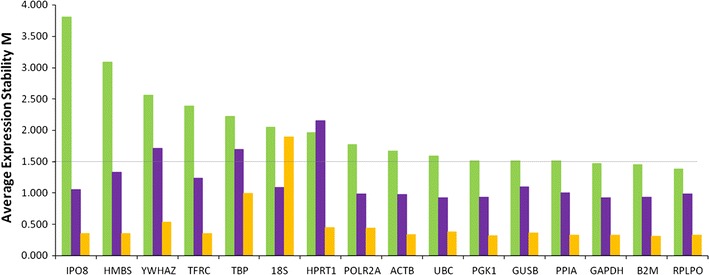
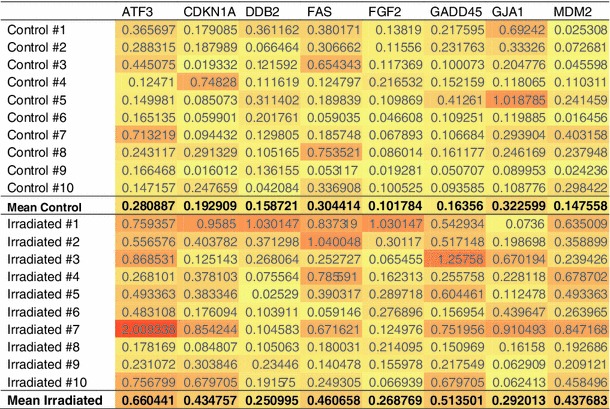
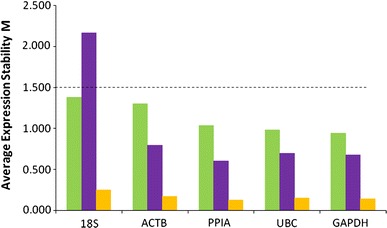
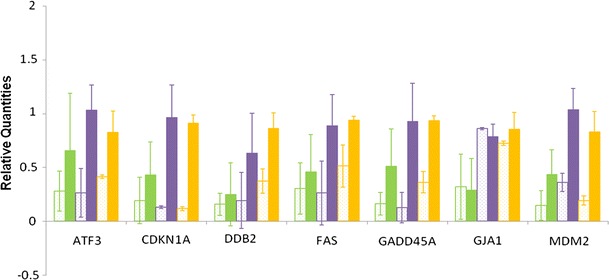
While gene expression studies have proved extremely important in understanding cellular processes, it is becoming more apparent that there may be differences in individual cells that are missed by studying the population as a whole. We have developed a qRT-PCR protocol that allows us to assay multiple gene products in small samples, starting at 100 cells and going down to a single cell, and have used it to study radiation responses at the single-cell level. Since the accuracy of qRT-PCR depends greatly on the choice of "housekeeping" genes used for normalization, initial studies concentrated on determining the optimal panel of such genes. Using an endogenous control array, it was found that for IMR90 cells, common housekeeping genes tend to fall into one of two categories-those that are relatively stably expressed regardless of the number of cells in the sample, e.g., B2M, PPIA, and GAPDH, and those that are more variable (again regardless of the size of the population), e.g., YWHAZ, 18S, TBP, and HPRT1. Further, expression levels in commonly studied radiation-response genes, such as ATF3, CDKN1A, GADD45A, and MDM2, were assayed in 100, 10, and single-cell samples. It is here that the value of single-cell analyses becomes apparent. It was observed that the expression of some genes such as FGF2 and MDM2 was relatively constant over all irradiated cells, while that of others such as FAS was considerably more variable. It was clear that almost all cells respond to ionizing radiation but the individual responses were considerably varied. The analyses of single cells indicate that responses in individual cells are not uniform and suggest that responses observed in populations are not indicative of identical patterns in all cells. This in turn points to the value of single-cell analyses.
虽然基因表达研究在理解细胞过程中已被证明极为重要,但越来越明显的是,通过对整个群体进行研究可能会遗漏单个细胞中的差异。我们开发了一种定量逆转录聚合酶链反应(qRT-PCR)方案,该方案使我们能够在小样本中检测多种基因产物,起始样本量为100个细胞,甚至低至单个细胞,并已用它在单细胞水平上研究辐射反应。由于qRT-PCR的准确性在很大程度上取决于用于标准化的“管家”基因的选择,因此初步研究集中在确定此类基因的最佳组合上。使用内参基因阵列发现,对于IMR90细胞,常见的管家基因往往分为两类——一类是无论样本中的细胞数量如何都相对稳定表达的基因,例如B2M、PPIA和GAPDH;另一类是变化较大的基因(同样与群体大小无关),例如YWHAZ、18S、TBP和HPRT1。此外,还在100个、10个和单细胞样本中检测了常用的辐射反应基因如ATF3、CDKN1A、GADD45A和MDM2的表达水平。单细胞分析的价值在此变得明显。观察到一些基因如FGF2和MDM2在所有受辐照细胞中的表达相对恒定,而其他基因如FAS的表达则变化较大。很明显,几乎所有细胞都对电离辐射有反应,但个体反应差异很大。单细胞分析表明,单个细胞中的反应并不一致,这表明在群体中观察到的反应并不代表所有细胞中的相同模式。这反过来又指出了单细胞分析的价值。