Lim Yunjung, Ryu Jae San, Shi Shanliang, Noh Won, Kim Eonmi, Le Quy Vang, Lee Hyun-Sook, Ro Hyeon-Su
Deparment of Microbiology and Research Institute of Life Science, Gyeongsang National University, 900 Gajwa-Dong, Chinju 660-701, Korea.
Mycobiology. 2008 Mar;36(1):13-8. doi: 10.4489/MYCO.2008.36.1.013. Epub 2008 Mar 31.
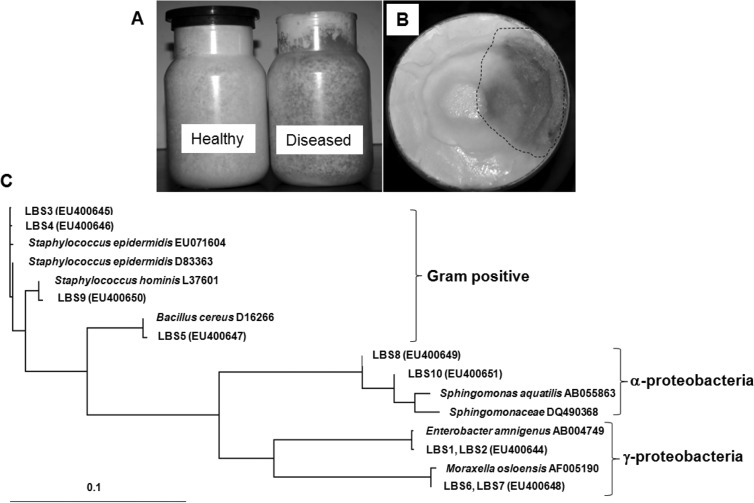
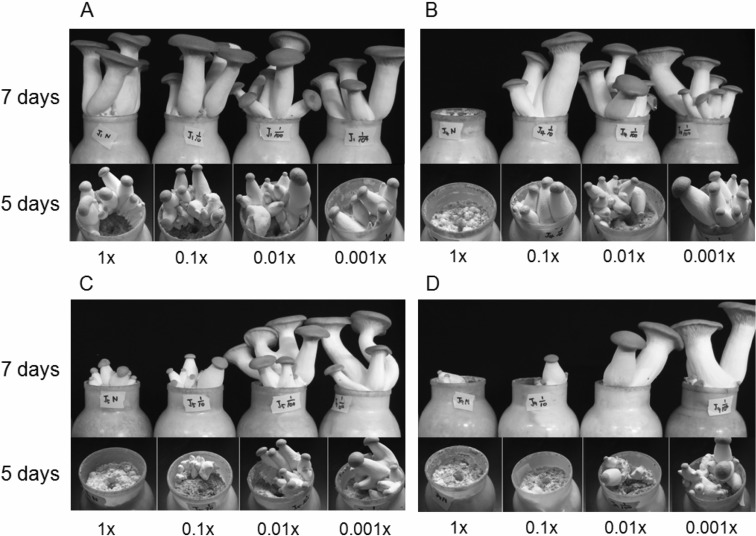
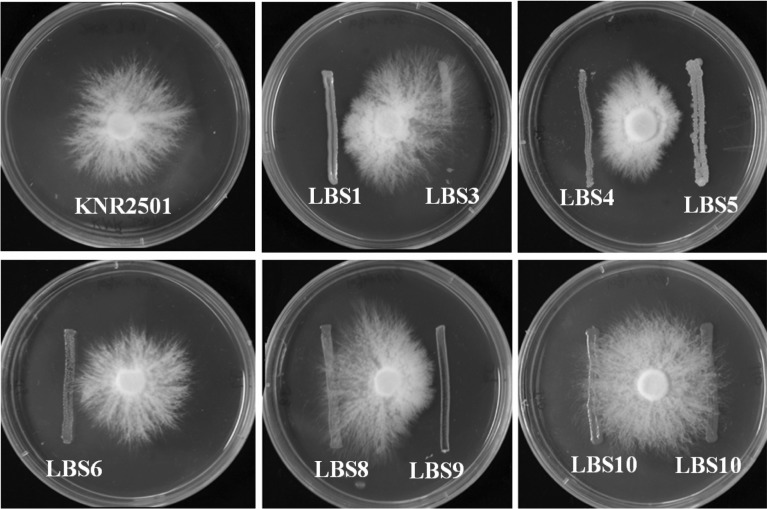
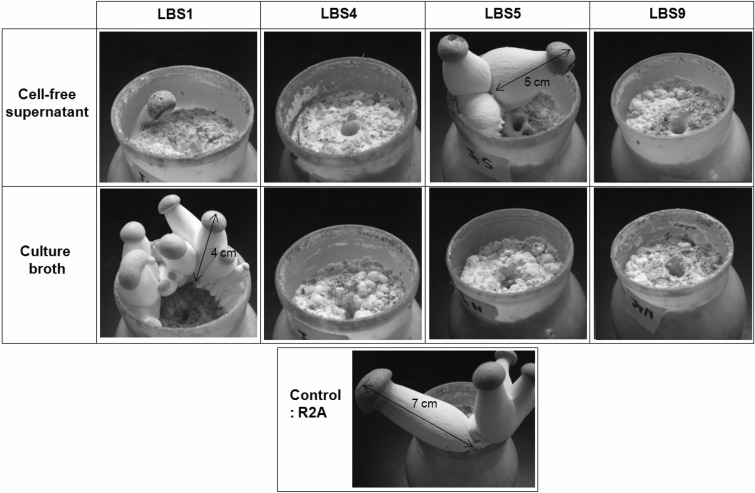
Eight distinct bacteria were isolated form diseased mycelia of the edible mushroom, Pleurotus eryngii. 16S rDNA sequence analysis showed that the isolates belonged to a variety of bacterial genera including Bacillus (LBS5), Enterobacter (LBS1), Sphingomonas (LBS8 and LBS10), Staphylococcus (LBS3, LBS4 and LBS9) and Moraxella (LBS6). Among them, 4 bacterial isolates including LBS1, LBS4, LBS5, and LBS9 evidenced growth inhibitory activity on the mushroom mycelia. The inhibitory activity on the growth of the mushroom fruiting bodies was evaluated by the treatment of the bacterial culture broth or the heat-treated cell-free supernatant of the broth. The treatment of the culture broths or the cell-free supernatants of LBS4 or LBS9 completely inhibited the formation of the fruiting body, thereby suggesting that the inhibitory agent is a heat-stable compound. In the case of LBS5, only the bacterial cell-containing culture broth was capable of inhibiting the formation of the fruiting body, whereas the cell-free supernatant did not, which suggests that an inhibitory agent generated by LBS5 is a protein or a heat-labile chemical compound, potentially a fungal cell wall-degrading enzyme. The culture broth of LBS1 was not inhibitory. However, its cell-free supernatant was capable of inhibiting the formation of fruiting bodies. This indicates that LBS1 may produce an inhibitory heat-stable chemical compound which is readily degraded by its own secreted enzyme.
从患病的杏鲍菇菌丝体中分离出了8种不同的细菌。16S rDNA序列分析表明,这些分离株属于多种细菌属,包括芽孢杆菌属(LBS5)、肠杆菌属(LBS1)、鞘氨醇单胞菌属(LBS8和LBS10)、葡萄球菌属(LBS3、LBS4和LBS9)和莫拉克斯氏菌属(LBS6)。其中,包括LBS1、LBS4、LBS5和LBS9在内的4种细菌分离株对蘑菇菌丝体具有生长抑制活性。通过用细菌培养液或培养液经热处理后的无细胞上清液处理来评估对蘑菇子实体生长的抑制活性。用LBS4或LBS9的培养液或无细胞上清液处理可完全抑制子实体的形成,从而表明该抑制剂是一种热稳定化合物。就LBS5而言,只有含细菌细胞的培养液能够抑制子实体的形成,而无细胞上清液则不能,这表明LBS5产生的抑制剂是一种蛋白质或热不稳定化合物,可能是一种真菌细胞壁降解酶。LBS1的培养液没有抑制作用。然而,其无细胞上清液能够抑制子实体的形成。这表明LBS1可能产生一种抑制性热稳定化合物,该化合物很容易被其自身分泌的酶降解。