Department of Epidemiology, Cardiovascular Disease Program, 137 E Franklin St., Chapel Hill, NC 27514, USA.
Prev Chronic Dis. 2013 Sep 5;10:E149. doi: 10.5888/pcd10.130035.
Prior assessments of emergency medical services (EMS) stroke capacity found deficiencies in education and training, use of protocols and screening tools, and planning for the transport of patients. A 2001 survey of North Carolina EMS providers found many EMS systems lacked basic stroke services. Recent statewide efforts have sought to standardize and improve prehospital stroke care. The objective of this study was to assess EMS stroke care capacity in North Carolina and evaluate statewide changes since 2001.
In June 2012, we conducted a web-based survey on stroke education and training and stroke care practices and policies among all EMS systems in North Carolina. We used the McNemar test to assess changes from 2001 to 2012.
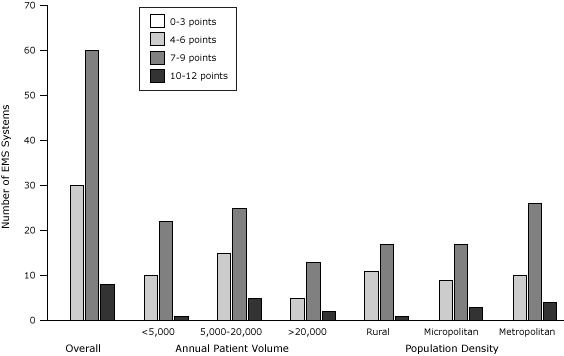
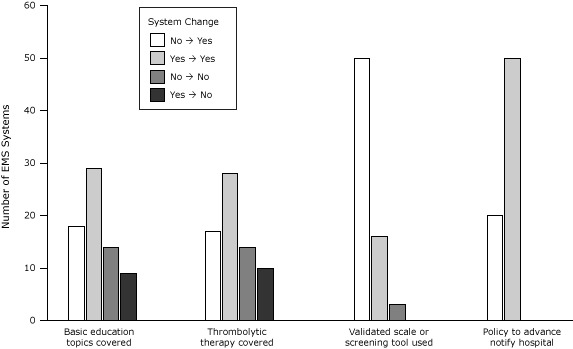
Of 100 EMS systems in North Carolina, 98 responded to our survey. Most systems reported providing stroke education and training (95%) to EMS personnel, using a validated stroke scale or screening tool (96%), and having a hospital prenotification policy (98%). Many were suboptimal in covering basic stroke educational topics (71%), always communicating stroke screen results to the destination hospital (46%), and always using a written destination plan (49%). Among 70 EMS systems for which we had data for 2001 and 2012, we observed significant improvements in education on stroke scales or screening tools (61% to 93%, P < .001) and use of validated stroke scales or screening tools (23% to 96%, P < .001).
Major improvements in EMS stroke care, especially in prehospital stroke screening, have occurred in North Carolina in the past decade, whereas other practices and policies, including use of destination plans, remain in need of improvement.
先前对急诊医疗服务(EMS)中风能力的评估发现,在教育和培训、使用协议和筛选工具以及患者转运规划方面存在不足。2001 年对北卡罗来纳州 EMS 提供者的调查发现,许多 EMS 系统缺乏基本的中风服务。最近全州范围内的努力旨在标准化和改善院前中风护理。本研究的目的是评估北卡罗来纳州的 EMS 中风护理能力,并评估自 2001 年以来全州范围内的变化。
2012 年 6 月,我们对北卡罗来纳州所有 EMS 系统进行了一项关于中风教育和培训以及中风护理实践和政策的网络调查。我们使用 McNemar 检验来评估 2001 年至 2012 年的变化。
在北卡罗来纳州的 100 个 EMS 系统中,有 98 个系统对我们的调查做出了回应。大多数系统报告向 EMS 人员提供中风教育和培训(95%),使用经过验证的中风量表或筛选工具(96%),并制定了医院预先通知政策(98%)。许多系统在涵盖基本中风教育主题方面并不理想(71%),总是将中风筛查结果传达给目的地医院(46%),并且总是使用书面目的地计划(49%)。在我们有 2001 年和 2012 年数据的 70 个 EMS 系统中,我们观察到中风量表或筛选工具教育(61%至 93%,P<.001)和使用经过验证的中风量表或筛选工具(23%至 96%,P<.001)方面的显著改善。
在过去十年中,北卡罗来纳州的 EMS 中风护理,尤其是在院前中风筛查方面,取得了重大进展,而其他实践和政策,包括目的地计划的使用,仍需要改进。