Department of International Health, Johns Hopkins Bloomberg School of Public Health, Baltimore, Maryland, USA.
PLoS One. 2013 Aug 29;8(8):e74391. doi: 10.1371/journal.pone.0074391. eCollection 2013.
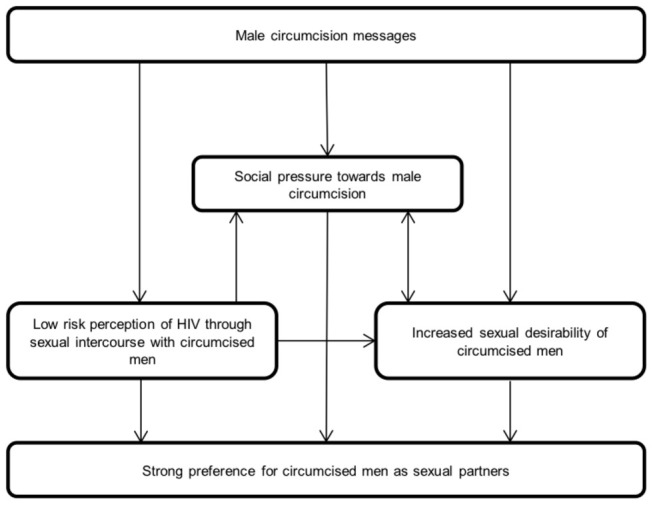
While male circumcision reduces the risk of female-to-male HIV transmission and certain sexually transmitted infections (STIs), there is little evidence that circumcision provides women with direct protection against HIV. This study used qualitative methods to assess women's perceptions of male circumcision in Iringa, Tanzania. Women in this study had strong preferences for circumcised men because of the low risk perception of HIV with circumcised men, social norms favoring circumcised men, and perceived increased sexual desirability of circumcised men. The health benefits of male circumcision were generally overstated; many respondents falsely believed that women are also directly protected against HIV and that the risk of all STIs is greatly reduced or eliminated in circumcised men. Efforts to engage women about the risks and limitations of male circumcision, in addition to the benefits, should be expanded so that women can accurately assess their risk of HIV or STIs during sexual intercourse with circumcised men.
虽然男性割礼可以降低女性向男性传播 HIV 和某些性传播感染(STIs)的风险,但几乎没有证据表明割礼可以为女性提供直接的 HIV 保护。本研究采用定性方法评估了坦桑尼亚伊林加地区女性对男性割礼的看法。由于对 HIV 风险的低感知,对割礼男性的偏好,社会规范对割礼男性的支持,以及对割礼男性性吸引力的增加,该研究中的女性对割礼男性有着强烈的偏好。男性割礼的健康益处被普遍夸大;许多受访者错误地认为女性也能直接受到 HIV 的保护,而且割礼男性感染所有性传播感染的风险大大降低或消除。除了宣传男性割礼的好处之外,还应该扩大努力,让女性了解男性割礼的风险和局限性,以便她们能够准确评估与割礼男性发生性行为时感染 HIV 或性传播感染的风险。