Institute of Integrative Biology, Plant Ecology, ETH Zurich, Universitätstrasse 16, Zurich 8092, Switzerland.
BMC Ecol. 2013 Sep 8;13:32. doi: 10.1186/1472-6785-13-32.
The important greenhouse gas (GHG) methane is produced naturally in anaerobic wetland soils. By affecting the production, oxidation and transport of methane to the atmosphere, plants have a major influence upon the quantities emitted by wetlands. Different species and functional plant groups have been shown to affect these processes differently, but our knowledge about how these effects are influenced by abiotic factors such as water regime and temperature remains limited. Here we present a mesocosm experiment comparing eight plant species for their effects on internal transport and overall emissions of methane under contrasting hydrological conditions. To quantify how much methane was transported internally through plants (the chimney effect), we blocked diffusion from the soil surface with an agar seal.
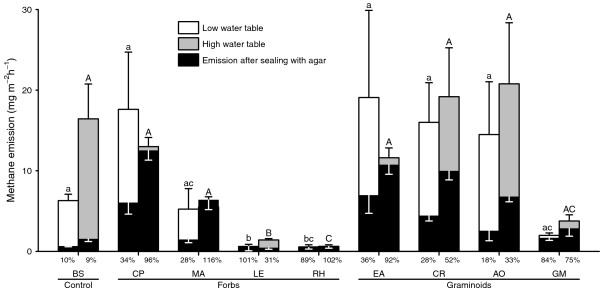
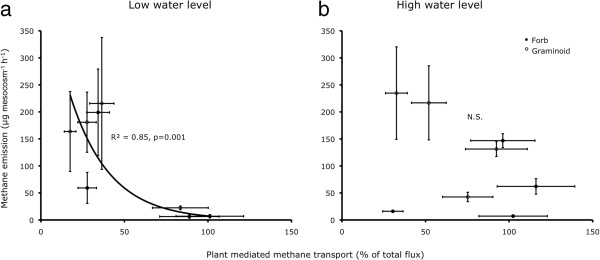
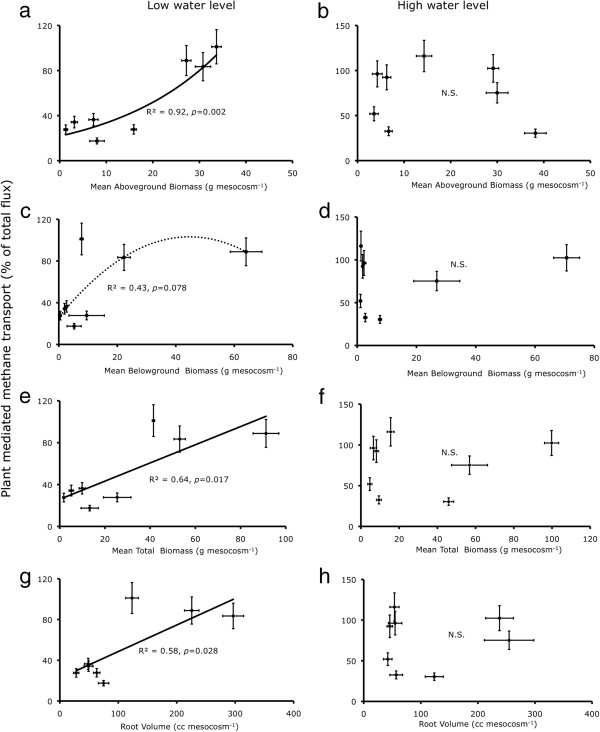
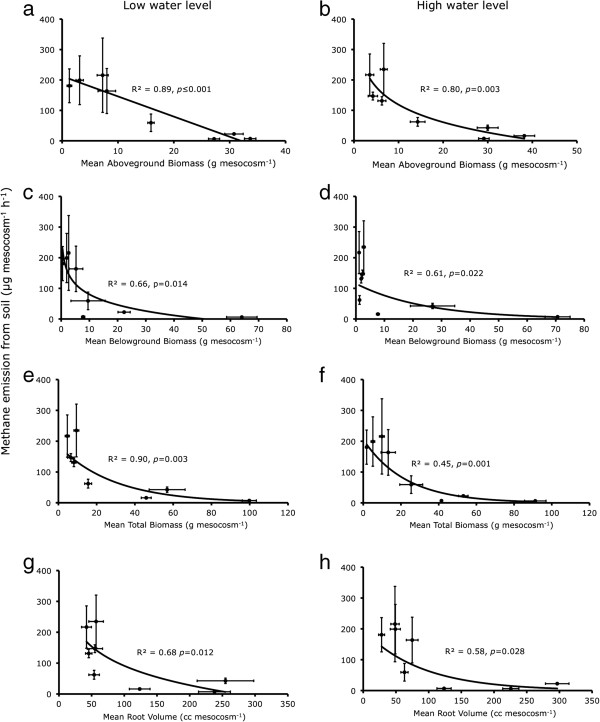
We found that graminoids caused higher methane emissions than forbs, although the emissions from mesocosms with different species were either lower than or comparable to those from control mesocosms with no plant (i.e. bare soil). Species with a relatively greater root volume and a larger biomass exhibited a larger chimney effect, though overall methane emissions were negatively related to plant biomass. Emissions were also reduced by lowering the water table.
We conclude that plant species (and functional groups) vary in the degree to which they transport methane to the atmosphere. However, a plant with a high capacity to transport methane does not necessarily emit more methane, as it may also cause more rhizosphere oxidation of methane. A shift in plant species composition from graminoids to forbs and/or from low to high productive species may lead to reduction of methane emissions.
重要的温室气体(GHG)甲烷在厌氧湿地土壤中自然产生。植物通过影响甲烷的产生、氧化和向大气的传输,对湿地排放的数量有重大影响。不同的物种和功能植物群已被证明对这些过程有不同的影响,但我们对这些影响如何受到水情和温度等非生物因素的影响的了解仍然有限。在这里,我们进行了一个中观实验,比较了八种植物在不同水文条件下对内部传输和整体甲烷排放的影响。为了量化甲烷通过植物内部传输的量(烟囱效应),我们用琼脂密封物阻止了从土壤表面的扩散。
我们发现,禾本科植物比杂类草引起的甲烷排放量更高,尽管来自不同物种的中观实验的排放量要么低于或与没有植物(即裸土)的对照中观实验的排放量相当。根体积相对较大和生物量较大的物种表现出较大的烟囱效应,尽管整体甲烷排放量与植物生物量呈负相关。降低地下水位也减少了排放。
我们的结论是,植物物种(和功能组)在向大气中输送甲烷的程度上存在差异。然而,具有高甲烷输送能力的植物不一定会排放更多的甲烷,因为它也可能导致更多的甲烷在根际氧化。从禾本科植物向杂类草和/或从低生产力物种向高生产力物种的植物物种组成的转变可能会导致甲烷排放量的减少。