Department of Nuclear Medicine, University Würzburg, Würzburg, Germany ; Martin-Luther University Halle-Wittenberg, Halle-Wittenberg, Germany.
PLoS One. 2013 Aug 27;8(8):e71729. doi: 10.1371/journal.pone.0071729. eCollection 2013.
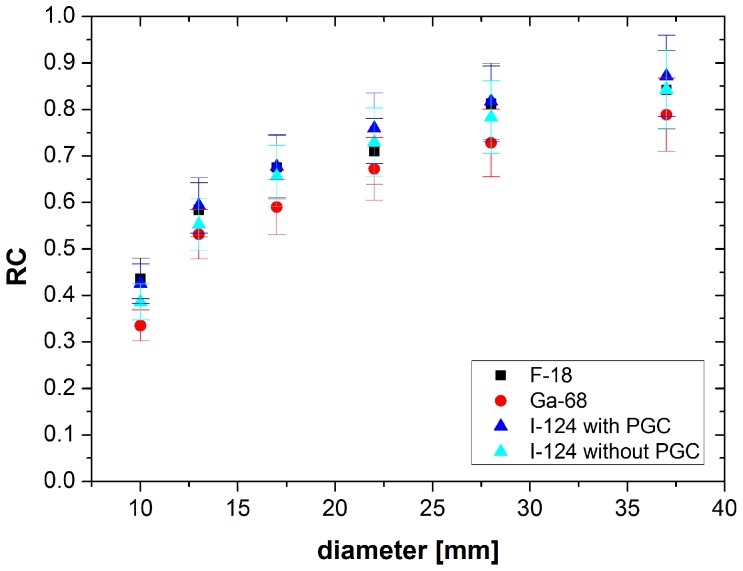
The aim of this study is to evaluate the quality of I-124 PET images with and without prompt gamma compensation (PGC) by comparing the recovery coefficients (RC), the signal to noise ratios (SNR) and the contrast to F-18 and Ga-68. Furthermore, the influence of the PGC on the quantification and image quality is evaluated.
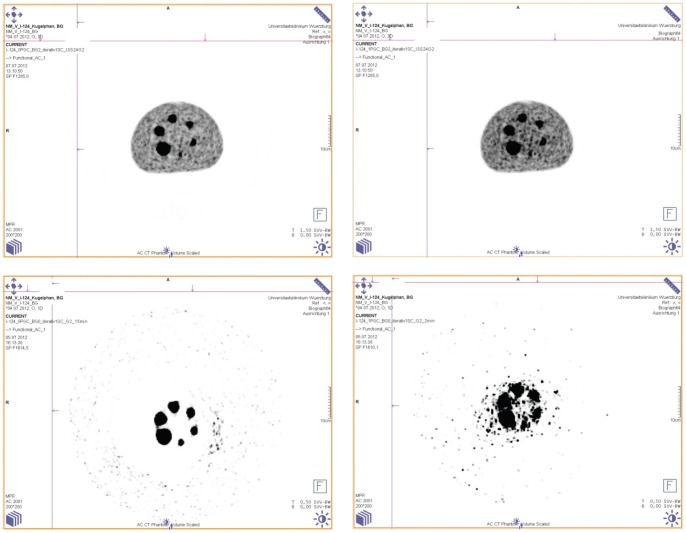
For measuring the image quality the NEMA NU2-2001 PET/SPECT-Phantom was used containing 6 spheres with a diameter between 10 mm and 37 mm placed in water with different levels of background activity. Each sphere was filled with the same activity concentration measured by an independently cross-calibrated dose calibrator. The "hot" sources were acquired with a full 3D PET/CT (Biograph mCT®, Siemens Medical USA). Acquisition times were 2 min for F-18 and Ga-68, and 10 min for I-124. For reconstruction an OSEM algorithm was applied. For I-124 the images were reconstructed with and without PGC. For the calculation of the RCs the activity concentrations in each sphere were determined; in addition, the influence of the background correction was studied.
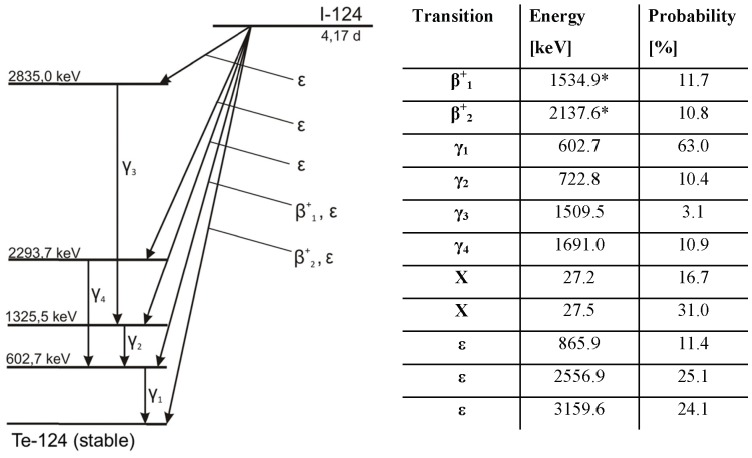
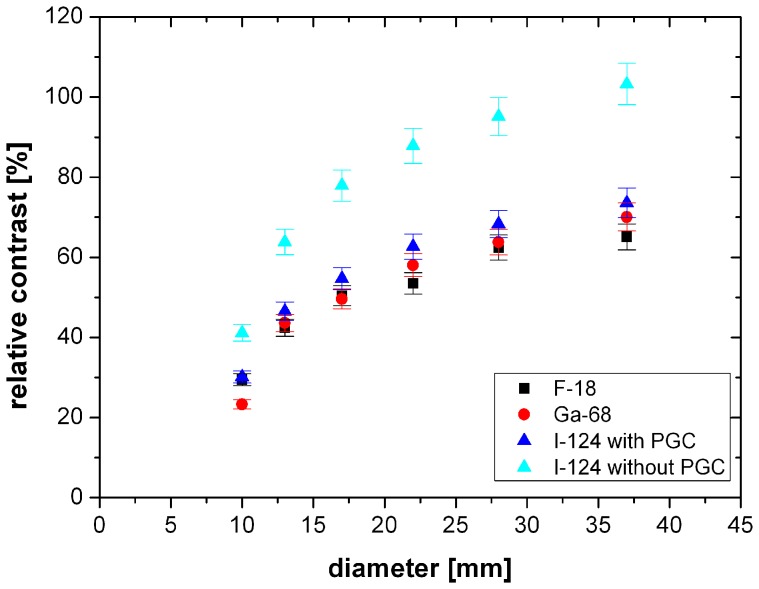
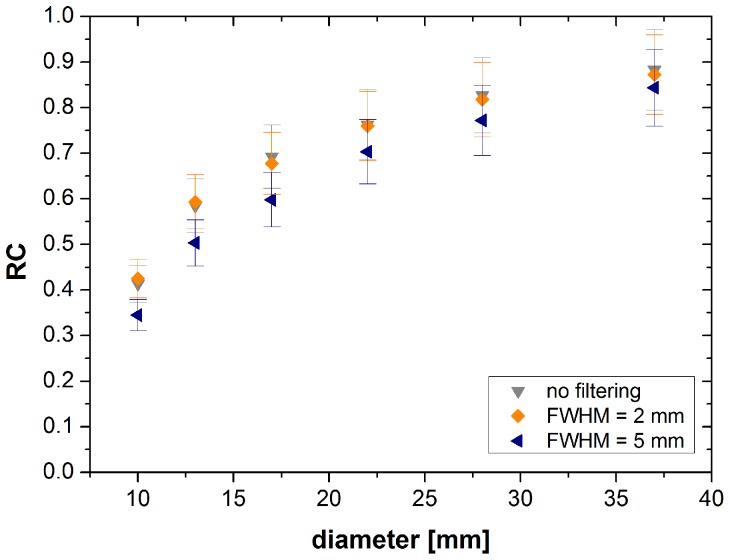
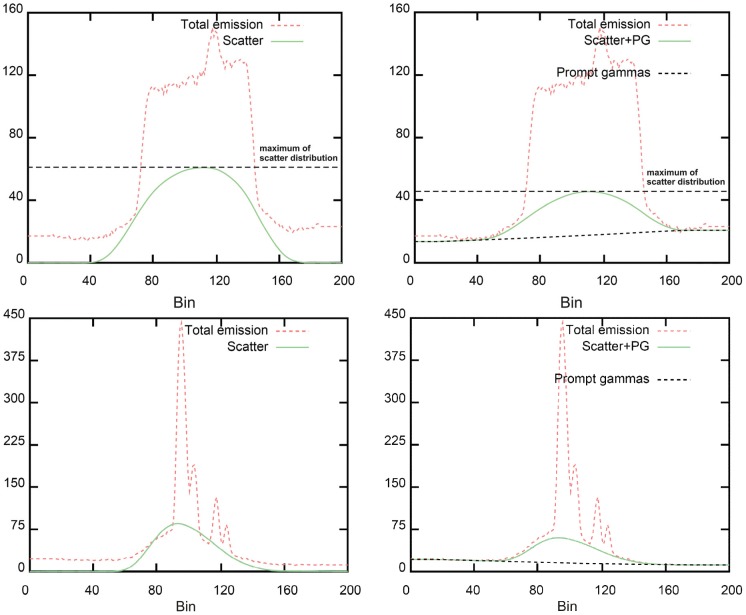
The RCs of Ga-68 are the smallest (79%). I-124 reaches similar RCs (87% with PGC, 84% without PGC) as F-18 (84%). showing that the quantification of I-124 images is similar to F-18 and slightly better than Ga-68. With background activity the contrast of the I-124 PGC images is similar to Ga-68 and F-18 scans. There was lower background activity in the I-124 images without PGC, which probably originates from an overcorrection of the scatter contribution. Consequently, the contrast without PGC was much higher than with PGC. As a consequence PGC should be used for I-124.
For I-124 there is only a slight influence on the quantification depending on the use of the PGC. However, there are considerable differences with respect to I-124 image quality.
本研究旨在通过比较 I-124 PET 图像的恢复系数(RC)、信噪比(SNR)和与 F-18、Ga-68 的对比度,来评估有和没有即时伽马补偿(PGC)的 I-124 PET 图像的质量。此外,还评估了 PGC 对定量和图像质量的影响。
为了测量图像质量,使用了包含 6 个直径在 10 毫米至 37 毫米之间的球体的 NEMA NU2-2001 PET/SPECT-Phantom,这些球体位于不同背景活动水平的水中。每个球体都填充有由独立交叉校准剂量校准器测量的相同活动浓度。“热”源是使用完全 3D PET/CT(Biograph mCT®,Siemens Medical USA)采集的。F-18 和 Ga-68 的采集时间为 2 分钟,I-124 的采集时间为 10 分钟。重建采用 OSEM 算法。对于 I-124,图像分别在有和没有 PGC 的情况下进行重建。为了计算 RC,确定了每个球体中的活动浓度;此外,还研究了背景校正的影响。
Ga-68 的 RC 最小(79%)。I-124 达到类似的 RC(PGC 为 87%,无 PGC 为 84%),与 F-18(84%)相似。这表明 I-124 图像的定量与 F-18 相似,略优于 Ga-68。有背景活动时,I-124 PGC 图像的对比度与 Ga-68 和 F-18 扫描相似。无 PGC 的 I-124 图像的背景活动较低,这可能是由于散射贡献的过度校正所致。因此,无 PGC 的对比度远高于有 PGC 的对比度。因此,应该对 I-124 使用 PGC。
对于 I-124,定量仅取决于 PGC 的使用,只有轻微影响。然而,在 I-124 图像质量方面存在相当大的差异。