Institute of Preventive Veterinary Medicine, Sichuan Agricultural University, Chengdu, Sichuan 611130, China.
Vet Res. 2013 Sep 9;44(1):82. doi: 10.1186/1297-9716-44-82.
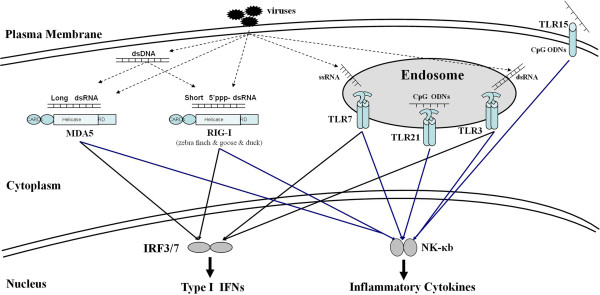
Similar to mammals, several viral-sensing pattern recognition receptors (PRR) have been identified in birds including Toll-like receptors (TLR) and retinoic acid-inducible gene I (RIG-I)-like receptors (RLR). Avian TLR are slightly different from their mammalian counterparts, including the pseudogene TLR8, the absence of TLR9, and the presence of TLR1La, TLR1Lb, TLR15, and TLR21. Avian TLR3 and TLR7 are involved in RNA virus recognition, especially highly pathogenic avian influenza virus (HPAIV), while TLR15 and TLR21 are potential sensors that recognize both RNA viruses and bacteria. However, the agonist of TLR15 is still unknown. Interestingly, chickens, unlike ducks, geese and finches, lack RIG-I, however they do express melanoma differentiation-associated gene 5 (MDA5) which functionally compensates for the absence of RIG-I. Duck RIG-I is the cytosolic recognition element for HPAIV recognition, while chicken cells sense HPAIV through MDA5. However, the contributions of MDA5 and RIG-I to IFN-β induction upon HPAIV infection is different, and this may contribute to the chicken's susceptibility to highly pathogenic influenza. It is noteworthy that the interactions between avian DNA viruses and PRR have not yet been reported. Furthermore, the role for avian Nod-like receptors (NLR) in viral immunity is largely unknown. In this review, recent advances in the field of viral recognition by different types of PRR in birds are summarized. In particular, the tissue and cellular distribution of avian PRR, the recognition and activation of PRR by viruses, and the subsequent expression of innate antiviral genes such as type I IFN and proinflammatory cytokines are discussed.
类似于哺乳动物,鸟类中已经鉴定出几种病毒感应模式识别受体 (PRR),包括 Toll 样受体 (TLR) 和视黄酸诱导基因 I (RIG-I)-样受体 (RLR)。禽类 TLR 与它们的哺乳动物对应物略有不同,包括假基因 TLR8、缺乏 TLR9 以及 TLR1La、TLR1Lb、TLR15 和 TLR21 的存在。禽类 TLR3 和 TLR7 参与 RNA 病毒的识别,特别是高致病性禽流感病毒 (HPAIV),而 TLR15 和 TLR21 是潜在的传感器,可识别 RNA 病毒和细菌。然而,TLR15 的激动剂仍不清楚。有趣的是,鸡与鸭、鹅和雀类不同,缺乏 RIG-I,但它们确实表达黑色素瘤分化相关基因 5 (MDA5),该基因在功能上弥补了 RIG-I 的缺失。鸭 RIG-I 是 HPAIV 识别的细胞质识别元件,而鸡细胞通过 MDA5 感知 HPAIV。然而,MDA5 和 RIG-I 在 HPAIV 感染后诱导 IFN-β 的贡献不同,这可能导致鸡对高致病性流感的易感性。值得注意的是,尚未报道禽 DNA 病毒与 PRR 之间的相互作用。此外,禽类 Nod 样受体 (NLR) 在病毒免疫中的作用在很大程度上尚不清楚。在本文综述中,总结了鸟类不同类型 PRR 对病毒识别的最新进展。特别是讨论了禽类 PRR 的组织和细胞分布、病毒对 PRR 的识别和激活以及随后的先天抗病毒基因如 I 型 IFN 和促炎细胞因子的表达。