Ritter Lane A, Wang Andrew Y, Sauer Bryan G, Kleiner Daniel E
Department of General Surgery, University of Virginia Health System, Charlottesville, VA, USA.
JSLS. 2013 Jul-Sep;17(3):481-3. doi: 10.4293/108680813X13693422521999.
Endoscopists have used clipping devices to successfully close acute, iatrogenic perforations throughout the gastrointestinal tract. We applied this technology to our bariatric patients, who tend to present with a more delayed anastomotic leak, to determine whether these leaks and fistulae would also heal with endoclip application.
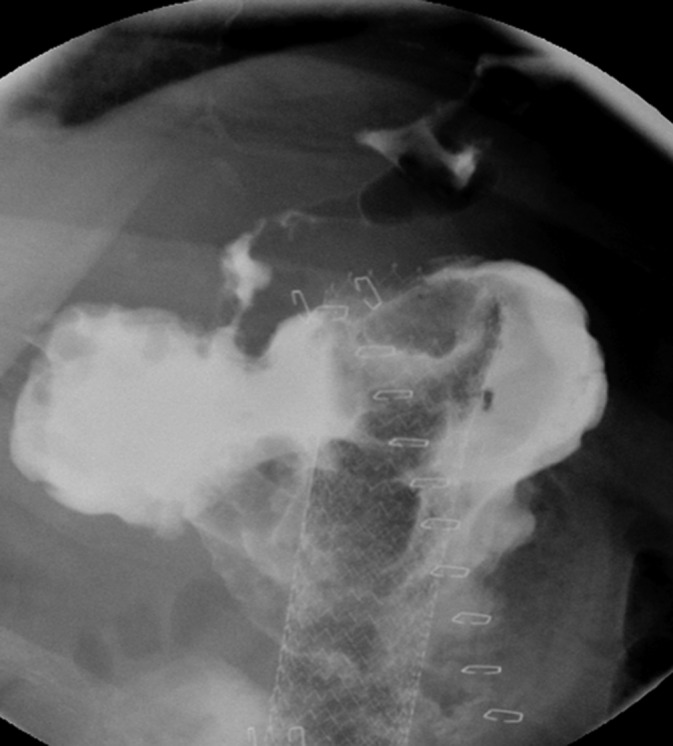
We describe a small series of 2 clinically stable bariatric patients who presented with postoperative anastomotic leaks who met criteria for non-operative therapy. The first underwent a laparoscopic Roux-en-Y gastric bypass and presented postoperatively with a leak at her gastrojejunal anastomosis. The location was not amenable to stent placement; therefore, 2 endoclips were placed. The leak was sealed by fluoroscopic examination 14 d later. The second had a reversal of a previous gastric bypass, creating a new gastrogastric anastomosis. A leak was found at this new connection postoperatively. After failure of a stent to seal the leak, 8 endoclips were used. This patient also had successful closure of her leak on fluoroscopy 14 d postprocedure.
Anastomotic leaks after bariatric surgery can incur severe morbidity, cost, and detriment to patients' quality of life. Unstable patients require operative intervention. Stable patients are candidates for more-conservative measures. Endoscopic stents have been successful in closing gastric leaks, though some are not anatomically amenable to stent placement, and stents also have the potential to migrate distally. We demonstrate 2 cases of successful closure of leaks in bariatric patients by using endoclips and suggest that this be considered an option in appropriate cases.
内镜医师已使用夹闭装置成功闭合整个胃肠道的急性医源性穿孔。我们将这项技术应用于肥胖症患者,这类患者往往出现较迟发性的吻合口漏,以确定这些漏口和瘘管是否也能通过内镜夹闭来愈合。
我们描述了一小系列2例临床稳定的肥胖症患者,他们术后出现吻合口漏,符合非手术治疗标准。第一例患者接受了腹腔镜Roux-en-Y胃旁路手术,术后胃空肠吻合口出现漏口。该位置不适合放置支架;因此,放置了2个内镜夹。14天后经荧光镜检查漏口被封闭。第二例患者之前的胃旁路手术进行了逆转,形成了新的胃胃吻合口。术后在这个新连接处发现了漏口。支架未能封闭漏口后,使用了8个内镜夹。该患者在术后14天经荧光镜检查也成功封闭了漏口。
肥胖症手术后的吻合口漏可导致严重的发病率、费用增加,并损害患者的生活质量。不稳定的患者需要手术干预。稳定的患者适合采取更保守的措施。内镜支架已成功用于闭合胃漏,尽管有些在解剖结构上不适合放置支架,而且支架也有可能向远端移位。我们展示了2例通过使用内镜夹成功闭合肥胖症患者漏口的病例,并建议在适当的情况下可考虑将其作为一种选择。