Puranik Ameya D, Agrawal Archi, Purandare Nilendu C, Shah Sneha, Rangarajan Venkatesh
Department of Nuclear Medicine and Molecular Imaging, Tata Memorial Hospital, Parel, Mumbai, India.
Indian J Nucl Med. 2012 Oct;27(4):266-8. doi: 10.4103/0972-3919.115404.
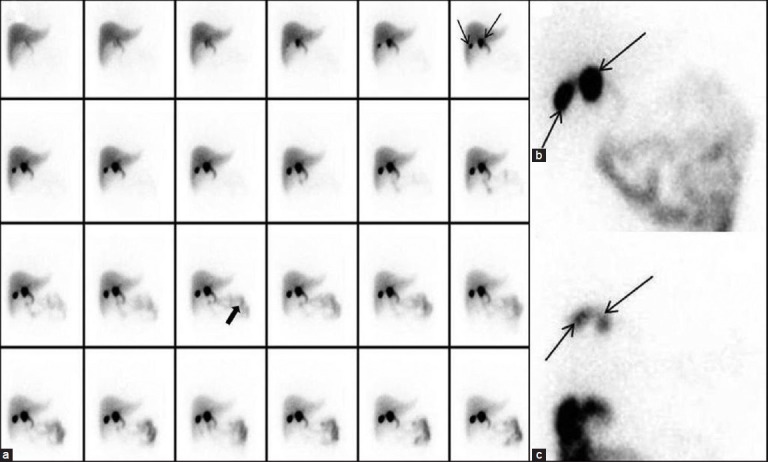
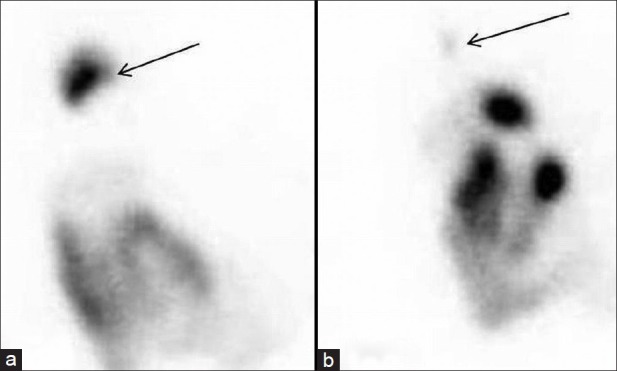
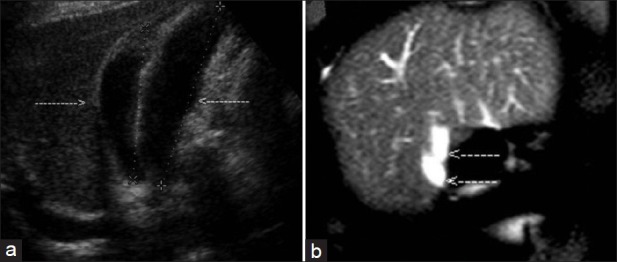
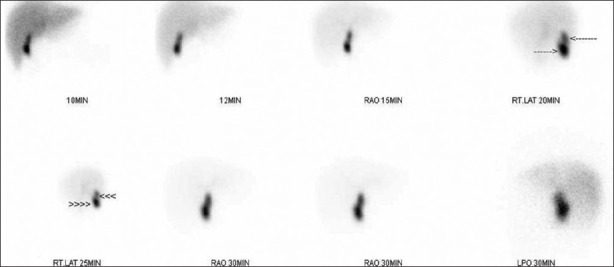
Gall bladder (GB) duplication is a rare condition often found incidentally; most of these detected on screening Ultrasonography (USG) for abdominal colic. Nuclear hepatobiliary scan, popularly known as hepatobiliary iminodiacetic acid (HIDA) scan, with its biliary kinetics, is highly specific for picking up abnormalities related to biliary tract and GB. We report two cases of duplication of GB visualized on HIDA scan. First case highlights the role of HIDA scan in diagnosis of duplicated GB, where USG was equivocal with a number of differentials, whereas in the second case, HIDA helped to rule out obstruction in this case of duplicated GB identified on USG; ruling out biliary cause for the abdominal colic.
胆囊重复是一种罕见的病症,通常是偶然发现的;其中大多数是在因腹部绞痛而进行的超声检查(USG)筛查中被检测到的。核肝胆扫描,通常称为肝胆亚氨基二乙酸(HIDA)扫描,凭借其胆动力学,在发现与胆道和胆囊相关的异常方面具有高度特异性。我们报告两例在HIDA扫描中显示胆囊重复的病例。第一例突出了HIDA扫描在诊断重复胆囊中的作用,在该病例中超声检查结果不明确,存在多种鉴别诊断;而在第二例中,HIDA有助于排除在超声检查中发现的重复胆囊病例中的梗阻情况,排除了腹部绞痛的胆道病因。