Laboratório de Genética de Populações e Evolução de Mosquitos Vetores, Coordenação de Biodiversidade, Instituto Nacional de Pesquisas da Amazônia, Avenida André Araujo, 2,936, Bairro Petrópolis, Manaus CEP 69,067-375, Amazonas, Brazil.
Parasit Vectors. 2013 Sep 11;6(1):258. doi: 10.1186/1756-3305-6-258.
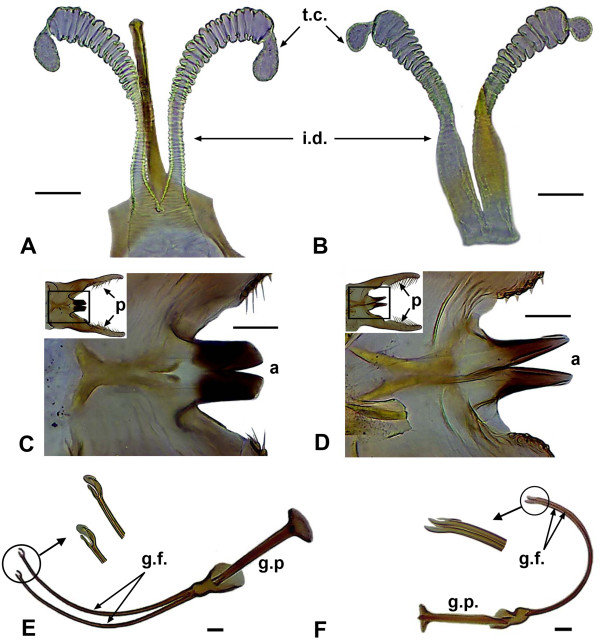
Lutzomyia umbratilis (a probable species complex) is the main vector of Leishmania guyanensis in the northern region of Brazil. Lutzomyia anduzei has been implicated as a secondary vector of this parasite. These species are closely related and exhibit high morphological similarity in the adult stage; therefore, they have been wrongly identified, both in the past and in the present. This shows the need for employing integrated taxonomy.
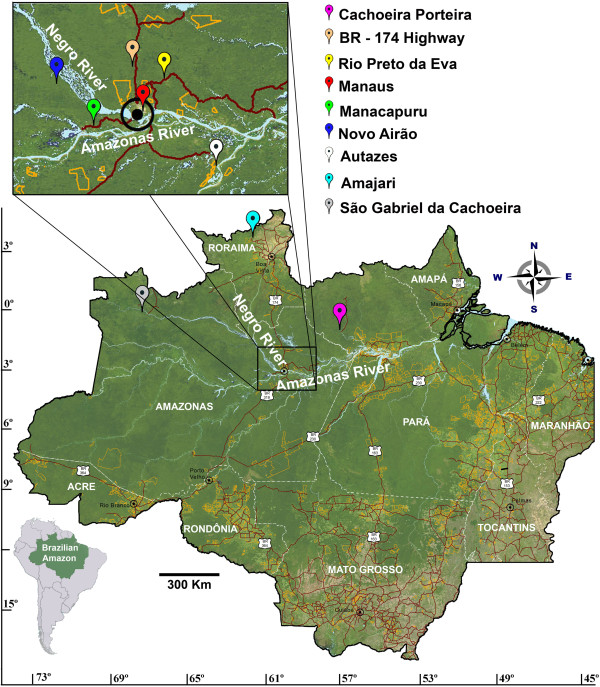
With the aim of gathering information on the molecular taxonomy and evolutionary relationships of these two vectors, 118 sequences of 663 base pairs (barcode region of the mitochondrial DNA cytochrome oxidase I - COI) were generated from 72 L. umbratilis and 46 L. anduzei individuals captured, respectively, in six and five localities of the Brazilian Amazon. The efficiency of the barcode region to differentiate the L. umbratilis lineages I and II was also evaluated. The data were analyzed using the pairwise genetic distances matrix and the Neighbor-Joining (NJ) tree, both based on the Kimura Two Parameter (K2P) evolutionary model.
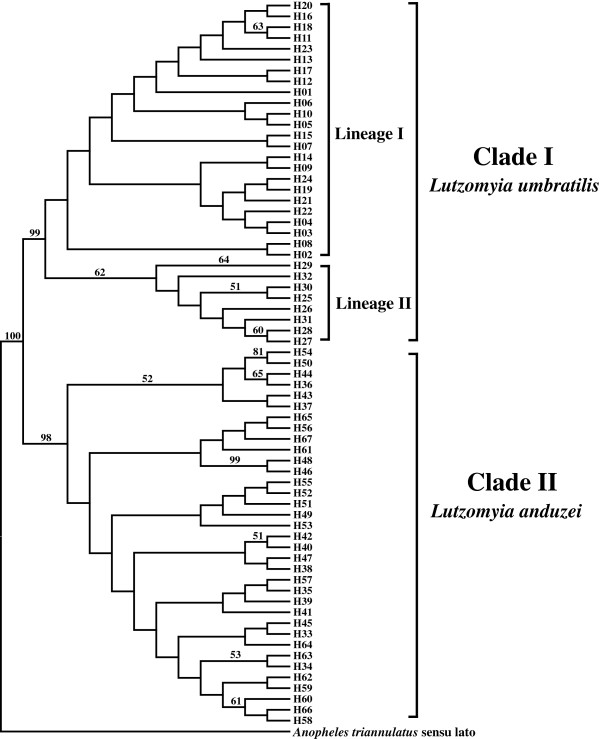
The analyses resulted in 67 haplotypes: 32 for L. umbratilis and 35 for L. anduzei. The mean intra-specific genetic distance was 0.008 (0.002 to 0.010 for L. umbratilis; 0.008 to 0.014 for L. anduzei), whereas the mean interspecific genetic distance was 0.044 (0.041 to 0.046), supporting the barcoding gap. Between the L. umbratilis lineages I and II, it was 0.009 to 0.010. The NJ tree analysis strongly supported monophyletic clades for both L. umbratilis and L. anduzei, whereas the L. umbratilis lineages I and II formed two poorly supported monophyletic subclades.
The barcode region clearly separated the two species and may therefore constitute a valuable tool in the identification of the sand fly vectors of Leishmania in endemic leishmaniasis areas. However, the barcode region had not enough power to separate the two lineages of L. umbratilis, likely reflecting incipient species that have not yet reached the status of distinct species.
Lutzomyia umbratilis(可能是一个复杂的物种)是巴西北部地区Leishmania guyanensis的主要传播媒介。Lutzomyia anduzei 已被牵连为该寄生虫的次要传播媒介。这些物种密切相关,在成虫阶段表现出高度的形态相似性;因此,它们过去和现在都被错误地识别。这表明需要采用综合分类学。
为了收集有关这两种传播媒介的分子分类学和进化关系的信息,从巴西亚马逊地区的六个和五个地点分别捕获的 72 只 L. umbratilis 和 46 只 L. anduzei 个体中生成了 118 个 663 个碱基对(线粒体 DNA 细胞色素氧化酶 I-COI 的条形码区域)的序列。还评估了条形码区域区分 L. umbratilis 谱系 I 和 II 的效率。使用基于 Kimura 双参数(K2P)进化模型的成对遗传距离矩阵和邻接法(NJ)树分析数据。
分析产生了 67 个单倍型:32 个用于 L. umbratilis,35 个用于 L. anduzei。种内平均遗传距离为 0.008(L. umbratilis 为 0.002 至 0.010;L. anduzei 为 0.008 至 0.014),而种间平均遗传距离为 0.044(0.041 至 0.046),支持条形码间隙。在 L. umbratilis 谱系 I 和 II 之间,为 0.009 至 0.010。NJ 树分析强烈支持 L. umbratilis 和 L. anduzei 的单系聚类,而 L. umbratilis 谱系 I 和 II 形成两个支持度较低的单系亚聚类。
条形码区域清楚地区分了这两个物种,因此可能成为鉴定地方性利什曼病地区利什曼原虫传播媒介的有用工具。然而,条形码区域没有足够的能力来分离 L. umbratilis 的两个谱系,这可能反映了尚未达到独特物种地位的初期物种。