Department of Infectious Disease Epidemiology, Imperial College London, London, United Kingdom.
J Clin Microbiol. 2013 Nov;51(11):3788-95. doi: 10.1128/JCM.01708-13. Epub 2013 Sep 11.
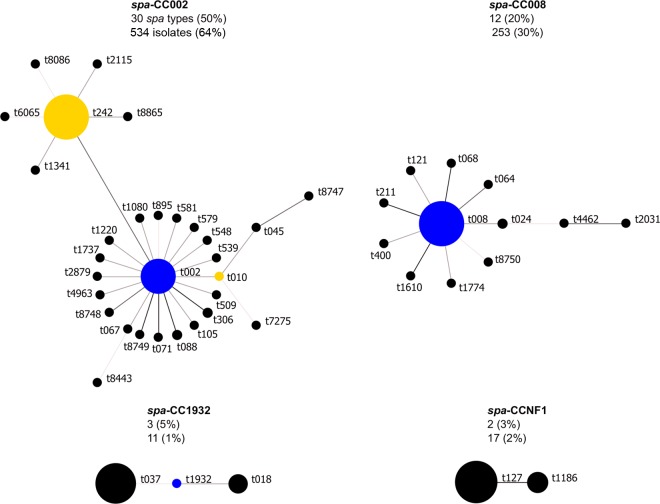
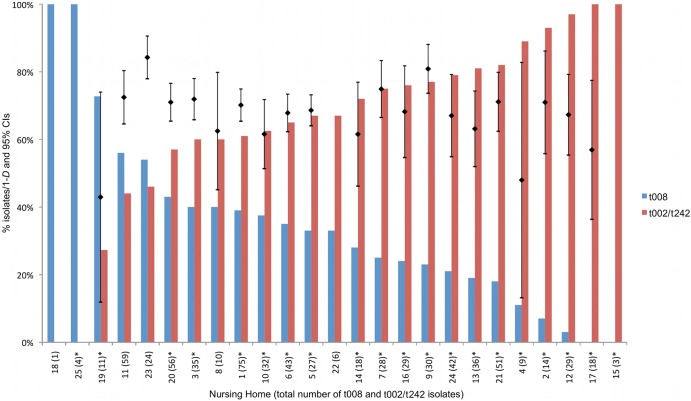
Nursing homes represent a unique and important methicillin-resistant Staphylococcus aureus (MRSA) reservoir. Not only are strains imported from hospitals and the community, strains can be transported back into these settings from nursing homes. Since MRSA bacteria are prevalent in nursing homes and yet relatively poorly studied in this setting, a multicenter, regional assessment of the frequency and diversity of MRSA in the nursing home reservoir was carried out and compared to that of the MRSA from hospitals in the same region. The prospective study collected MRSA from nasal swabbing of residents of 26 nursing homes in Orange County, California, and characterized each isolate by spa typing. A total of 837 MRSA isolates were collected from the nursing homes. Estimates of admission prevalence and point prevalence of MRSA were 16% and 26%, respectively. The spa type genetic diversity was heterogeneous between nursing homes and significantly higher overall (77%) than the diversity in Orange County hospitals (72%). MRSA burden in nursing homes appears largely due to importation from hospitals. As seen in Orange County hospitals, USA300 (sequence type 8 [ST8]/t008), USA100 (ST5/t002), and a USA100 variant (ST5/t242) were the dominant MRSA clones in Orange County nursing homes, representing 83% of all isolates, although the USA100 variant was predominant in nursing homes, whereas USA300 was predominant in hospitals. Control strategies tailored to the complex problem of MRSA transmission and infection in nursing homes are needed in order to minimize the impact of this unique reservoir on the overall regional MRSA burden.
养老院是耐甲氧西林金黄色葡萄球菌 (MRSA) 的一个独特而重要的储存库。不仅从医院和社区输入的菌株,而且还可以从养老院将这些菌株运输回这些环境中。由于 MRSA 细菌在养老院中普遍存在,但在这种环境中研究相对较少,因此进行了一项多中心、区域性评估,以评估养老院中 MRSA 的频率和多样性,并将其与同一地区医院中的 MRSA 进行比较。这项前瞻性研究从加利福尼亚州奥兰治县的 26 家养老院居民的鼻腔拭子中收集了 MRSA,并通过 spa 分型对每个分离株进行了特征描述。从养老院共收集了 837 株 MRSA 分离株。MRSA 的入院流行率和时点流行率估计分别为 16%和 26%。spa 型遗传多样性在养老院之间存在异质性,且总体上明显高于奥兰治县医院(72%)(77%)。养老院中 MRSA 的负担主要归因于从医院输入。与美国橙县医院中观察到的情况一样,USA300(序列型 8 [ST8]/t008)、USA100(ST5/t002)和 USA100 变体(ST5/t242)是橙县养老院中主要的 MRSA 克隆,占所有分离株的 83%,尽管 USA100 变体在养老院中占优势,而 USA300 在医院中占优势。需要针对养老院中 MRSA 传播和感染的复杂问题制定控制策略,以最大限度地减少这个独特储存库对整体区域 MRSA 负担的影响。