INSERM U936, University of Rennes 1, Brittany, France.
PLoS One. 2013 Sep 9;8(9):e71991. doi: 10.1371/journal.pone.0071991. eCollection 2013.
Case-based reasoning (CBR) is an emerging decision making paradigm in medical research where new cases are solved relying on previously solved similar cases. Usually, a database of solved cases is provided, and every case is described through a set of attributes (inputs) and a label (output). Extracting useful information from this database can help the CBR system providing more reliable results on the yet to be solved cases.
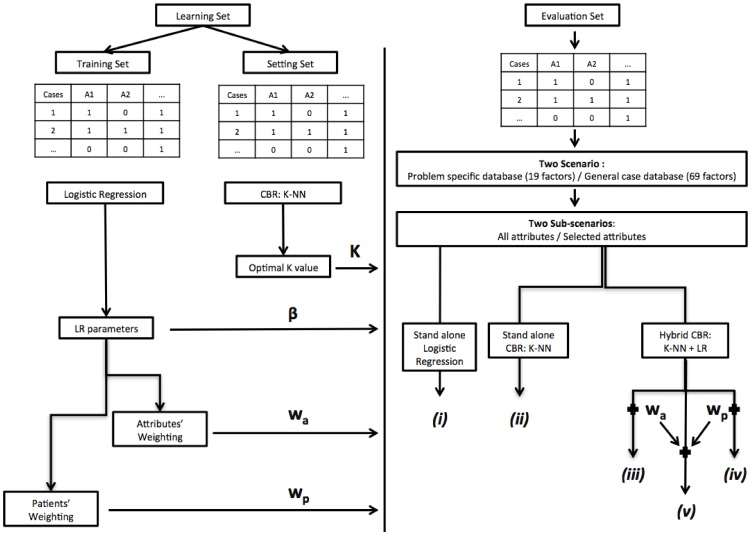
We suggest a general framework where a CBR system, viz. K-Nearest Neighbour (K-NN) algorithm, is combined with various information obtained from a Logistic Regression (LR) model, in order to improve prediction of access to the transplant waiting list.
LR is applied, on the case database, to assign weights to the attributes as well as the solved cases. Thus, five possible decision making systems based on K-NN and/or LR were identified: a standalone K-NN, a standalone LR and three soft K-NN algorithms that rely on the weights based on the results of the LR. The evaluation was performed under two conditions, either using predictive factors known to be related to registration, or using a combination of factors related and not related to registration.
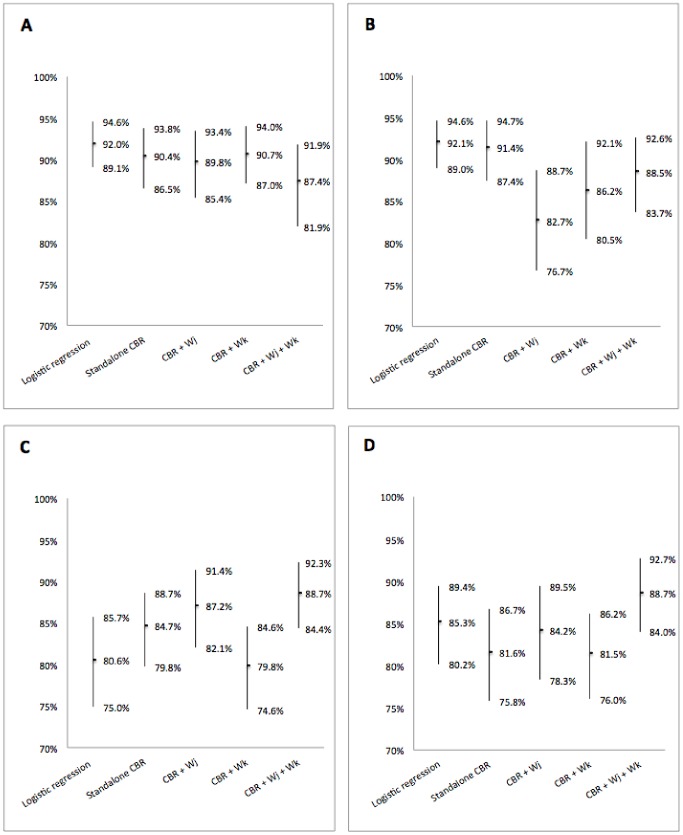
The results show that our suggested approach, where the K-NN algorithm relies on both weighted attributes and cases, can efficiently deal with non relevant attributes, whereas the four other approaches suffer from this kind of noisy setups. The robustness of this approach suggests interesting perspectives for medical problem solving tools using CBR methodology.
基于案例推理(CBR)是医学研究中一种新兴的决策制定范例,新病例的解决依赖于先前解决的类似病例。通常,提供一个已解决病例的数据库,每个病例通过一组属性(输入)和一个标签(输出)来描述。从这个数据库中提取有用的信息可以帮助 CBR 系统为尚未解决的病例提供更可靠的结果。
我们提出了一个通用框架,其中基于案例推理系统(即 K-最近邻(K-NN)算法)与从逻辑回归(LR)模型获得的各种信息相结合,以提高对移植等待名单准入的预测。
将 LR 应用于病例数据库,为属性和已解决病例分配权重。因此,确定了基于 K-NN 和/或 LR 的五个可能的决策支持系统:独立的 K-NN、独立的 LR 以及三个依赖于基于 LR 结果的加权案例的软 K-NN 算法。评估是在两种条件下进行的,一种是使用已知与注册相关的预测因素,另一种是使用与注册相关和不相关的因素组合。
结果表明,我们提出的方法,即 K-NN 算法同时依赖于加权属性和案例,可以有效地处理不相关的属性,而其他四种方法则受到这种嘈杂设置的影响。这种方法的稳健性为使用 CBR 方法学的医学问题解决工具提供了有趣的前景。