Department of Pulmonology, Institute for Cardiovascular Research, VU University Medical Center, Amsterdam, The Netherlands.
PLoS One. 2013 Sep 5;8(9):e72013. doi: 10.1371/journal.pone.0072013. eCollection 2013.
Exercise variables determined in patients with pulmonary arterial hypertension (PAH) at the time of diagnosis, predict survival. It is unknown whether upon treatment, subsequent changes in these exercise variables reflect improvements in survival. The aim of this study was to determine changes in exercise variables in PAH patients and to relate these changes to survival.
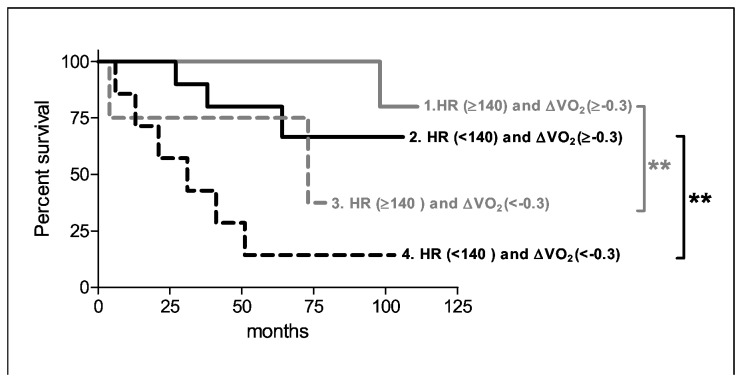
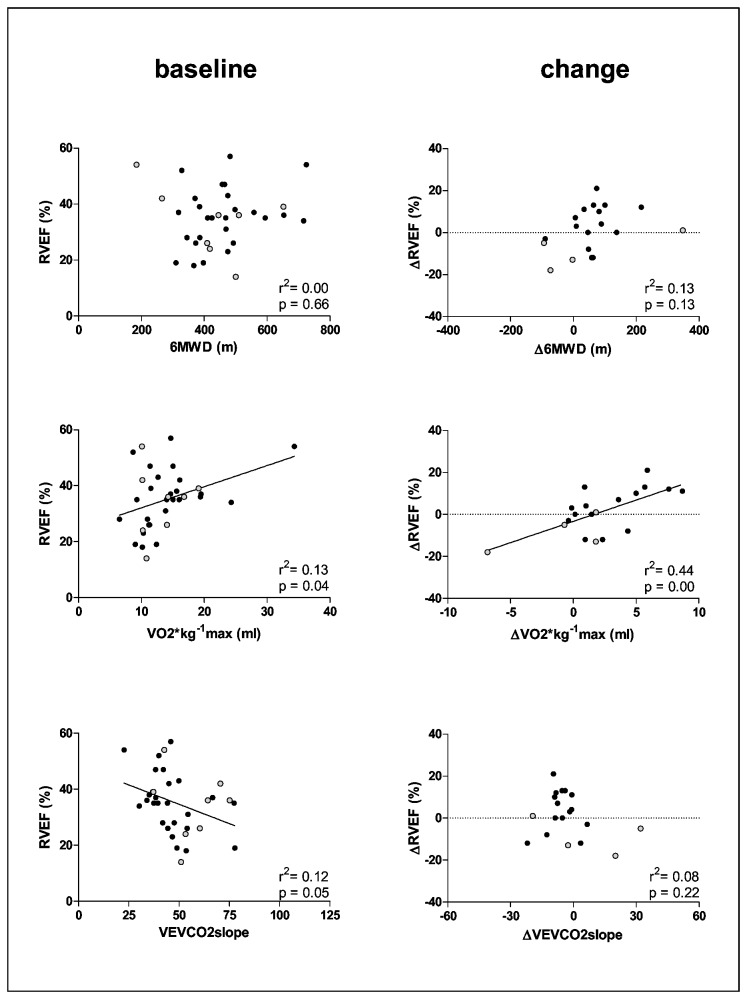
Baseline cardiopulmonary exercise test (CPET) variables and six-minute-walk-distance (6MWD) were available from 65 idiopathic PAH patients (50 females; mean age 45±2yrs). The same variables were determined after treatment (13months) in a sub group of 43 patients. To estimate the association between changes in exercise variables and changes in cardiac function, right-ventricle ejection fraction (RVEF) was measured by cardiac MRI at baseline and after treatment in 34 patients. Mean follow-up time after the second CPET was 53 (range: 4-111) months. Kaplan-Meier analysis was used to relate survival to baseline and treatment-associated changes in exercise variables.
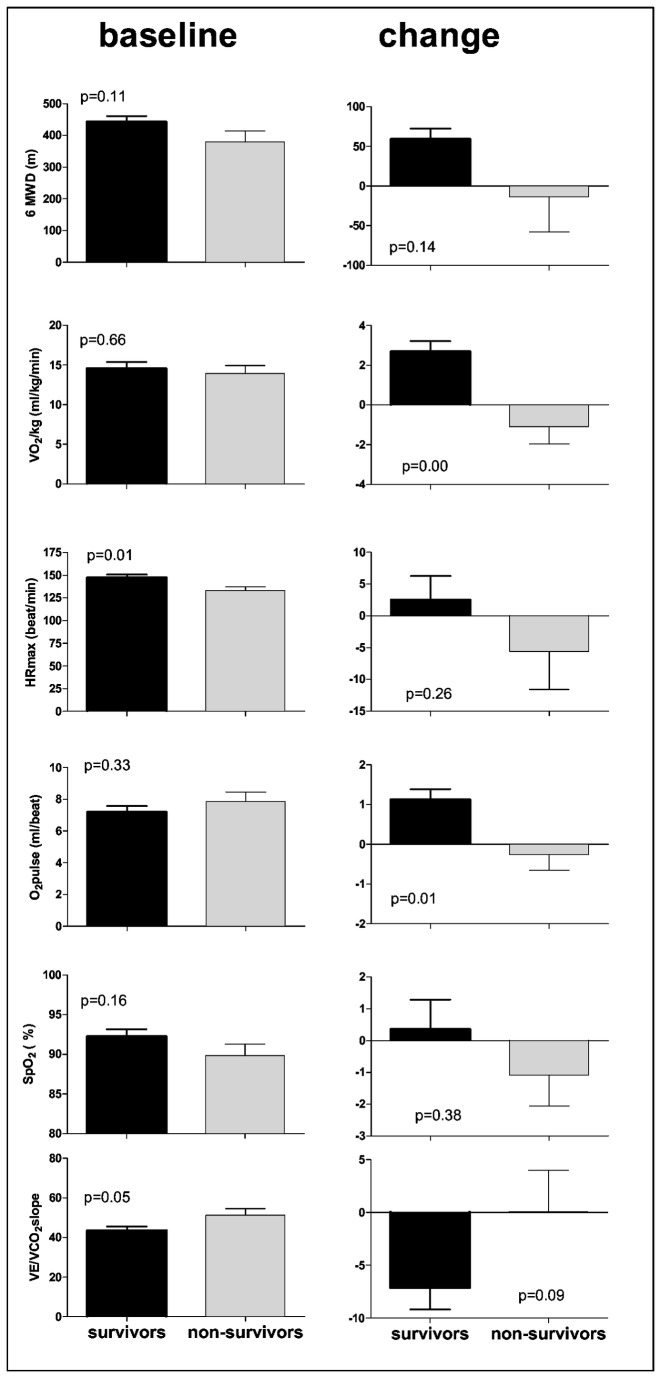
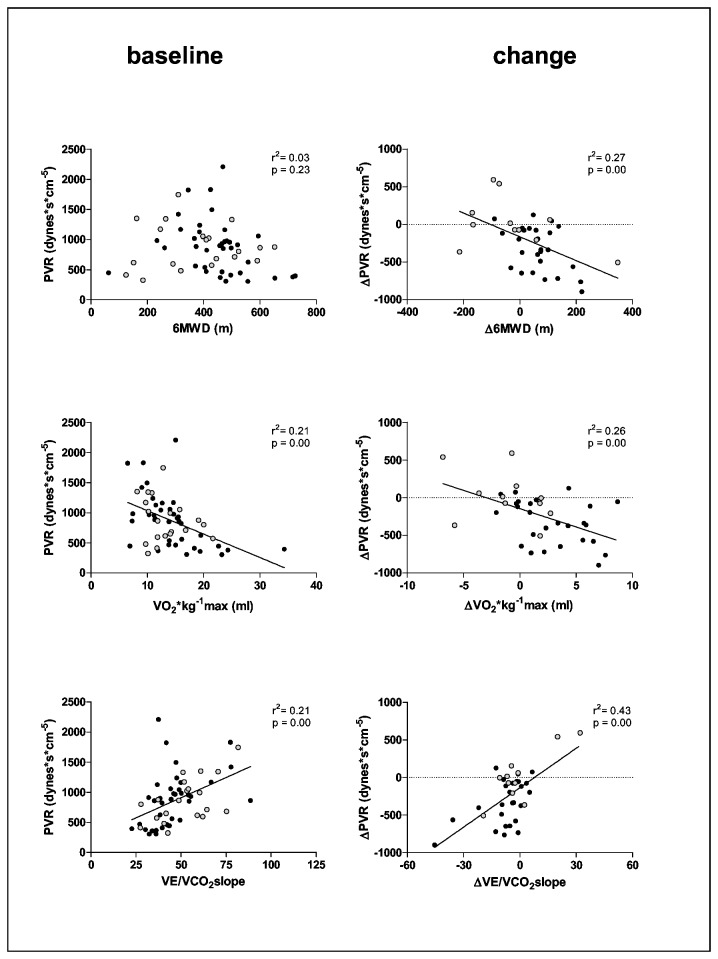
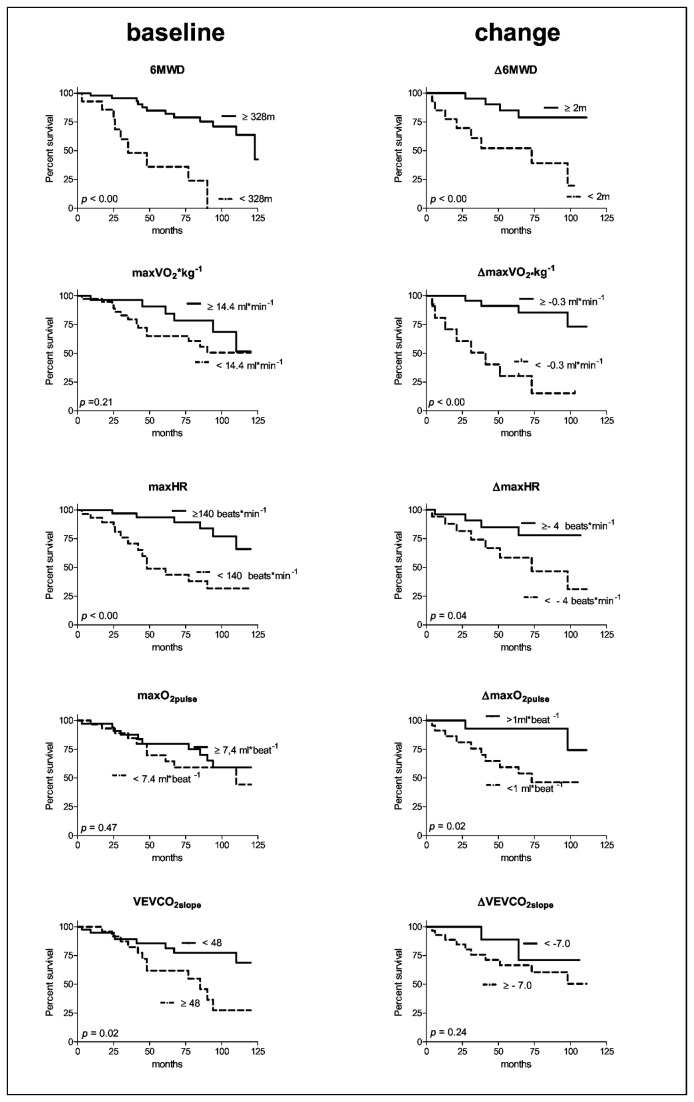
Survivors showed a significantly greater change in maximal oxygen uptake than non-survivors and this change in aerobic capacity was significantly related to changes in RVEF. From baseline until the end of the study period, two patients underwent a lung transplantation and 19 patients died. Survival analysis showed that baseline 6MWD (p<0.0001), maximal heart rate (p<0.0001) and the slope relating ventilation with carbon dioxide production (p≤0.05) were significant predictors of survival, whereas baseline oxygen uptake and oxygen pulse held no predictive value. Treatment associated changes in 6MWD (p<0.01), maximal heart rate (p<0.05), oxygen uptake (p<0.001) and oxygen pulse predicted survival (p<0.05), whereas changes in the slope relating ventilation with carbon dioxide production did not.
Exercise variables with prognostic significance when determined at baseline, retain their prognostic relevance after treatment. However, when changes in exercise variables upon treatment are considered, a different set of variables provides prognostic information.
在肺动脉高压(PAH)患者确诊时确定的运动变量可预测生存率。尚不清楚在治疗后,这些运动变量的后续变化是否反映了生存率的改善。本研究的目的是确定 PAH 患者运动变量的变化,并将这些变化与生存率相关联。
65 例特发性 PAH 患者(50 名女性;平均年龄 45±2 岁)的基线心肺运动测试(CPET)变量和 6 分钟步行距离(6MWD)可用。在 43 名患者亚组中,在治疗后(13 个月)确定了相同的变量。为了评估运动变量变化与心脏功能变化之间的关联,在 34 名患者中使用心脏 MRI 在基线和治疗后测量右心室射血分数(RVEF)。第二次 CPET 后平均随访时间为 53(范围:4-111)个月。Kaplan-Meier 分析用于将生存与运动变量的基线和治疗相关变化相关联。
幸存者的最大摄氧量变化明显大于非幸存者,而这种有氧能力的变化与 RVEF 的变化明显相关。从基线到研究结束期间,有 2 名患者接受了肺移植,有 19 名患者死亡。生存分析显示,基线 6MWD(p<0.0001)、最大心率(p<0.0001)和与二氧化碳产生相关的通气斜率(p≤0.05)是生存的显著预测因子,而基线摄氧量和氧脉冲无预测价值。6MWD(p<0.01)、最大心率(p<0.05)、摄氧量(p<0.001)和氧脉冲治疗相关变化预测生存(p<0.05),而与二氧化碳产生相关的通气斜率变化则没有。
在基线时确定的具有预后意义的运动变量在治疗后仍保持其预后相关性。然而,当考虑治疗时运动变量的变化时,一组不同的变量提供了预后信息。