Department of Neuroscience, Physiology and Pharmacology, University College London, London, United Kingdom.
PLoS One. 2013 Sep 10;8(9):e73328. doi: 10.1371/journal.pone.0073328. eCollection 2013.
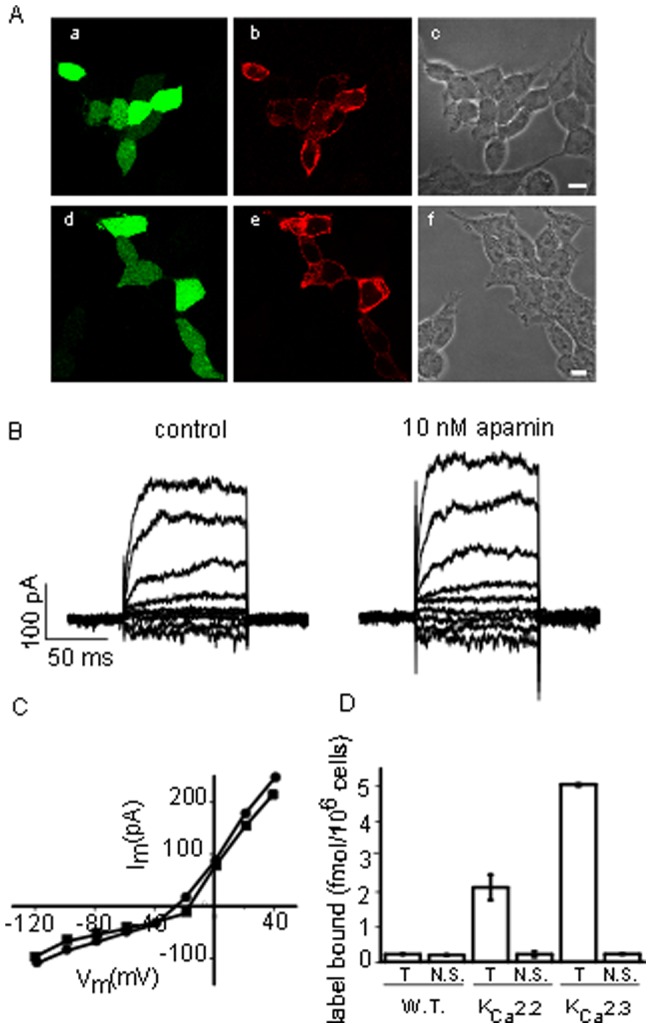
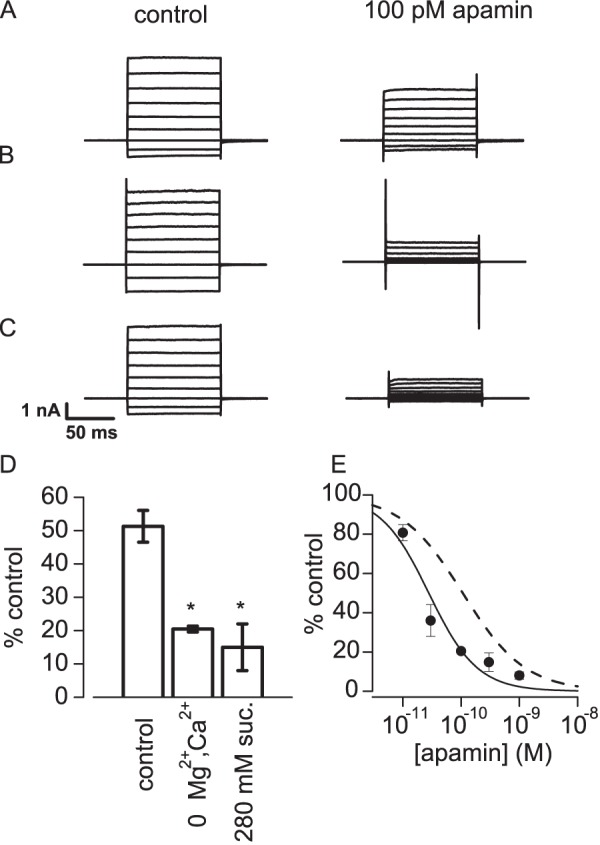
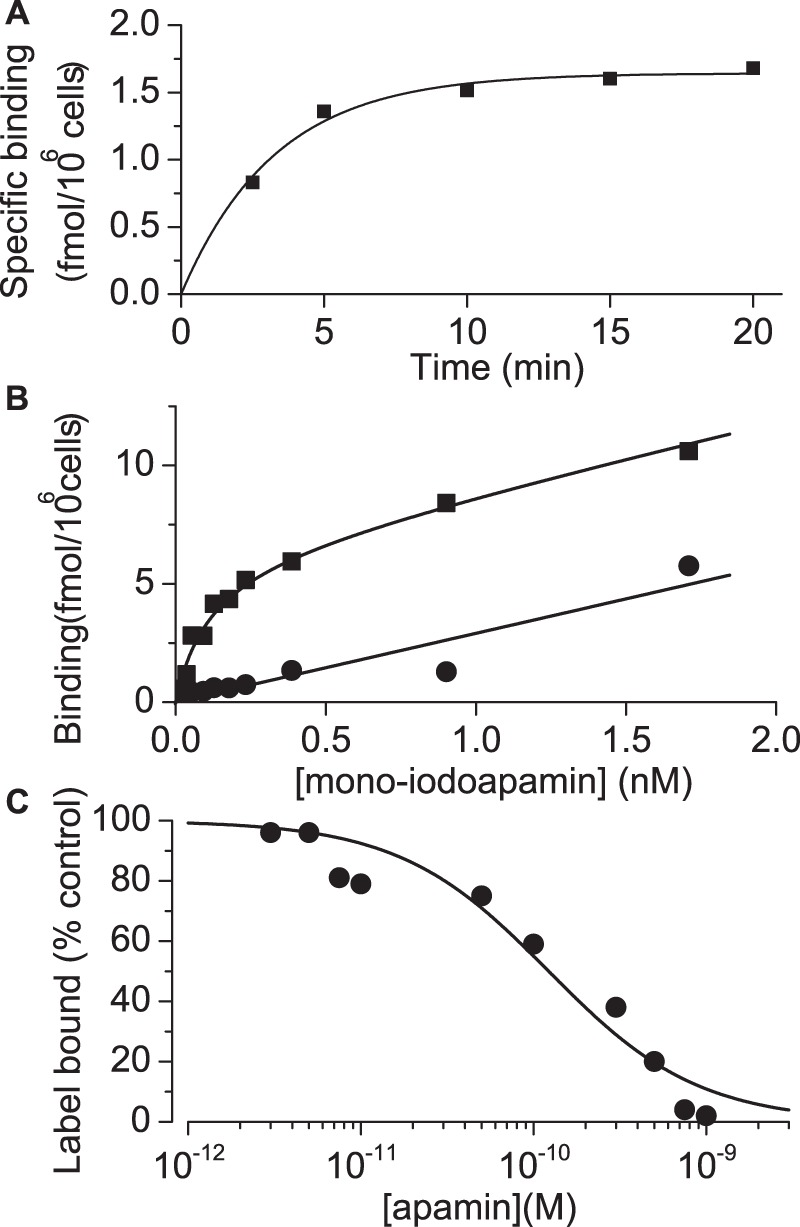
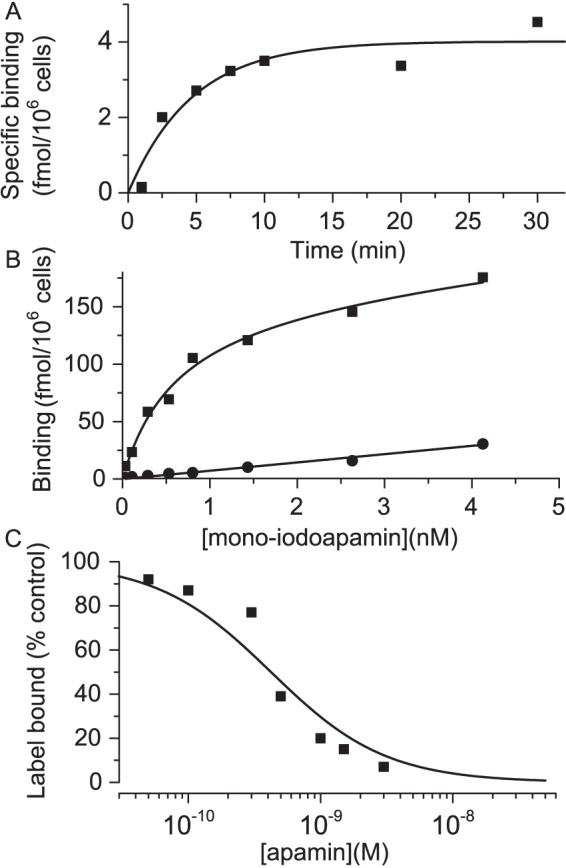
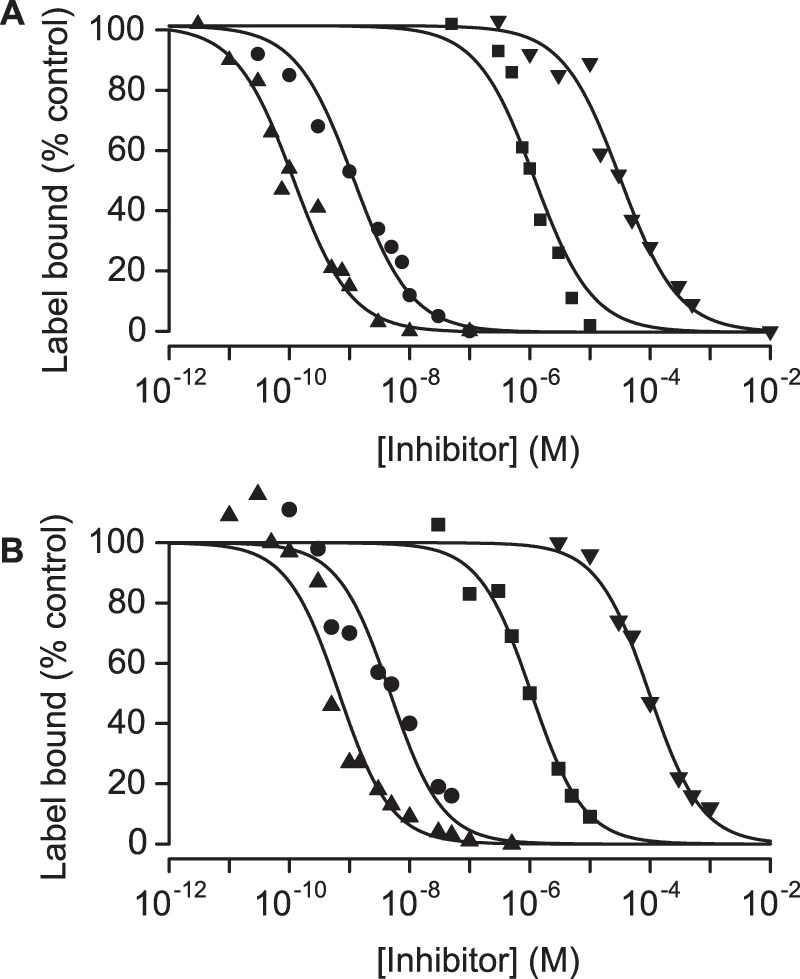
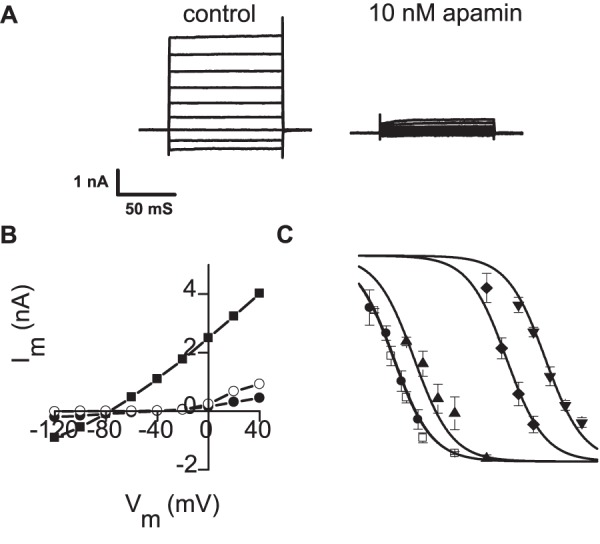
Small conductance calcium-activated potassium channels (KCa2.1,2.2,2.3) are blocked with high affinity by both peptide toxins (e.g. apamin) and small molecule blockers (e.g. UCL 1848). In electrophysiological experiments, apamin shows subtype selectivity with IC50s of ∼100 pM and ∼1 nM for block KCa2.2 and KCa2.3 respectively. In binding studies, however, apamin appears not to discriminate between KCa2.2 and 2.3 and is reported to have a significantly higher (∼20-200-fold) affinity (∼5 pM). This discrepancy between binding and block has been suggested to reflect an unusual mode of action of apamin. However, these binding and electrophysiological block experiments have not been conducted in the same ionic conditions, so it is also possible that the discrepancy arises simply because of differences in experimental conditions. We have now examined this latter possibility. Thus, we measured (125)I-apamin binding to intact HEK 293 cells expressing KCa2 channels under the same ionic conditions (i.e. normal physiological conditions) that we also used for current block measurements. We find that binding and block experiments agree well if the same ionic conditions are used. Further, the binding of apamin and other blockers showed subtype selectivity when measured in normal physiological solutions (e.g.(125)I-apamin bound to KCa2.2 with K L 91±40 pM and to KCa2.3 with K L 711±126 pM, while inhibiting KCa2.2 current at IC50 103±2 pM). We also examined KCa2 channel block in Ca(2+) and Mg(2+) free solutions that mimic conditions reported in the literature for binding experiments. Under these (non-physiological) conditions the IC50 for apamin block of KCa2.2 was reduced to 20±3 pM. Our results therefore suggest that the apparent discrepancy between blocking and binding reported in the literature can be largely accounted for by the use of non-physiological ionic conditions in binding experiments.
小电导钙激活钾通道(KCa2.1、2.2、2.3)被肽毒素(如蜂毒素)和小分子阻滞剂(如 UCL 1848)高亲和力阻断。在电生理学实验中,蜂毒素对 KCa2.2 和 KCa2.3 的 IC50 分别约为 100 pM 和 1 nM,具有亚型选择性。然而,在结合研究中,蜂毒素似乎不能区分 KCa2.2 和 2.3,并报道其具有显著更高(约 20-200 倍)的亲和力(约 5 pM)。这种结合和阻断之间的差异被认为反映了蜂毒素的一种不寻常作用模式。然而,这些结合和电生理阻断实验并未在相同的离子条件下进行,因此也有可能差异仅仅是由于实验条件的不同。我们现在已经检查了后一种可能性。因此,我们在与我们用于电流阻断测量相同的离子条件(即正常生理条件)下,测量了表达 KCa2 通道的完整 HEK 293 细胞中(125)I-蜂毒素的结合。我们发现,如果使用相同的离子条件,结合和阻断实验非常吻合。此外,当在正常生理溶液中测量时,蜂毒素和其他阻滞剂的结合显示出亚型选择性(例如,(125)I-蜂毒素与 KCa2.2 的 K L 为 91±40 pM,与 KCa2.3 的 K L 为 711±126 pM,而抑制 KCa2.2 电流的 IC50 为 103±2 pM)。我们还研究了在模拟文献中报道的结合实验中条件的 Ca(2+)和 Mg(2+)自由溶液中的 KCa2 通道阻断。在这些(非生理)条件下,蜂毒素阻断 KCa2.2 的 IC50 降低至 20±3 pM。因此,我们的结果表明,文献中报道的阻断和结合之间的明显差异可以在很大程度上归因于结合实验中使用的非生理离子条件。