Department of Geography, Environment and Earth Sciences, University of Hull, Hull United Kingdom.
PLoS One. 2013 Sep 11;8(9):e74834. doi: 10.1371/journal.pone.0074834. eCollection 2013.
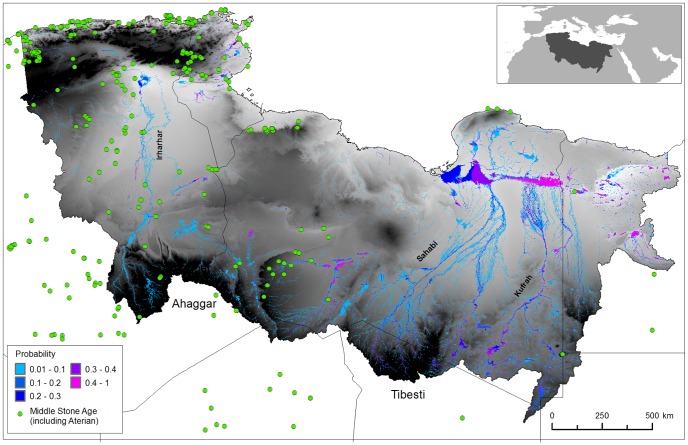
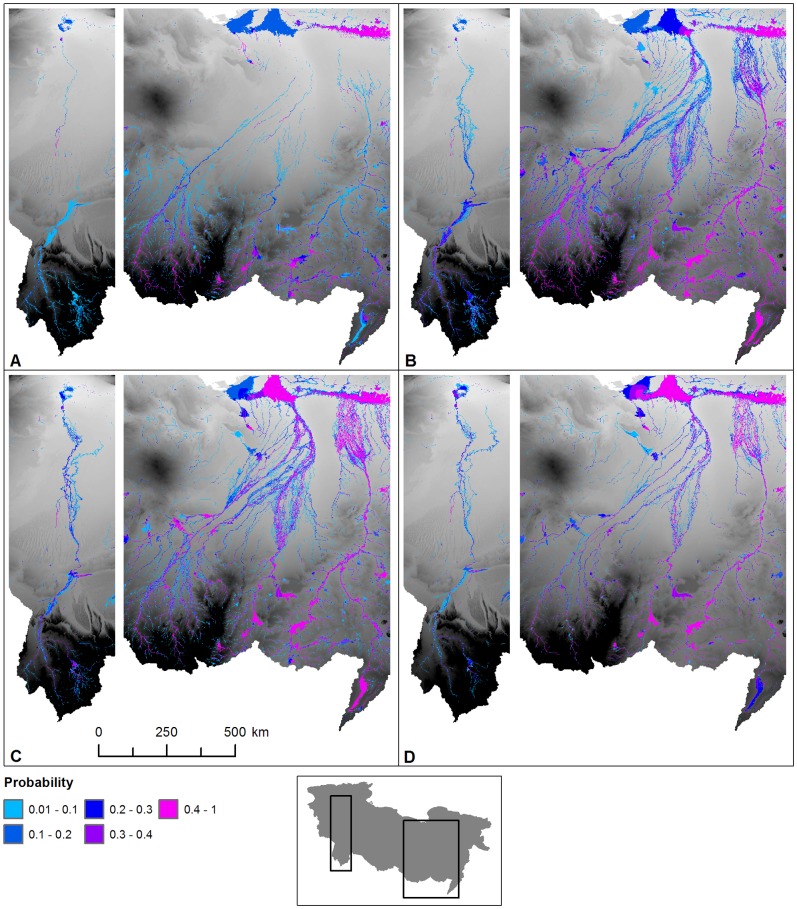
Human migration north through Africa is contentious. This paper uses a novel palaeohydrological and hydraulic modelling approach to test the hypothesis that under wetter climates c.100,000 years ago major river systems ran north across the Sahara to the Mediterranean, creating viable migration routes. We confirm that three of these now buried palaeo river systems could have been active at the key time of human migration across the Sahara. Unexpectedly, it is the most western of these three rivers, the Irharhar river, that represents the most likely route for human migration. The Irharhar river flows directly south to north, uniquely linking the mountain areas experiencing monsoon climates at these times to temperate Mediterranean environments where food and resources would have been abundant. The findings have major implications for our understanding of how humans migrated north through Africa, for the first time providing a quantitative perspective on the probabilities that these routes were viable for human habitation at these times.
人类向北穿越非洲的迁移一直存在争议。本文采用了一种新颖的古水文和水力建模方法,来验证假设,即在约 10 万年前更湿润的气候条件下,主要的河流系统会向北穿过撒哈拉沙漠,流入地中海,从而形成可行的迁移路线。我们确认,在人类穿越撒哈拉沙漠的关键时期,现在已经被掩埋的三条古河流系统中的三条可能是活跃的。出人意料的是,这三条古河流中最西部的伊拉哈勒河是人类迁移最有可能的路线。伊拉哈勒河自南向北直接流淌,将此时经历季风气候的山区与食物和资源丰富的温和地中海环境独特地连接起来。这些发现对我们理解人类如何向北穿越非洲具有重大意义,首次从定量的角度来看待这些路线在这些时期是否适合人类居住的可能性。