Departments of Ophthalmology (MAP, OYB, BBB, NJN, VB), Neurology (BBB, NJN, VB), and Neurological Surgery (NJN), Emory University, Atlanta, Georgia.
J Neuroophthalmol. 2013 Dec;33(4):330-7. doi: 10.1097/WNO.0b013e318299c292.
Idiopathic intracranial hypertension (IIH) is increasingly recognized as a cause of spontaneous cerebrospinal fluid (CSF) leak in the otolarnygological and neurosurgical literature. The diagnosis of IIH in patients with spontaneous CSF leaks typically is made a few weeks after surgical repair of the leak when symptoms and signs of elevated intracranial pressure (ICP) appear.
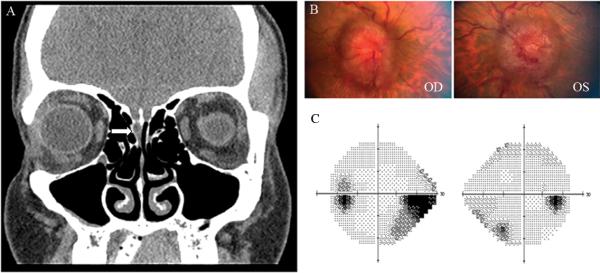
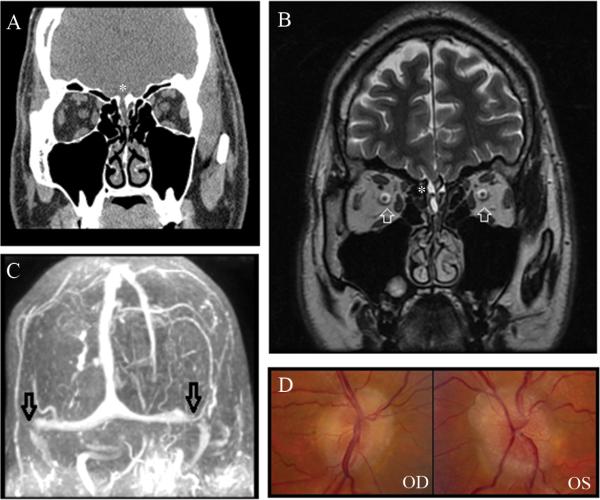
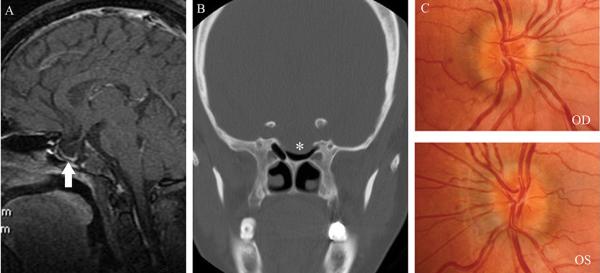
Case reports and literature review. Two young obese women developed spontaneous CSF rhinorrhea related to an empty sella in one and a cribriform plate encephalocele in the other. Both patients underwent surgical repair of the CSF leak. A few weeks later, they developed chronic headaches and bilateral papilledema. Lumbar punctures showed elevated CSF opening pressures with normal CSF contents, with temporary improvement of headaches. A man with a 3-year history of untreated IIH developed spontaneous CSF rhinorrhea. He experienced improvement of his headaches and papilledema after a CSF shunting procedure, and the rhinorrhea resolved after endoscopic repair of the leak.
These cases and the literature review confirm a definite association between IIH and spontaneous CSF leak based on: 1) similar demographics; 2) increased ICP in some patients with spontaneous CSF leak after leak repair; 3) higher rate of leak recurrence in patients with raised ICP; 4) patients with intracranial hypertension secondary to tumors may develop CSF leak, confirming that raised ICP from other causes than IIH can cause CSF leak.
CSF leak occasionally may keep IIH patients symptom-free; however, classic symptoms and signs of intracranial hypertension may develop after a CSF leak is repaired, exposing these patients to a high risk of recurrence of the leak unless an ICP-lowering intervention is performed.
特发性颅内高压(IIH)越来越被认为是耳科学和神经外科学文献中自发性脑脊液(CSF)漏的原因。在接受自发性 CSF 漏修复手术后几周,当出现颅内压(ICP)升高的症状和体征时,通常会在患有 IIH 的患者中诊断出 IIH。
病例报告和文献回顾。两名年轻肥胖女性因空蝶鞍(one)和筛板脑膨出(the other)分别出现自发性 CSF 鼻漏。两名患者均接受了 CSF 漏的手术修复。几周后,她们出现了慢性头痛和双侧视乳头水肿。腰椎穿刺显示 CSF 开放压力升高,CSF 内容物正常,头痛暂时缓解。一名患有未经治疗的 IIIH 病史 3 年的男性出现自发性 CSF 鼻漏。他在进行 CSF 分流手术后头痛和视乳头水肿有所改善,漏口在漏口内镜修复后得到解决。
这些病例和文献回顾证实了 IIH 与自发性 CSF 漏之间存在明确的关联,其依据为:1)相似的人口统计学特征;2)一些患者在漏口修复后出现 ICP 升高;3)ICP 升高的患者漏口复发率较高;4)颅内压升高继发于肿瘤的患者可能会发生 CSF 漏,这证实了除 IIH 以外的其他原因引起的颅内压升高可导致 CSF 漏。
偶尔 CSF 漏可能使 IIH 患者无症状;然而,在 CSF 漏修复后,可能会出现颅内高压的典型症状和体征,使这些患者面临高复发风险,除非进行 ICP 降低干预。