Division of Health Information, Ministry of Health, 39 Yirmiyahu Street, Jerusalem, Israel.
Isr J Health Policy Res. 2013 Sep 17;2(1):37. doi: 10.1186/2045-4015-2-37.
Female physicians have become an increasing proportion of the medical workforce in Israel. This study investigates this trend and discusses its likely impact on the quantity and quality of medical care available.
Data on licensed physicians and new licenses issued to physicians were taken from a Ministry of Health database, and analyzed by gender, age, academic origin (Israeli graduates, immigrants, Israeli-born who studied abroad), and specialty for the years 1999-2011.Data on employed physicians, their population group, and work hours were taken from the Central Bureau of Statistics (CBS) annual Labour Force Survey for the years 2009-2011.
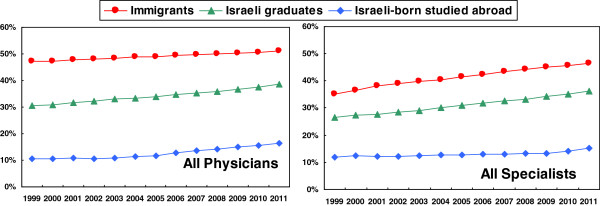
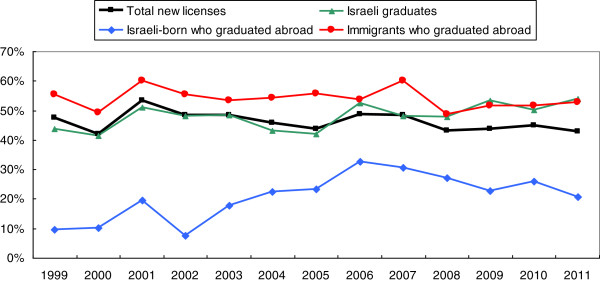
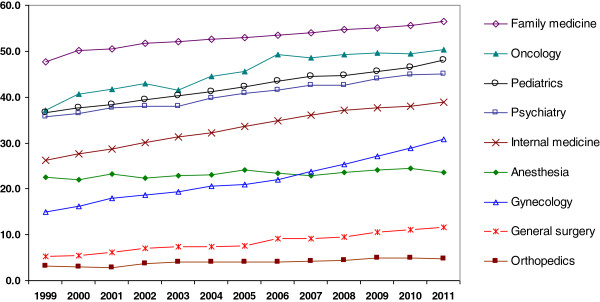
The proportion of women amongst physicians aged under 65 rose from 38% in 1999 to 42% in 2011, and was even higher for younger physicians. The highest proportion of females is found amongst new immigrant physicians who studied abroad. The corresponding proportion has been rising steadily amongst Israeli-educated physicians, and is lowest amongst Israeli-born physicians who studied abroad.Similarly, among newly licensed physicians, the proportion of females has traditionally been highest among immigrants who studied abroad and lowest among Israeli-born graduates who studied abroad. Among newly-licensed physicians who studied in Israel, the proportion of females has historically been intermediate between the other two groups, but it has recently risen to 54% and now parallels the proportion of females among immigrants who studied abroad. In recent years, the mix of academic origins among newly licensed physicians has changed dramatically, with important implications for the proportion of women among newly licensed physicians.The highest percentage of females was found in family medicine followed by oncology, pediatrics and psychiatry. The greatest increase over the years in this percentage was for gynecology and internal medicine.Female physicians worked shorter hours than males, particularly at younger ages. The proportion of females among employed Arab physicians is much lower than among Jewish physicians.
The proportion of female physicians has been steadily rising, although in recent years the increase has leveled off. This has been due, in part, to the decline in the flow of immigrant physicians and the increase in the number of Israelis studying abroad. Future developments in medical education options and immigration will determine whether their proportion will continue rising. Planning for future medical personnel must take these results into consideration.
在以色列,女性医生在医疗工作者中的比例不断增加。本研究调查了这一趋势,并讨论了其对医疗服务数量和质量可能产生的影响。
从卫生部的数据库中获取了 1999 年至 2011 年期间持照医生和新颁发的医生执照的数据,并按性别、年龄、学术背景(以色列毕业生、移民、在国外学习的以色列出生者)和专业进行分析。2009 年至 2011 年期间,从中央统计局(CBS)年度劳动力调查中获取了就业医生及其所属人群和工作时间的数据。
65 岁以下的医生中,女性的比例从 1999 年的 38%上升到 2011 年的 42%,年轻医生中的比例更高。在新移民医生中,女性的比例最高,他们在国外学习。在以色列接受教育的医生中,这一比例一直在稳步上升,而在国外学习的以色列出生的医生中,这一比例最低。同样,在新获得执照的医生中,女性的比例历来在国外学习的移民中最高,在国外学习的以色列出生的毕业生中最低。在新获得执照的在以色列学习的医生中,女性的比例在历史上处于其他两组之间,但最近上升到 54%,现在与在国外学习的移民中的女性比例相当。近年来,新获得执照的医生的学术背景组合发生了巨大变化,这对新获得执照的医生中女性的比例产生了重要影响。在家庭医学、肿瘤学、儿科学和精神病学中,女性的比例最高。多年来,这一比例的增长最大的是妇科和内科。女医生的工作时间比男医生短,尤其是在年轻的时候。在就业的阿拉伯医生中,女性的比例远低于犹太医生。
女性医生的比例一直在稳步上升,尽管近年来增长有所放缓。这部分是由于移民医生人数的减少和在国外学习的以色列人数的增加。未来医学教育选择和移民的发展将决定他们的比例是否会继续上升。未来的医疗人员规划必须考虑到这些结果。