Bundeswehr Institute of Radiobiology, Neuherbergstr. 11, 80937 Munich, Germany.
Br J Cancer. 2013 Oct 15;109(8):2286-94. doi: 10.1038/bjc.2013.574. Epub 2013 Sep 17.
A strong, consistent association between childhood irradiation and subsequent thyroid cancer provides an excellent model for studying radiation carcinogenesis.
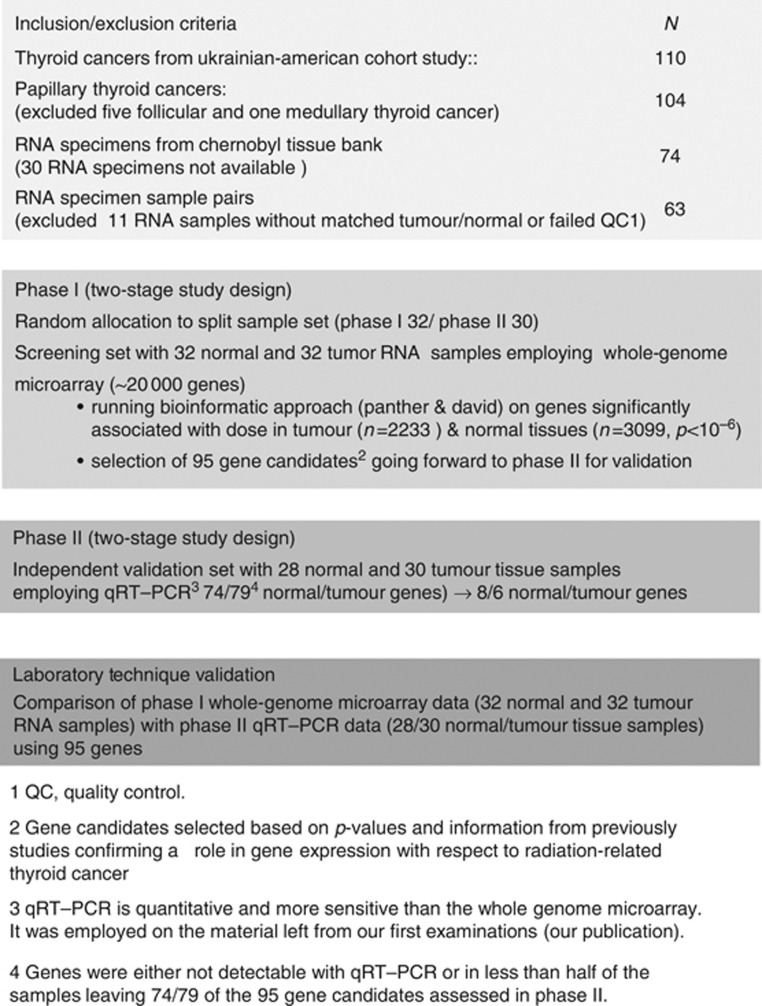
We evaluated gene expression in 63 paired RNA specimens from frozen normal and tumour thyroid tissues with individual iodine-131 (I-131) doses (0.008-8.6 Gy, no unirradiated controls) received from Chernobyl fallout during childhood (Ukrainian-American cohort). Approximately half of these randomly selected samples (32 tumour/normal tissue RNA specimens) were hybridised on 64 whole-genome microarrays (Agilent, 4 × 44 K). Associations between I-131 dose and gene expression were assessed separately in normal and tumour tissues using Kruskal-Wallis and linear trend tests. Of 155 genes significantly associated with I-131 after Bonferroni correction and with ≥2-fold increase per dose category, we selected 95 genes. On the remaining 31 RNA samples these genes were used for validation purposes using qRT-PCR.
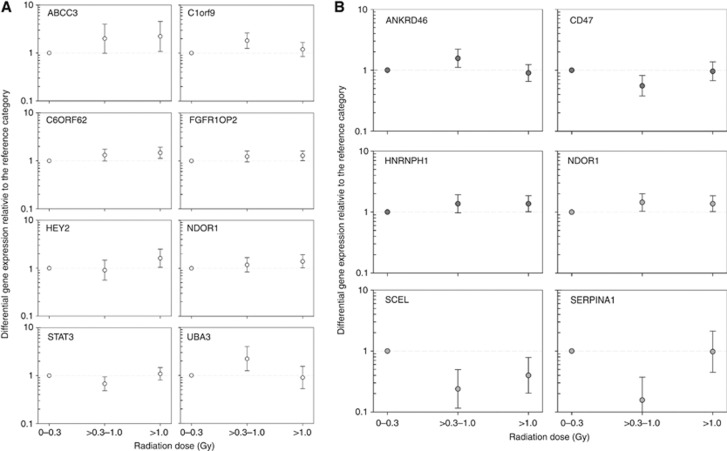
Expression of eight genes (ABCC3, C1orf9, C6orf62, FGFR1OP2, HEY2, NDOR1, STAT3, and UCP3) in normal tissue and six genes (ANKRD46, CD47, HNRNPH1, NDOR1, SCEL, and SERPINA1) in tumour tissue was significantly associated with I-131. PANTHER/DAVID pathway analyses demonstrated significant over-representation of genes coding for nucleic acid binding in normal and tumour tissues, and for p53, EGF, and FGF signalling pathways in tumour tissue.
The multistep process of radiation carcinogenesis begins in histologically normal thyroid tissue and may involve dose-dependent gene expression changes.
儿童时期接受强烈且一致的辐射与随后发生甲状腺癌之间存在密切关联,这为研究辐射致癌提供了一个极好的模型。
我们评估了 63 对来自切尔诺贝利放射性沉降物的冰冻正常和肿瘤甲状腺组织的 RNA 标本的基因表达,这些个体曾在儿童时期接受过碘-131(I-131)照射(剂量为 0.008-8.6Gy,无未受照射对照)(乌克兰-美国队列)。从这些随机选择的样本(32 个肿瘤/正常组织 RNA 样本)中,大约一半样本(155 个基因)被杂交到 64 个全基因组微阵列(Agilent,4 × 44K)上。使用 Kruskal-Wallis 和线性趋势检验分别评估 I-131 剂量与正常和肿瘤组织中基因表达之间的关系。在经过 Bonferroni 校正后,有 155 个基因与 I-131 显著相关,且每个剂量类别均增加 2 倍以上,我们从中选择了 95 个基因。在其余 31 个 RNA 样本中,使用 qRT-PCR 对这些基因进行了验证。
正常组织中 8 个基因(ABCC3、C1orf9、C6orf62、FGFR1OP2、HEY2、NDOR1、STAT3 和 UCP3)和肿瘤组织中 6 个基因(ANKRD46、CD47、HNRNPH1、NDOR1、SCEL 和 SERPINA1)的表达与 I-131 显著相关。PANTHER/DAVID 途径分析表明,正常和肿瘤组织中编码核酸结合的基因以及肿瘤组织中编码 p53、EGF 和 FGF 信号通路的基因显著过表达。
辐射致癌的多步骤过程始于组织学正常的甲状腺组织,可能涉及剂量依赖性的基因表达变化。